
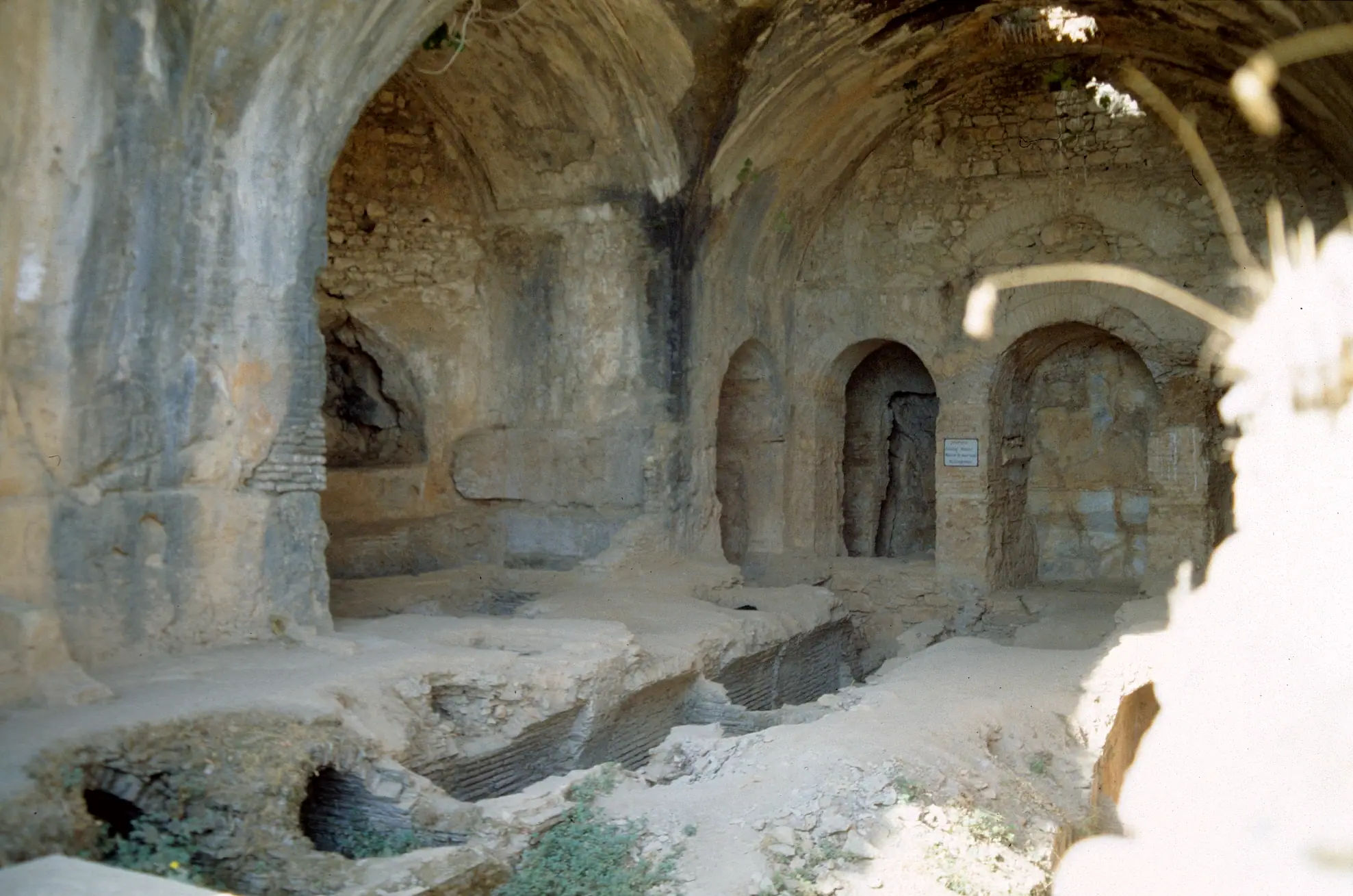
On the slope of Panayırdağ, above the ancient city, is a cemetery of rock-cut tomb chambers built up around a cave shrine1. It is known across the Christian and Islamic worlds by the same story, told rather differently in each, and Ephesus is not the only place that claims it: Muslim tradition mostly places the Qur’anic cave at Tarsus or Afşin, and there are further rival sites near Amman, in Damascus and in Nakhchivan2. What makes the Ephesus site distinctive is not the legend but the archaeology under it, which turns out to argue with the story in specific, checkable ways.
The legend
As the story is usually told, the seven were noble young men of Ephesus, in the emperor Decius’s own service, who refused to worship idols. They were baptised, took Christian names, gave away their goods when Decius demanded they recant, and withdrew to a cave on Mount Keleus — Panayırdağ, under an older name. One of them, Malchus, went back into the city for food and news. In the common version, they hid from Decius’s persecution and woke, two centuries later, in the reign of Theodosius II, before dying soon afterward and being buried in the same cave3. According to Foss, Theodosius II himself is said to have visited the scene shortly afterward, on a pilgrimage to Ephesus, and to have prayed to St John there about who would succeed him4.
The story was already being treated as history within a few centuries of its supposed setting. John of Ephesus accepted it as fact in the 6th century, and the pilgrim Theodosius, writing under Justinian around 530, named the Tomb of the Seven Sleepers specifically among the sites he visited5. The tale reached a wide audience well beyond Christendom: the Qur’an tells its own version in Surah 18, al-Kahf, where the number of sleepers is left open — God alone is said to know it — though later tradition usually settles on seven67.
The excavated site
What archaeologists found here, from 1926 onward, is a large, multi-stage burial complex rather than a single unified building. Its oldest identifiable part is a rock-cut catacomb with ten burial chambers, five to a side of a central corridor, thought by Elliger to be the actual burial place the legend has in mind, with a church built over it soon after8. West of the church, Elliger records, a barrel-vaulted burial hall about 7 by 16 m held 86 grave niches on its own, and later additions — a terrace chapel, a domed mausoleum — brought the complex’s total capacity to something like 700 burial places, a considerable figure given that graves here were routinely reused9. Counting both its lower and upper levels together, Ladstätter and Magdalino’s fuller architectural survey puts the complex at 32 m and 45 m long respectively, with at least 250 original graves between them10.
The last major addition came from a named individual: a banker called Abradas built a domed, cross-shaped mausoleum here in Justinian’s time, roughly two centuries after an earlier bath renovation by one Scholastica. At that point, on the evidence recovered so far, there was still no physical trace of pilgrimage to, or veneration of, the Seven Sleepers themselves11.

The archaeology complicates the legend
The most important finding here is not about the legend but about the building that supposedly proves it. Every popular telling dates the burial complex to “the reign of Theodosius II” (408–450), because that is the reign in which the legend says the youths woke. Foss was the first to question this: from the style of the mosaics and frescoes, he argued the church is actually at least half a century older, built under Theodosius I (379–395) — meaning the physical church was already standing before the miracle it is supposed to commemorate12.
The proof that settles the question, rather than merely proposing it, is a coin. Beneath the original mosaic floor of the upper church, W. Jobst found a coin of Valentinian I (AD 364–375) alongside a coin of Constantine, demonstrating that the whole complex’s interior decoration — crypt and church together — was carried out at the earliest in the 370s AD13. The redating is independently confirmed on stylistic grounds too: matching fresco motifs link the lower apse hall and the upper church, showing the two levels were decorated together rather than centuries apart, which corrects the original excavator Miltner, who had dated the oldest parts to the 5th century solely because the legend is set under Theodosius II, with no independent evidence of his own14.
A further, unexpected source backs the coin evidence up. Jobst’s redating places both crypt and church under Theodosius I, not Theodosius II — and this is independently confirmed by a text Miltner’s own 1937 excavation report had missed entirely. Eutychius of Alexandria’s 10th-century Annals record that in the eighth year of Theodosius I’s reign, 386 AD, the Seven Sleepers emerged from their cave at Ephesus, having fled there from King Decius; they were then ordered buried within that same cave, and a church bearing their name was built over it, with an annual festival established in their honour15. Ladstätter and Magdalino’s newer architectural analysis adds the physical proof behind the now-standard reading: the church’s east wall still shows both the corners of an original rectangular niche and a later, inserted semicircular apse, confirming that the shrine dedicated specifically to the Seven Sleepers was built into an already-standing 4th-century structure, not raised at the same time as it16. Building and cult, in other words, belong to two different centuries: the building to the late 4th century, the dedication to the youths to the 5th.
The site’s lamps make the same point a second way, and correct a figure that has circulated in guides for years. Where a commonly repeated count puts “over 2,000” terracotta lamps at the site, Foss, citing the excavation publication directly, gives a lower, more precise number: 1,381 datable lamps, of which 651 predate the mid-4th century — earlier, that is, than the legend’s own claimed founding date under Theodosius II. Foss rejects Miltner’s suggestion that these early lamps were simply preserved heirlooms or old stock, calling it unconvincing given the sheer quantity involved17.
Not exclusively Christian
Pagan tombstones and Jewish lamps and symbols are mixed in among the burials here, showing that the cemetery was not, at least at first, used exclusively by Christians — a fact both Foss and Strelan accept, though they read it differently. Foss calls the mixture “curiously enough,” a neutral aside rather than an argument. Strelan reads the same evidence as a sign that Jewish tradition persisted stubbornly at Ephesus, possibly carried by Christians of Jewish background18. Strelan goes further, and more speculatively, suggesting the Ephesian synagogue Paul is recorded as attending may have stood outside the city walls near water, in the way diaspora synagogues often did, and links this by analogy to the Jewish symbols in the cave and to the traditional extramural burials of John and Timothy — a chain of reasoning he presents, honestly, as his own speculation rather than as an established location19.
How early writers treated the story
The earliest written trace of the legend is itself disputed. Its oldest surviving form, a Syriac verse homily by Jacob of Serugh, may draw on a lost Greek source, the Hypomnemata. Honigmann attributes that source to Stephen, bishop of Ephesus from 448 to 451; Foss, reporting the same attribution, calls it “not altogether convincing” — a rare case of a single writer naming a theory and then declining to fully accept it20. One possible reason the name and date might have been altered in later versions: Stephen’s own memory was condemned at Chalcedon, in the disrepute that followed the 449 “Robber Council,” which would have made him an awkward figure to credit publicly.
Foss offers his own historical kernel behind the story, again explicitly as a theory rather than a finding: perhaps seven young men really did appear at Ephesus around the mid-5th century claiming, or letting others believe, that they had survived from the Decian persecutions two centuries earlier — testimony that would have conveniently supported the local church’s position in the contemporary Origenist controversy over bodily resurrection21.
A living pilgrimage site, centuries on
Whatever its origins, the cult here had a long working life. Visitor graffiti recorded at the site — Frankish monograms and coats of arms from northern Italy and the lower Rhine — show it was still being visited by Levant-trading merchants from the Netherlands, France, Spain and Italy well into the Seljuk and Ottoman periods; three independent surveys of the site converge on roughly 50 such inscriptions, in Greek, Armenian and Latin, dating from the 13th to the 15th centuries22. Ladstätter and Magdalino find that at least six of the catacomb’s rooms had their entrances closed off with small apses, crosses painted on the ceilings, and little windows so that pilgrims could look in at the sleepers’ bodies, said to be exhibited within23.
The site drew visitors named in the record as individuals, not only as graffiti. The Russian abbot Daniel, touring Ephesus in 1106, took in the cave of the Seven Sleepers — where he also recorded relics of “300 holy fathers” and a Saint Alexander — alongside the tomb of St John, the tomb and head of Mary Magdalene, the body of St Timothy, and the spot where John was said to have been cast up by the sea, in one continuous pilgrim itinerary that also touches Sacred Ephesus’s wider cast of shrines24. Later still, in 899 AD, the emperor Leo VI had Mary Magdalene’s own relics transferred to Constantinople, taken, according to the Menologion, from her grave at the entrance to the Cemetery of the Seven Sleepers itself — tying this site directly to the story told on House of the Virgin Mary and Church of Ephesus25.
The Duke asked me whether we could not give this 'army' the slip, and I said 'Certainly,' and spurred my horse, all following, towards the pretended 'Cave of the Seven Sleepers'; but the wonderful vigilance and extraordinary running powers of the Turkish infantry were here shown.By the early 17th century, Ladstätter and Magdalino note, the complex already appears to have been destroyed, its remains buried under collapsed walls and ceilings for centuries; only in recent decades has pilgrim and visitor activity returned, drawing Christians, Muslims and tourists of several faiths alike26. What draws them is still, on the ground, the legend as it is usually told. What the excavators found underneath it is a building whose own chronology runs a surprising and specific half-century or more ahead of the story built on top of it.
Sources
Each source is listed once. The numbers link back to the claims it supports; dates show when the source was checked.
- OpenStreetMap nodes: Lower Gate 37.9454,27.3421; Upper Gate 37.9355,27.3462; Selçuk station 37.9509,27.3729 1
- en.wikipedia.org › Cave_of_the_Seven_Sleepers 1
- www.kulturportali.gov.tr › yedi-uyuyanlar-magarasi 2, 7
- en.wikipedia.org › Seven_Sleepers 2, 6, 7
- Elliger 1985, 164 3, 8
- Foss 1979, 42 3, 4, 5
- api.alquran.cloud › en.sahih 6
- doi.org › cbo9780511599491.003 6
- doi.org › ejoss_v03i1004 6
- turkisharchaeonews.net › grotto-seven-sleepers-ephesus 6
- digitalwindow.vassar.edu › 3 6
- api.alquran.cloud › en.sahih 7
- Elliger 1985, 165 8, 9
- Elliger 1985, 166 9, 22
- Ladstätter and Magdalino 2019, 259 10
- Ladstätter and Magdalino 2019, 260 10
- Foss 1979, 24 11
- Ladstätter and Magdalino 2019, 266 11
- Foss 1979, 85 12, 17, 18
- Jobst 1977, 52 13, 15
- Strocka 1977, 59 13
- Jobst 1977, 41 14
- Strocka 1977, 63 14
- Ladstätter and Magdalino 2019, 261 16
- Strelan 1996, 206 18, 19
- Foss 1979, 43 20, 21, 22
- Ladstätter and Magdalino 2019, 268 22, 23
- Foss 1979, 127 24
- Ladstätter and Magdalino 2019, 267 25
- Ladstätter and Magdalino 2019, 269 26