The eastern gate in Ephesus’s city wall takes its name from the road that left through it toward Magnesia on the Maeander1. How old the gate actually is remains an open question. Rogers dates it, together with the city walls it sits in, to the third century BC2. This site instead follows excavation reporting from 2008–09, which places construction around 100 BC — specifically to correct the idea that the gate is contemporary with Lysimachus’s early Hellenistic walls2. Both figures are in print; the modern excavation papers that might settle the question between them have not yet been checked against their proofed page numbers, so this page records the dispute rather than picking a side.
The gate itself
Two independent descriptions agree on the gate’s basic form. Rogers, and Wood’s own 1869 excavation report — quoted directly in the 2018 Forschungen in Ephesos XII/6 volume — both describe three passages set behind flanking towers: one for pedestrians only, and two for wheeled traffic1. Rogers adds that the passages were flanked by two marble lions, a detail Wood’s account does not mention3, and argues that Salutaris’s procession most likely used the pedestrian passage rather than either of the two wheeled ones4.
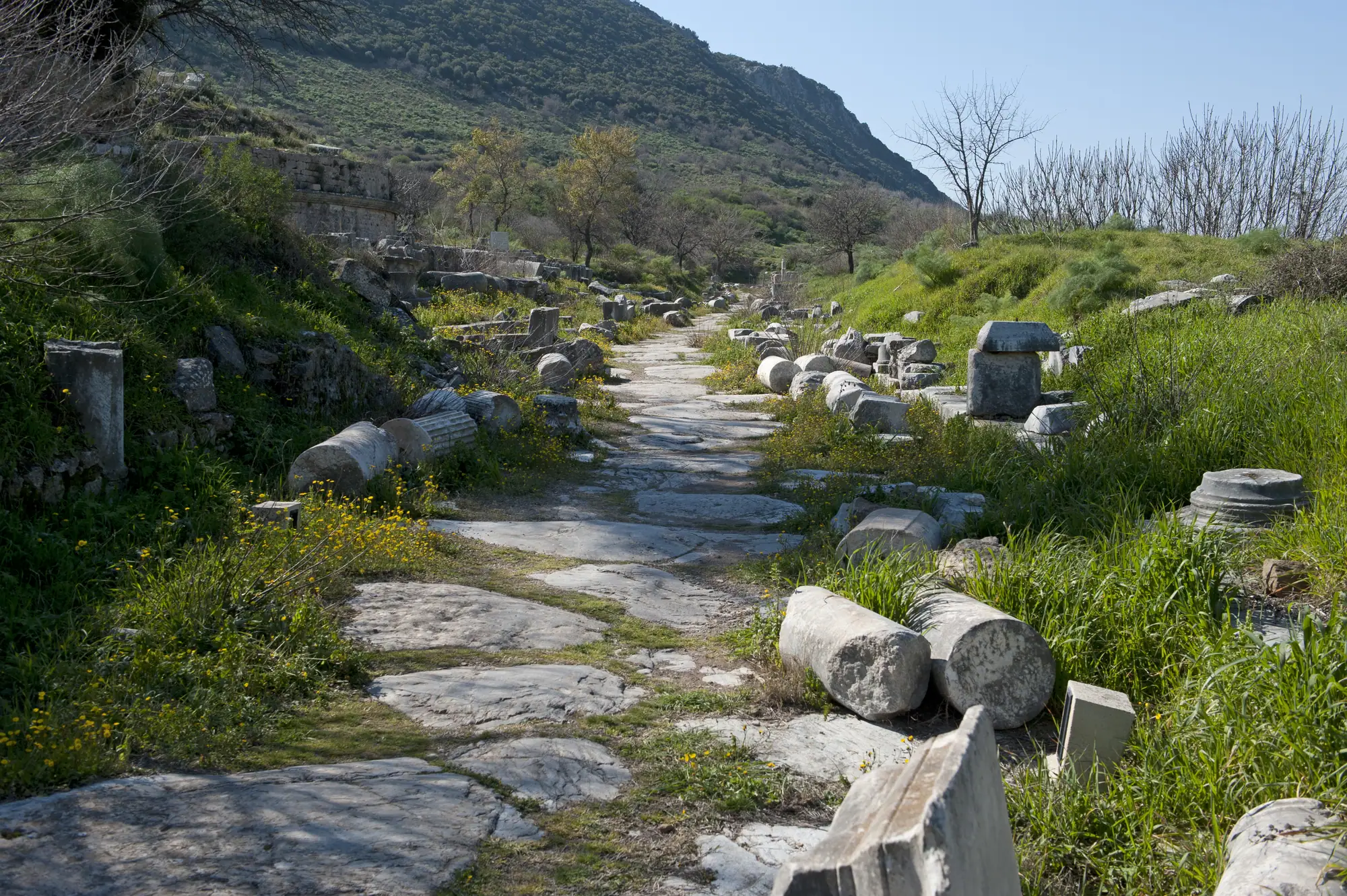
Wood’s own report gives the gate’s approach roads in unusually physical detail. Of the busier of the two roads meeting at the gate, the one running toward Ayasoluk, he measured a width of about 24 feet, cart ruts 4 feet apart from centre to centre and, in places, as much as 5 inches deep, the roadway itself laid with large paving stones5.
Of the two roads that meet at the Magnesian Gate, the one bearing towards Ayasolouk is evidently the most important, its average width is 24 feet (7.31 m), and the carriage ruts, which are 4 feet apart from centre to centre, are much more marked than in the road to Magnesia, in many places they are as much as 5 inches deep, the roadway being laid with very large stones about 9 inches thick.
William Hamilton, climbing the hillside the wall runs along a few decades earlier, left his own account of the terrain: a steep, well-worn water channel up the slope of Coressus, with occasional traces of an ancient road cut into the rock3.
In this direction we ascended Coressus by a steep and well-worn water-channel, down which trickled the only stream flowing from these hills into the plain, and where a few traces of an ancient road cut in the solid rock, and winding up the face of the hill, were occasionally perceptible.
Why Salutaris chose this gate
The gate’s clearest moment in the historical record is not architectural but ceremonial. Gaius Vibius Salutaris endowed a procession of statues that, on set days in AD 104, entered the city through the Magnesian Gate rather than the easier Koressian Gate on the opposite side, Rogers records6. Rogers argues that the choice was deliberate: routing the procession past the Roman-built Upper Agora on its way in was a piece of civic storytelling, asserting that Ephesus’s Roman refoundation came before its Ionian one, not after6. It is the strongest single piece of storytelling the gate offers, and it explains a detail the site’s own account of the Salutaris procession states but does not otherwise account for.
The East Gymnasium next door
A large bath-gymnasium stands beside the gate, and its founding is itself disputed. Rogers dates its construction to the mid-140s AD, credited to a group of benefactors built explicitly to rival Vedius Antoninus’s gymnasium at Koressos7 — decades before the sophist Flavius Damianus, active under Marcus Aurelius and Commodus in the 170s–190s, is otherwise attested at the building. The two figures are not necessarily a contradiction: they most likely describe two phases of the same building’s story, an original group of founders in the 140s and, much later, Damianus’s own portrait statues added to it.
What turned up nearby
The gate’s surroundings have produced their own finds. A fragment of the Latin text of Paullus Fabius Persicus’s edict, issued around AD 44, was found reused in a tomb near the Magnesian Gate; a second fragment of the same inscribed stone turned up decades later, in 1902, in the theatre’s north paving, per Wankel’s edition of the inscription8. The oldest known finds from the Ephesus area itself — Neolithic mudbrick wall remains together with obsidian and ceramic finds — were made in spring 1995 east of the gate, on the road toward Aydın, Bammer and Muss report9.
Closer to the gate, the tomb-house of Claudia Antonia Tatiane lies just outside the city wall to the southeast; it was backfilled again after excavation, so nothing of it is visible today, per Kintrup’s excavation report10. A fragment of a Dionysiac sarcophagus showing a maenad, now Ephesus Museum inventory 45/57/79, was recovered during 1979 excavations at the gate, Kintrup records11.
The road to the Artemision
Following the road toward Ayasoluk from the gate, Wood identified the remains of a covered street — a stoa — built by the sophist Flavius Damianus, recorded by the writer Philostratus, running from the Magnesian Gate toward the Temple of Artemis over what had originally been an unpaved sacred way12. Its date is best left unstated here rather than guessed at from unproofed sources; what is secure is its existence and its route.
Pausanias, writing in his own lifetime, records that the tomb of Androklos, the city’s founding hero, was still visible on the road running from the Artemision, past the Olympieion, to the Magnesian Gate13. Working from that description together with the building technique of what he found, Wood identified an isolated Greek-period monument he excavated in February 1869 — 43 feet square, several courses of finely dressed, mortarless masonry, a doorway on its east side — as the tomb Pausanias described; its exact findspot has since been lost again14.
Seeing it today
The gate sits in the walk between the ancient city and the medieval hill, covered together with the rest of the ancient city’s upper reaches. The Temple of Artemis it once led travellers toward, and the Great Theatre, where the twin of the Persicus inscription fragment turned up decades later, are both a short walk from where the gate itself now stands.
Sources
Each source is listed once. The numbers link back to the claims it supports; dates show when the source was checked.