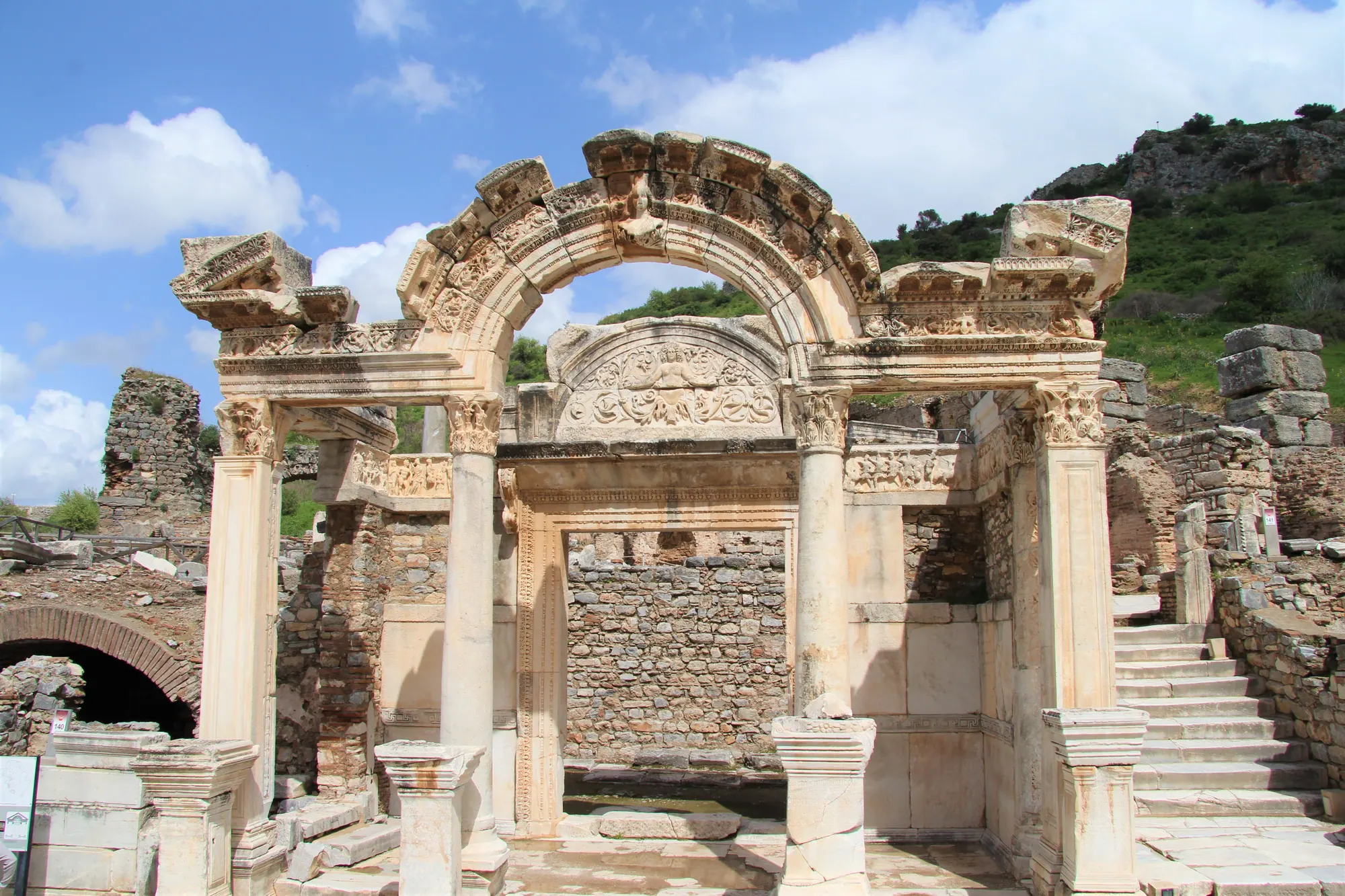
The so-called Temple of Hadrian is a small, richly carved building on Curetes Street. Its dedication names three recipients: Artemis of Ephesus, the emperor Hadrian and the people of the city1. The name has stuck, but whether this was ever a temple of Hadrian in the official sense is doubted2, and the frieze most photographs focus on was carved long after Hadrian’s time3.
Who built the Temple of Hadrian?
A local benefactor, Publius Quintilius Valens Varius, dedicated it together with his wife and daughter1.
The porch was one half of a larger gift. Varius planned and built it together with the bath-house behind it5. Later generations named those baths after Scholastikia, the Christian woman who paid to renovate them in the 4th or 5th century, so the “Scholastica Baths” of the guidebooks are Varius’s own foundation under a later name8. Her statue, now headless, is still seated inside9.
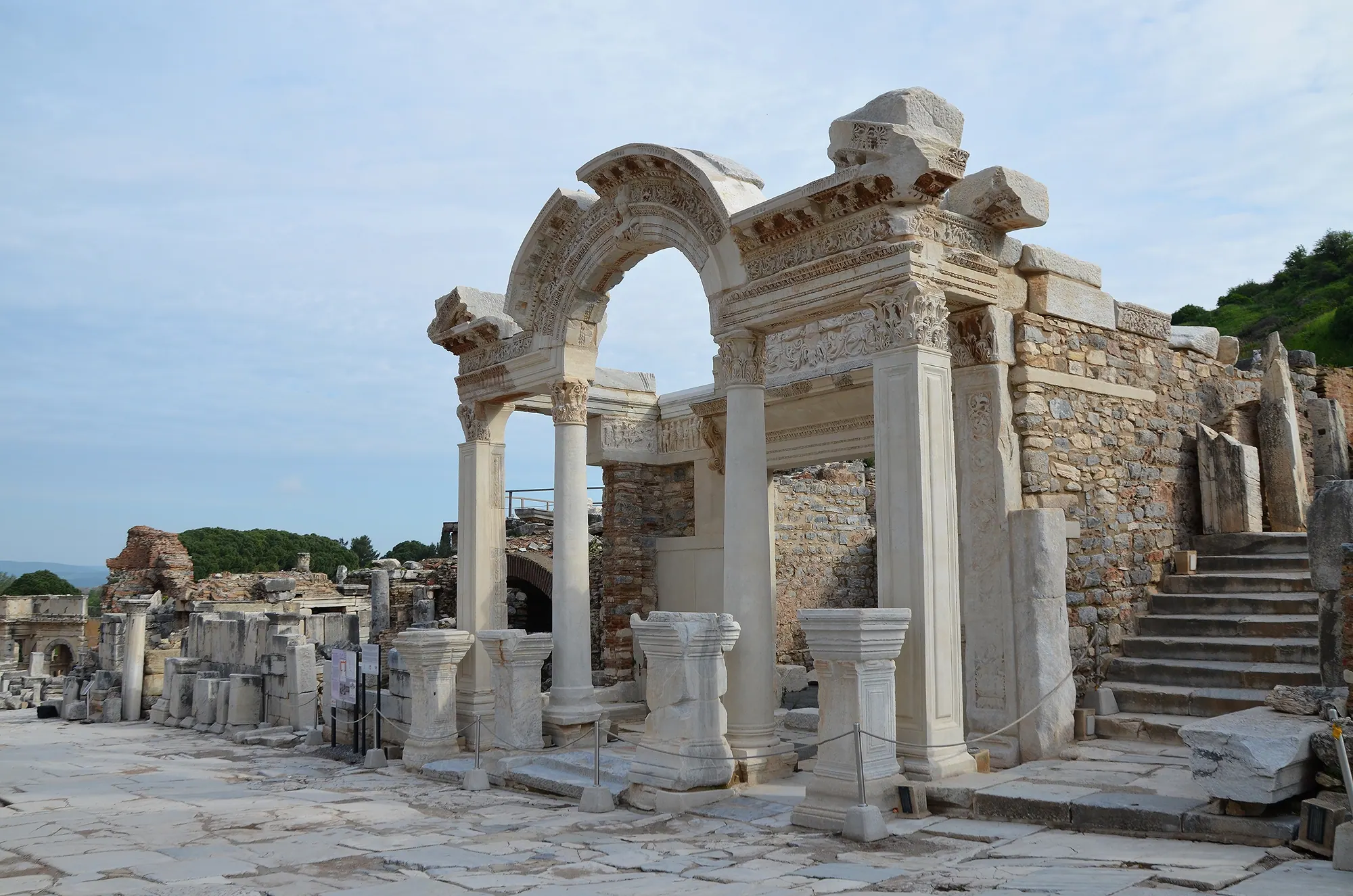
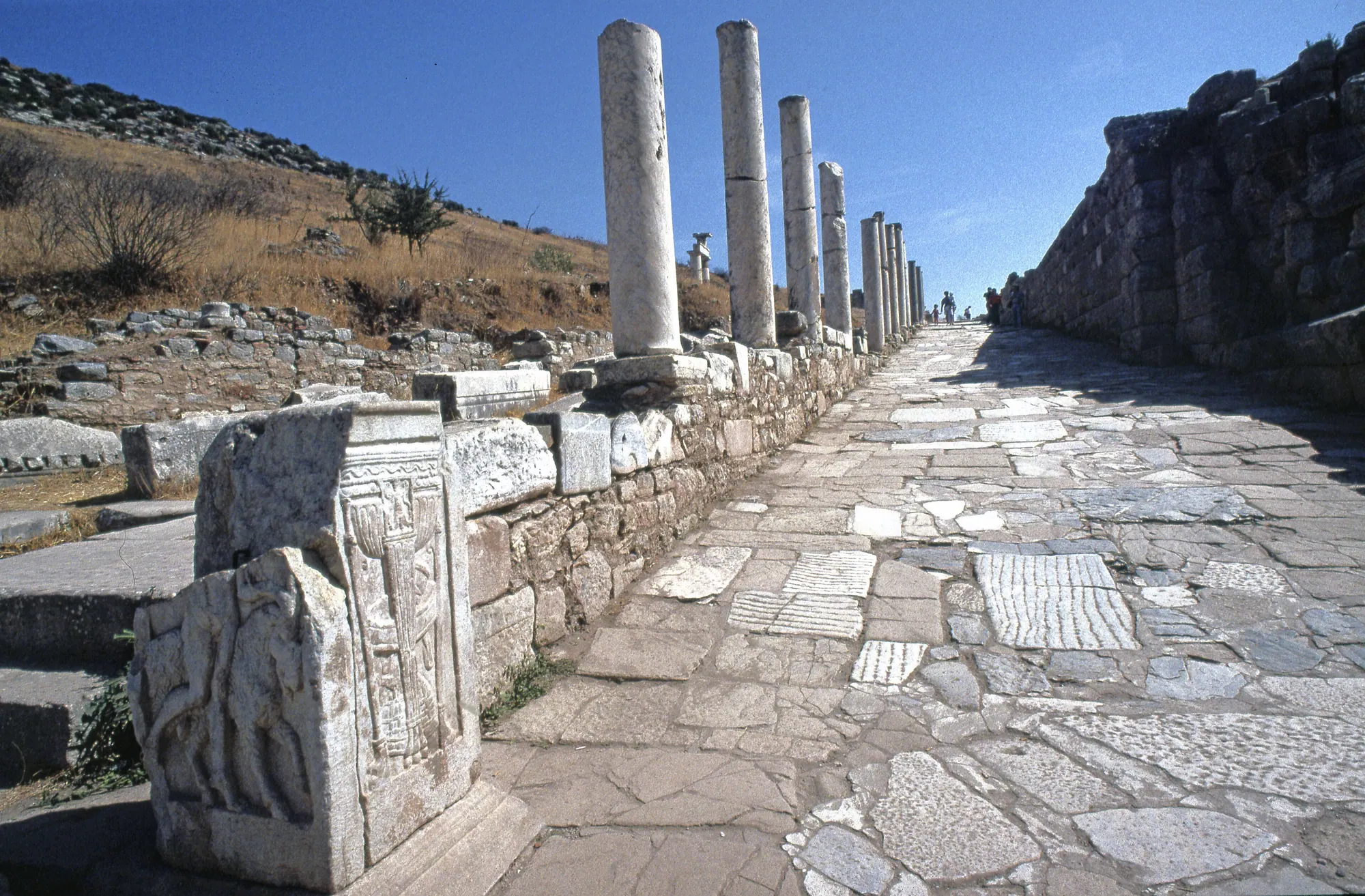
Varius chose a prominent address. Curetes Street runs down from the Hercules Gate to the Library of Celsus10, and because it ignores the orthogonal grid of the rest of the city it is read as very old, a processional route for Artemis11.

Dating the dedication
The inscription on the architrave probably dates the dedication to 117 or 1184. That early date is a revision, and not every source has adopted it: the ministry gives a span of 118–138, and older accounts put the building around 1384.
If the early date is right, the dedication came several years before the emperor first set foot in the city in AD 124. He probably came back in 128/129, and Ephesus honoured him as a founder12.
Was it really a temple of Hadrian?
Probably not in the sense the name suggests. Ursula Quatember, who led the modern building study, published an article in 2013 whose title asks exactly that question, and many scholars place Hadrian’s official temple elsewhere in the city2.
The doubt makes more sense beside the city’s record of imperial temples. Ephesus first held the official title of neokoros, keeper of an imperial-cult temple, from the dedication of the Temple of the Sebastoi in AD 89/9013. Hadrian’s reign doubled the honour, and “twice neokoros” is attested by AD 13214. Near the harbour, meanwhile, the city laid out a vast precinct for Zeus Olympios and the deified Hadrian, whose southern hall alone ran to about 263 m15. Beside that, a porch paid for by one family and offered jointly to the goddess, the emperor and the people is a modest thing. “Temple of Hadrian” is best taken as a convenient label rather than a statement of what the building was for2.

Reading the façade
The front is a porch of four supports standing ahead of the inner chamber, a form architects call tetrastyle prostyle. Over the middle the entablature rises into a so-called Syrian arch, and the keystone of that arch carries a bust of Tyche16, the goddess of the city’s fortune.
In front of the porch stand four inscribed bases. They carried statues of the First Tetrarchy, the four emperors who ruled jointly: Diocletian, Maximian, Constantius Chlorus and Galerius. Maximian’s statue was later replaced with one of the father of Theodosius I17.

The frieze: founders, Amazons and an unnamed emperor
The carved frieze inside the porch is not Hadrianic. It was carved in the 3rd or 4th century, and some of its slabs probably came from a different monument, reused here after a 4th-century earthquake3. The panels in place today are casts, with the originals kept in the museum at Selçuk18.
Its subjects are the city’s own stories: the foundation legend, gods, Amazons and a procession in honour of Dionysus3. The legend belongs to the early history of Ephesus as the Greeks told it: Androclus, son of King Codrus of Athens, was in their tradition the leader of the Ionian settlers and the founder of Ephesus19. Behind the boar on the frieze lies an oracle. Androclus had been promised a site marked by a fish and a boar; a fish jumped out of the fire where it was being cooked, the flames caught the undergrowth, and the boar that bolted from it was killed by Androclus where the city would stand20. The Amazons belong to an older strand of the city’s memory: ancient writers credited them with founding the cult of Artemis here21.
Of the frieze’s slabs, the fourth is the puzzle. Its figures are often identified as Theodosius I and his family, but that reading is debated, and scholars have also proposed Dionysus, Cybele or an emperor who cannot be named22.

Excavation and re-erection
Franz Miltner excavated the building, and it was partly re-erected in 1957–58 under the architect Karl Heinz Göschl6. In the same decade Miltner cleared Curetes Street to join the excavated monuments into a single route, the beginning of Ephesus as a landscape of ruins for visitors23.
The detailed modern study came much later. Ursula Quatember’s building research ran from January 2009 to April 2012 and was published in 2017 as volume XI/3 of Forschungen in Ephesos24. By then Ephesus had been on the World Heritage List for two years25, and this porch was one of the four buildings the listing names under criterion (iii), in company with the Library of Celsus, the Serapeion and Terrace House 27.
What stands around it on Curetes Street
Curetes Street is about 210 m long and falls some 20 m from the Hercules Gate to the library26. Directly above it, on the slope of Bülbüldağ27, the Terrace Houses keep a block of Roman homes under a modern roof28.
Further down the street is the Octagon, a marble tomb of the late 1st century BC29, where a 2025 study found the bones of a boy30 and ruled out the old attribution to Cleopatra’s sister31. Beside it, a Hellenistic building later made into a fountain carries the name Heroon of Androklos32, although its link with the founder is widely doubted33.
By the corner with Marble Street, visitors pass a 1st-century public latrine, its marble seats set over a channel of running water34. In 1957 Franz Miltner interpreted the house next door as a public brothel35. Werner Jobst went back over the evidence and ruled out a public brothel on the site36, and a survey in 2000–2001 revealed a large peristyle house37. These and the other monuments down to the harbour are taken one by one in the guide to the ancient city.
Sources
Each source is listed once. The numbers link back to the claims it supports; dates show when the source was checked.
- www.turkishmuseums.com › 1 1, 4, 16, 17
- turkisharchaeonews.net › temple-hadrian-ephesus 1, 2, 3, 4, 6, 17, 18, 22
- de.wikipedia.org › Hadrianstempel_(Ephesos) 1, 2, 3, 4, 5, 6, 8, 16, 17, 18, 23, 24
- en.wikipedia.org › Ephesus 3, 12, 14, 18, 22, 25
- www.quatember.at › project1.html 5, 24
- turkisharchaeonews.net › scholastica-baths-ephesus 5, 8, 9
- www.oeaw.ac.at › research-history 6, 23, 27, 28
- whc.unesco.org › 6387 7, 25
- www.worldheritagesite.org › ephesus 7
- de.wikipedia.org › Ephesos 8, 25
- austriaca.at › 0xc1aa5576_0x0007e384.pdf 9
- journals.uio.no › 5874 9
- turkisharchaeonews.net › curetes-street-ephesus 10, 11, 26
- de.wikipedia.org › Kuretenstraße 10, 11, 32, 33
- Brickell, citing Burrell 2004 and Friesen 1993 12, 14
- doi.org › hist.2020.848 13
- en.wikipedia.org › Temple_of_the_Sebastoi 13
- turkisharchaeonews.net › church-virgin-mary-ephesus 15
- de.wikipedia.org › Marienkirche_(Ephesos) 15
- de.wikipedia.org › Ephesos-Museum_Selçuk 18
- Strabo 14.1, Loeb tr. 19
- Macquarie Univ., The Coinage of Ephesus 19, 20
- www.worldhistory.org › ephesos 19
- Kraft, Brückner, Kayan, Engelmann 2007, Geoarchaeology 22:121-149, doi:10.1002/gea.20151 20
- Herodotus 1.26; Pausanias 4.31.8, 7.2.6-8, 8.13.1; Callimachus Hymn 3.237ff; Strabo 4.1.4, 14.1.26 21
- en.wikipedia.org › Temple_of_Artemis 21
- quod.lib.umich.edu › * 22
- www.oeaw.ac.at › forschungen-in-ephesos 24
- web.archive.org › multiple=1 25
- web.archive.org › 1018 25
- www.austriaca.at › 9783700183419 26
- www.petersommer.com › ephesus-terrace-house-2 27
- de.wikipedia.org › Hanghäuser_von_Ephesos 27, 28
- pmc.ncbi.nlm.nih.gov › PMC11723936 29, 30, 31
- www.oeaw.ac.at › cleopatras-sister-remains-missing-1 29, 30, 31
- turkisharchaeonews.net › octagon-ephesus 29
- turkisharchaeonews.net › hellenistic-heroon-ephesus 32, 33
- www.austriaca.at › 0xc1aa5576 0x00043046.pdf 34, 35, 36, 37
- turkisharchaeonews.net › public-latrines-ephesus 34
- www.theephesus.com › brothel-of-ephesus 35, 36, 37