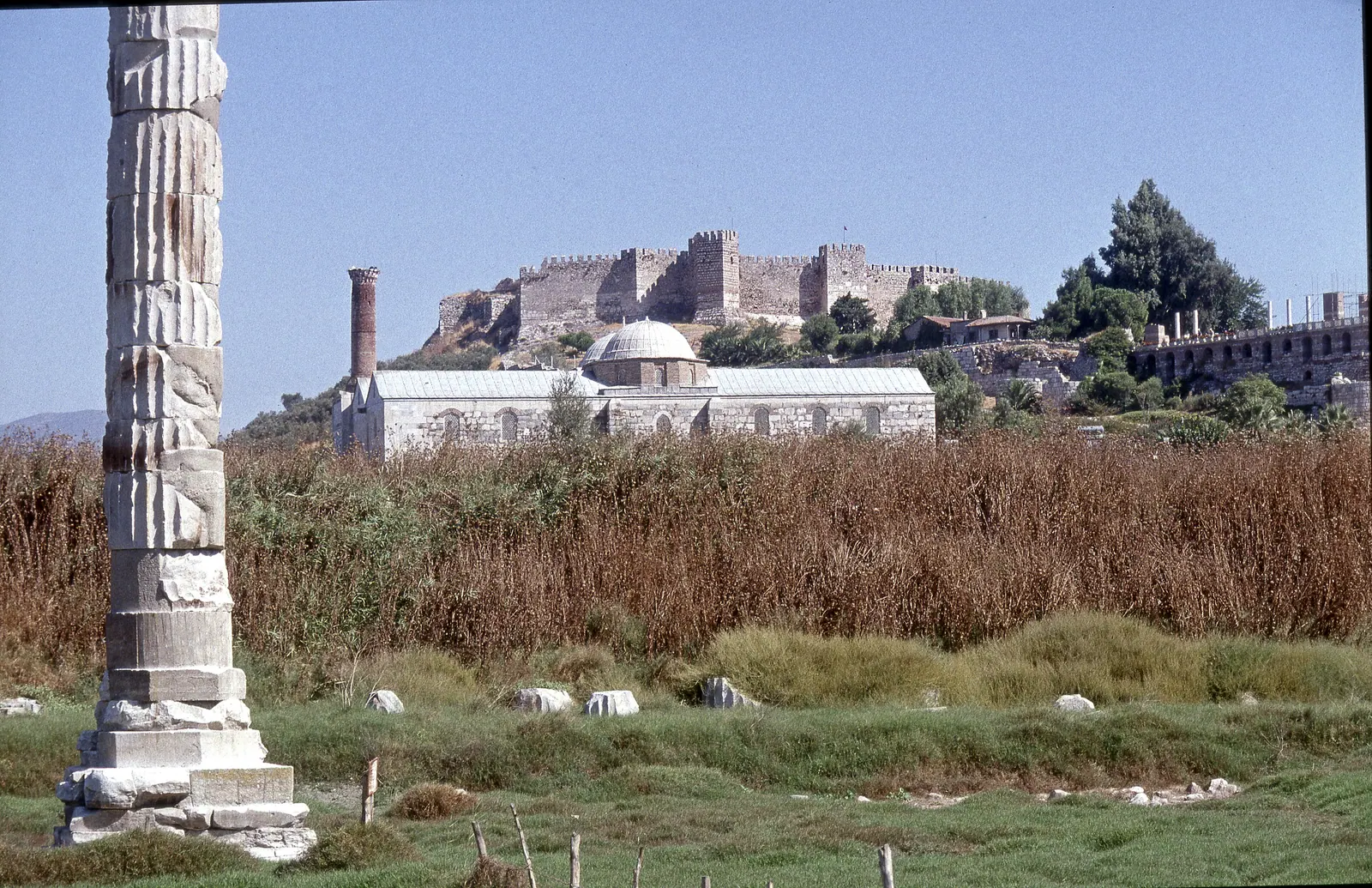
The history of Ephesus is the history of a place more than of a single city. People first settled here in the Neolithic, on a mound that stood near the prehistoric shore1. Over the following millennia the settlement moved several times, pushed by a coastline that kept retreating west2. The ruins most visitors see belong to the city Lysimachus founded in the early 3rd century BC3, which Rome later made the seat of its governor of Asia4. When that city faded, life went on at Ayasuluk hill, where the town of Selçuk stands today5.
Through the ages
The table gives the broad shape. The sections below take each period in turn.
| Period | Dates | Where people lived | Turning points |
|---|---|---|---|
| Prehistoric | c. 6700–2750 BC | Çukuriçi Höyük1 | Obsidian from Melos; about 50 metalworking furnaces13 |
| Late Bronze Age | late 14th century BC | Ayasuluk hill, probably Apaša14 | Muršili II takes Apaša15 |
| Ionian and Archaic | 11th century BC – 547/546 BC | Around the Athenaion and Mount Koressos, then down by the Artemision16 | Croesus takes the city c. 560 BC17 |
| Persian and Classical | 547/546–334 BC | Around the Artemision18 | The temple burns in 356 BC19 |
| Hellenistic | 334–133 BC | The new city between Panayırdağ and Bülbüldağ3 | Lysimachus moves the city3 |
| Roman | 133 BC – 3rd century AD | The same site3 | Earthquake and raids under Gallienus20 |
| Late antique and Byzantine | 4th–13th century | Lower city, then increasingly Ayasuluk5 | Councils of 431 and 4499; Seljuk capture in 109021 |
| Turkish | 1304 onwards | Ayasuluk22 | Aydınid capital; Ottoman for good from 142523 |
Before the Greeks: Çukuriçi and Apaša
The oldest settlement in the Ephesus area is Çukuriçi Höyük, a low mound near the later city. Its first villagers lived there in the Neolithic, around 6700–5900 BC; the mound then stood empty for more than 2,500 years, was resettled in the Late Chalcolithic, around 3300–3000 BC, and was finally abandoned at the end of the first phase of the Early Bronze Age, around 2750 BC1. At the time the coast lay only about 1.5 km away, which gave the settlers direct access to the Aegean24.
What they did with that access shows up in the finds. Obsidian came by sea from the island of Melos, and the Early Bronze Age levels hold about 50 metallurgical furnaces, evidence of early copper and arsenical-copper working13. The Selçuk museum carried out the first excavations in the late 1990s; systematic research followed from 2006 to 2014, led by Barbara Horejs under the Austrian Archaeological Institute’s licence25.
By the Late Bronze Age attention had shifted to Ayasuluk hill. Many scholars identify it with Apaša, the capital of the kingdom of Arzawa named in Hittite texts, though the case rests on the similar name and on Mycenaean finds, not on an inscription14. The annals of the Hittite king Muršili II record that in the third year of his reign he entered Apaša, the city of the Arzawan king Uhhaziti, who fled rather than fight; by the usual chronology that was in the late 14th century BC15.

Androclus, the boar and the Ionian city
The Greeks told their own foundation story. Androclus, a son of King Codrus of Athens, led the Ionian settlers who founded Ephesus, and his descendants were still honoured as “kings” in Strabo’s day26. An oracle had promised him that a fish and a boar would show him where to build. A fish jumped out of a cooking fire, the brushwood caught, a boar broke cover, and the city was founded where Androclus killed it27. The scene was still being carved in Roman times, on the frieze of the so-called Temple of Hadrian28.
According to Strabo, Carians and Leleges held the site before Androclus drove them out and settled his people around the Athenaion, the Hypelaios spring and the slopes of Mount Koressos16. Another tradition said the city was once called Smyrna, after an Amazon who took it29. Ancient writers also credited the Amazons with founding the cult of Artemis at Ephesus30, though Pausanias disagreed: in his view the sanctuary was older, and the Amazons only came to it as suppliants31.
The archaeology is less colourful and more useful. The Ionian settlement is traditionally dated to the 11th or 10th century BC, and the earliest Iron Age Greek pottery found at Ephesus belongs to the late 11th century BC6. Greek pottery of that date also turns up in the terracing of the low hill where the temple of Artemis would later stand32.

Lydians, Persians and the Archaic temple
In the mid-7th century BC Cimmerian raiders attacked Ephesus and the sanctuary of Artemis33. The next threat came from Lydia. When Croesus besieged the city, the Ephesians dedicated it to Artemis by running a rope from the temple to the city wall, seven stades away, a little over a kilometre34. Croesus took Ephesus around 560 BC17 and then paid for some of the columns of the great new temple; drums carrying his dedication survive35.
That temple was the first of the two that made the Artemision famous. Ancient tradition said it took 120 years to build, with all Asia contributing to the Temple of Artemis36. Croesus’s reign also moved the town. Strabo says the Ephesians had lived on the mountainside until then, and afterwards came down to live around the Artemision, where they stayed until Alexander’s time18.
After Cyrus of Persia defeated Croesus, the Persian general Harpagus brought Ephesus under Persian rule37. In 498 BC, during the Ionian Revolt, the rebels marched inland from Ephesus to burn Sardis and were later beaten by the Persians near the city38.
This is also the Ephesus of Heraclitus, the philosopher of flux and of the logos, active around 500 BC39. He came from the old royal family, gave up his honorary kingship to his brother40, and deposited his single book in the temple of Artemis41.

Classical Ephesus and the fire of 356 BC
After the Persian defeat in 479 BC, Ephesus joined the Athenian-led Delian League42. Late in the Peloponnesian War, in 407 BC, the Spartan admiral Lysander made it his fleet base, raised his ships from 70 to 90, and in 406 BC defeated the Athenians off nearby Notium43.
In 356 BC the Artemision burned down. The arsonist was Herostratus, who wanted to be remembered, and later tradition set the fire on the night Alexander the Great was born19. The Ephesians banned his name, and it survives only because the historian Theopompus wrote it down anyway44. Some modern scholars doubt that he acted alone, or at all: one suggestion is that temple officials, knowing the foundations were sinking, were glad to see the building go45. The exact day often quoted for the fire, 21 July, is a modern reconstruction from the Alexander story and should not be treated as a record19.
Alexander took Ephesus from the Persians in 334 BC, after his victory at the Granicus46. He offered to pay for the rebuilding of the temple if his name were inscribed on it. The Ephesians declined; one of them answered that it was not fitting for a god to dedicate offerings to gods47. They paid for it themselves, with women’s jewellery, private gifts and the sale of the old temple’s columns48. Alexander did extend the temple’s zone of asylum, to one stade, a boundary that later rulers stretched and Augustus finally cut back because it sheltered criminals49.

Lysimachus moves the city
Lysimachus, one of Alexander’s successors, made the move that shaped everything visitors see today: he took the city away from the Artemision and rebuilt it inside new walls on the valley floor below two hills, Panayırdağ and Bülbüldağ3. The date is less secure than most books suggest. Lysimachus first seized Ephesus in 301/300 BC, but he held it firmly only from 287 BC until his death in 281 BC; the safest statement is that he refounded the city in the early 3rd century BC, often given as around 290 BC7.
He renamed it Arsinoeia after his wife Arsinoe II, but the name did not last; after his death at Corupedium in 281 BC the city was Ephesus again50. The people did not want to move, according to Strabo. Lysimachus waited for a heavy downpour, blocked the drains and flooded the old town until its inhabitants were glad to leave51. Geoarchaeology suggests a more practical motive: the harbour by the Artemision was silting up, while the bay between the two hills still gave deep, good anchorage52. He also destroyed the nearby cities of Lebedos and Colophon and moved their people into his new Ephesus53.
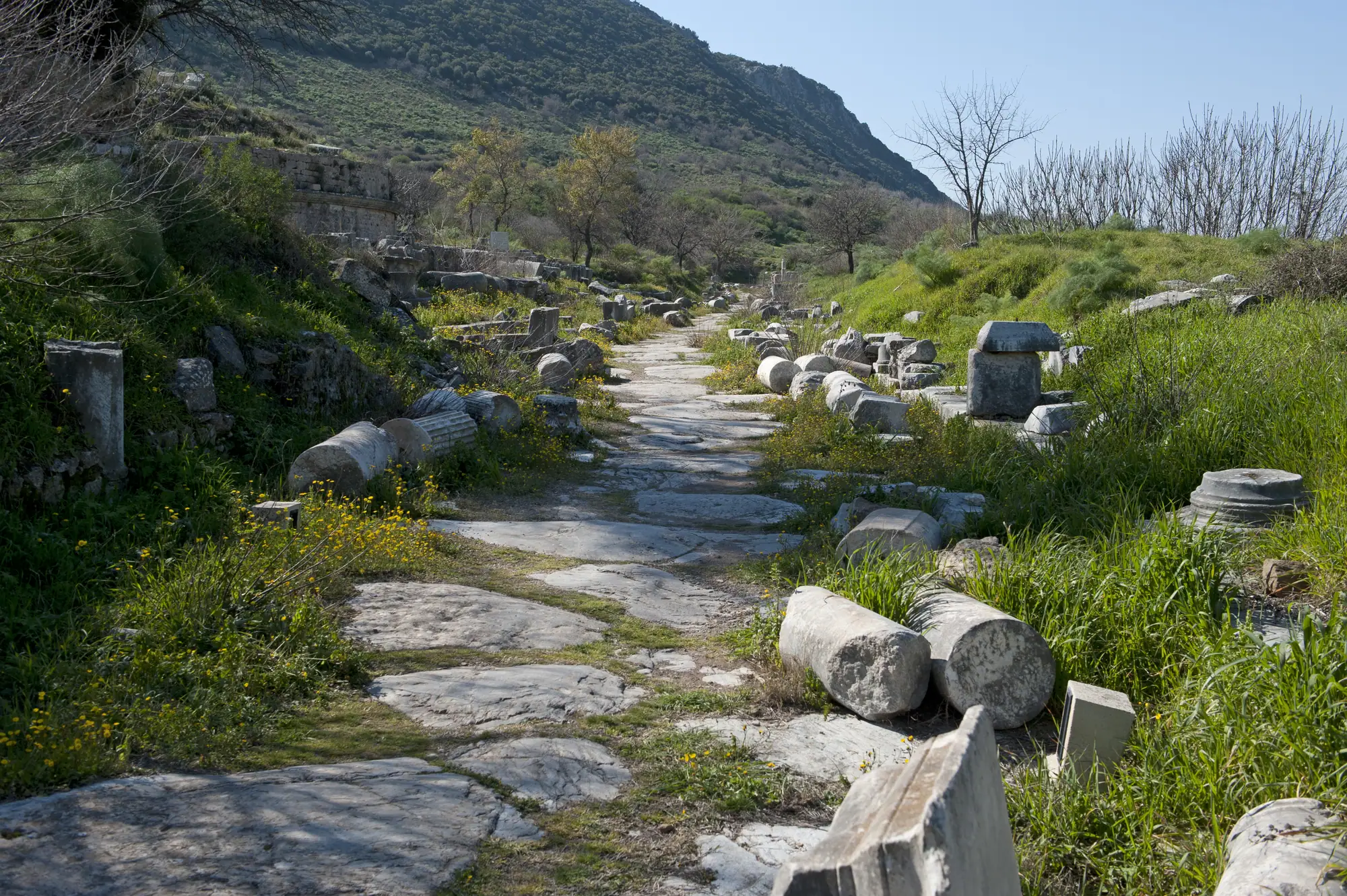
The new city was built to last. The wall circuit followed the crest of Bülbüldağ and took in ground over 4 km from end to end and 2 km across54, and its streets were laid out on a regular grid55. Not everything credited to Lysimachus was his, though. The Great Theatre, often said to be his work, was begun generations after him, in the 2nd century BC, according to the excavators’ final publication56. The Magnesian Gate, too, dates from around 100 BC, not from his walls57.
Between kingdoms: Seleucids, Ptolemies and Pergamon
After Lysimachus the city was contested between the Seleucid kings and the Ptolemies of Egypt, and it was in Seleucid hands again by 196 BC, when Antiochus III used it as his base58. Around 190 BC Livy describes its harbour as “like a river”, long, narrow and full of shoals, when the Romans considered trapping Antiochus’s fleet inside by sinking cargo ships in the channel59.
Rome defeated Antiochus, and after the Peace of Apamea in 188 BC Ephesus was handed to the Attalid kings of Pergamon60. One of them, Attalus II, made the silting worse. Strabo says his engineers narrowed the wide harbour mouth with a mole, expecting the channel to deepen; instead it trapped the river’s silt, and the whole harbour grew shallower61.
Rome’s city in Asia
Attalus III died in 133 BC and left his kingdom to Rome; after the revolt of Aristonicus was crushed, the province of Asia was organised in 129 BC8. Ephesus became the seat of the Roman governor. Whether it was formally the capital, in place of Pergamon, is debated: the governor toured the province’s assize towns and landed at Ephesus, and “the governor’s seat and effectively the capital” is the fairest description4.
Roman rule was not popular at first. In 88 BC Ephesus welcomed Mithridates VI of Pontus and pulled down Roman statues62. In the massacre remembered as the Asiatic Vespers, the cities of Asia killed their Roman and Italian residents on his orders, and Appian says the Ephesians dragged fugitives away from the images of Artemis in her temple63. Ancient writers put the dead at anywhere from 80,000 to 150,000, figures modern historians regard as exaggerated64. By 86 BC the city had turned against Mithridates and was back under Rome after Sulla’s victory65.
The late Republic brought its most famous visitors. Arsinoe IV, Cleopatra’s younger sister, was killed on Mark Antony’s orders in 41 BC; Josephus places the killing at the Artemision of Ephesus, where she had taken refuge, while Appian puts it at Miletus66. When Antony entered the city that year, Ephesus greeted him as Dionysus, with women dressed as Bacchantes and men and boys as satyrs67. In 33/32 BC he and Cleopatra wintered there while they gathered their fleet; Plutarch says 800 warships and transports assembled at Ephesus68.
Octavian, the future Augustus, allowed the Romans living in Asia to set up a sanctuary of Rome and the deified Julius Caesar at Ephesus in 29 BC69. Strabo, writing under Augustus or Tiberius, called Ephesus the largest trading centre in Asia this side of the Taurus mountains, and a city that grew by the day70.

The imperial peak
The first two centuries AD were the city’s grandest. After the earthquakes that struck Asia in AD 17 and later, Ephesus was among the cities thanked for Tiberius’s help on a monument set up at Puteoli in AD 30, though Tacitus’s list of the twelve cities hit in AD 17 does not include it71. Hadrian visited in AD 124 and probably again in 128/129, and was honoured as a founder72. Under him Ephesus became “twice neokoros”, twice the official keeper of a temple of the imperial cult; it was “thrice” from AD 211, and briefly “four times” under Elagabalus, a record in the Roman East73.
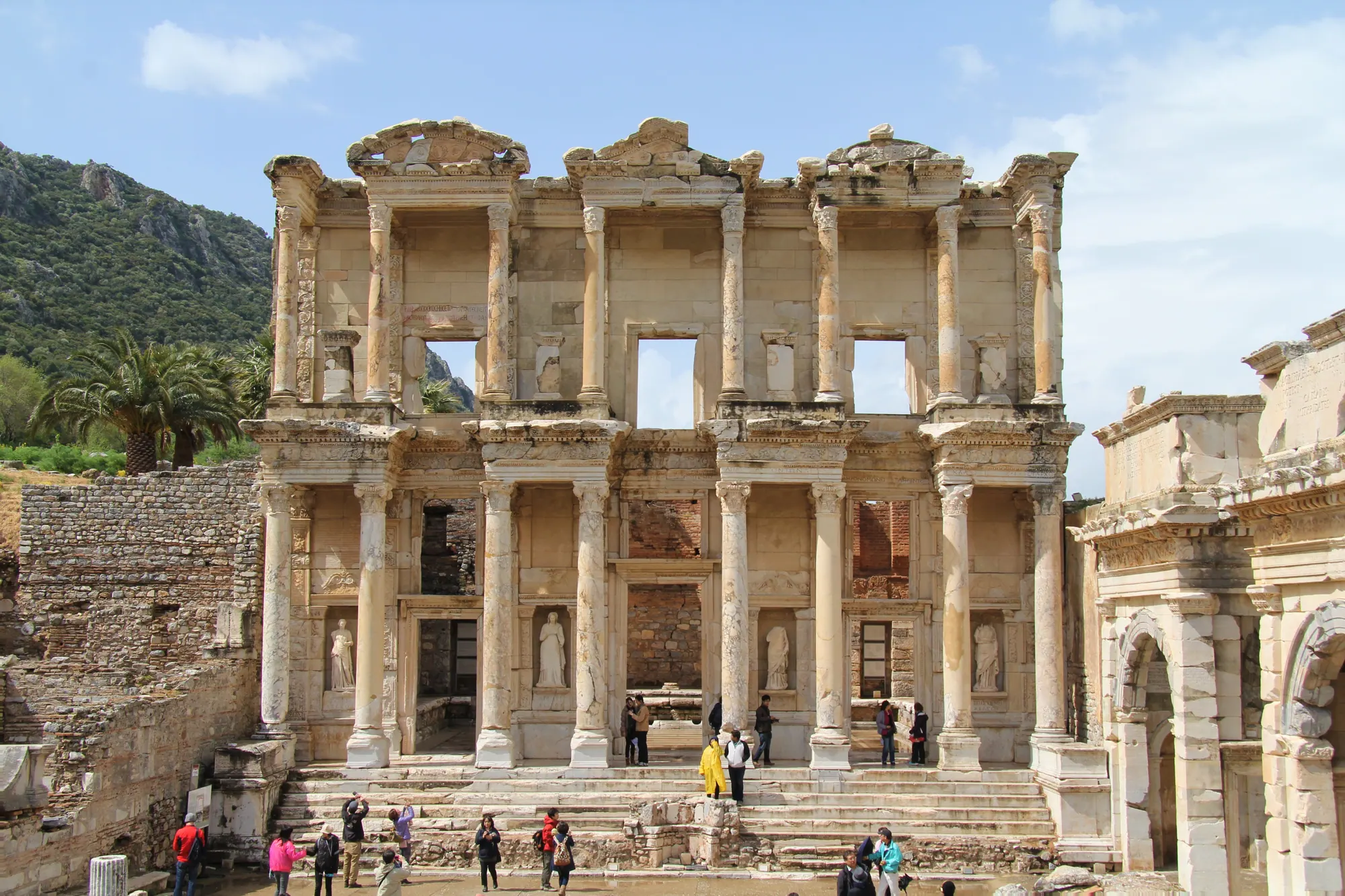
Much of what stands in the ancient city today was built in these years. The Library of Celsus honoured Tiberius Julius Celsus Polemaeanus, consul in AD 9274, who was buried beneath it75. Terrace House 2, the block of Terrace Houses climbing the slope over Curetes Street, covers about 4,000 m²76. The Vedius Gymnasium, a bath-gymnasium of almost 13,000 m², opened between AD 147 and 14977.
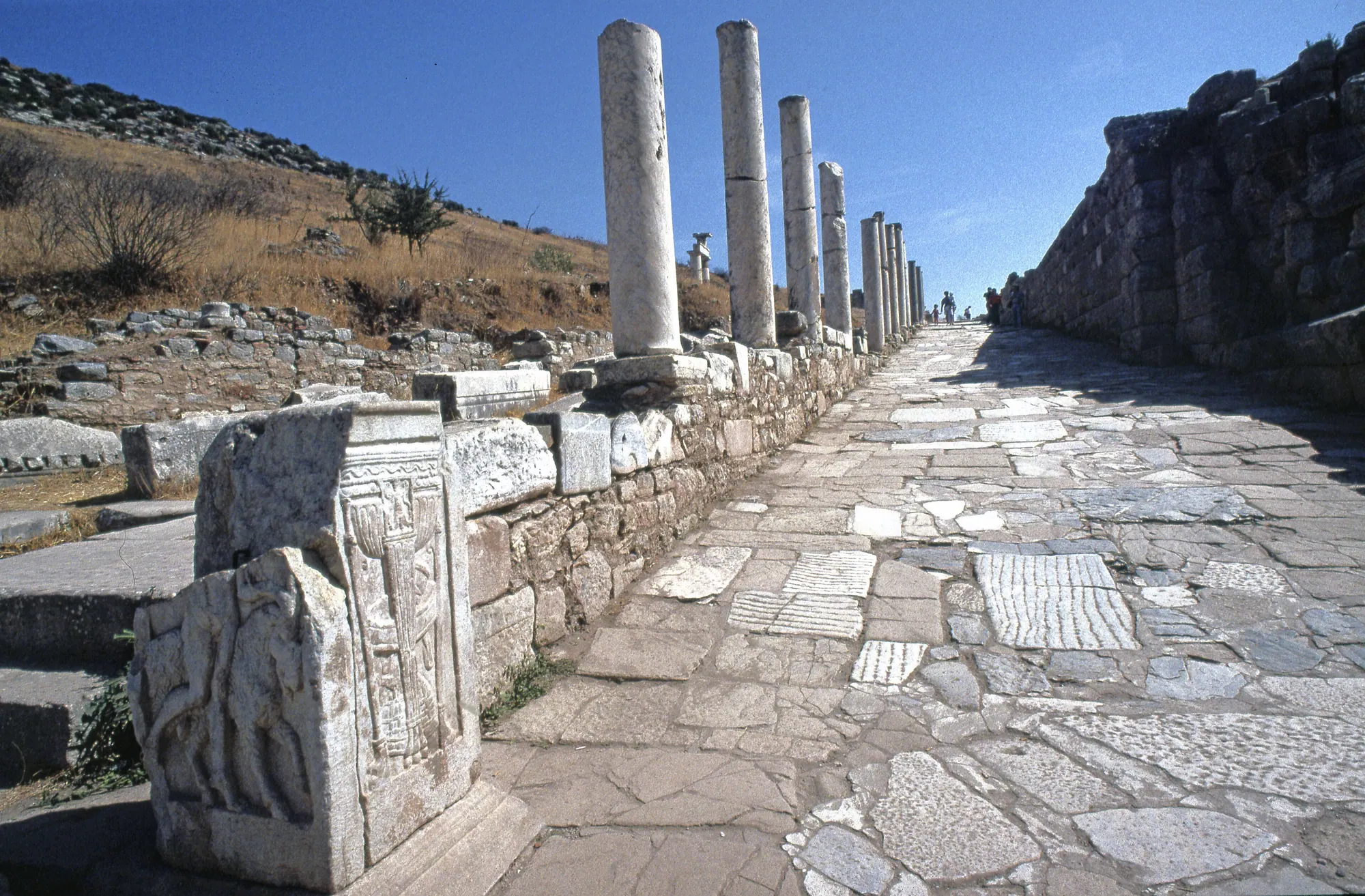
The harbour needed constant work. Under Nero the governor Barea Soranus tried to clear it; around AD 100 benefactors paid for its enlargement; in the mid-2nd century a governor banned dumping into the harbour canal; and further works followed in the 3rd century78. As the delta advanced, the Romans cut a long canal west from the harbour basin to reach open water79.
Christian Ephesus has its beginnings in the same years. Acts says Paul taught in the synagogue for three months and then daily for two years in the lecture hall of Tyrannus80, and he wrote 1 Corinthians from the city81. Acts also tells how the silversmith Demetrius, who made silver shrines of Artemis, stirred up a riot against Paul’s preaching that ended in the theatre82.
How many people lived in Roman Ephesus?
The estimates are far apart: the highest is more than six times the lowest. The traditional figure, repeated in much of the older literature, is about 200,000 to 250,000 people, but no count from the excavations stands behind it83. The historian T. R. S. Broughton suggested up to 225,00084; Jerome Murphy-O’Connor, working from density, arrived at 138,000 to 172,50085. J. W. Hanson’s density-based estimate is far lower, at 33,600 to 56,00086, and a 2017 demographic model by Hanson, Ortman and Lobo gives about 71,60087.
The fairest summary, then, is that estimates range from roughly 34,000–72,000 in recent density models to the traditional 200,000–250,00083. The popular claim that Ephesus was “the fourth-largest city of the Empire” is a modern commonplace; the historian Walter Scheidel counts it among the five largest cities of the Greco-Roman world by the 2nd century AD, alongside Rome, Alexandria, Antioch and Carthage88.

Earthquake, Goths and the end of the imperial city
The good years ended in the 3rd century. A severe earthquake struck Ephesus in the reign of Gallienus (253–268) and was followed by raids from the sea by Gothic warriors20. According to Jordanes, Goths led by Respa, Veduc and Thuruar burned the temple of Artemis; modern writers date the raid variously to 262/263 or 267/268, so “in the 260s” is as close as the evidence allows89. The excavators date the destruction of Terrace House 2 to the third quarter of the 3rd century20, and they now attribute the ruin of the Library of Celsus to an earthquake around AD 27090.
The Terrace Houses were never rebuilt as luxury homes, and these disasters mark the end of the city’s imperial peak91. The temple of Artemis never regained its old state either; its cella seems to have been partly restored and stayed in use through the 4th century, before the ruins became a quarry92.

Christian Ephesus in late antiquity
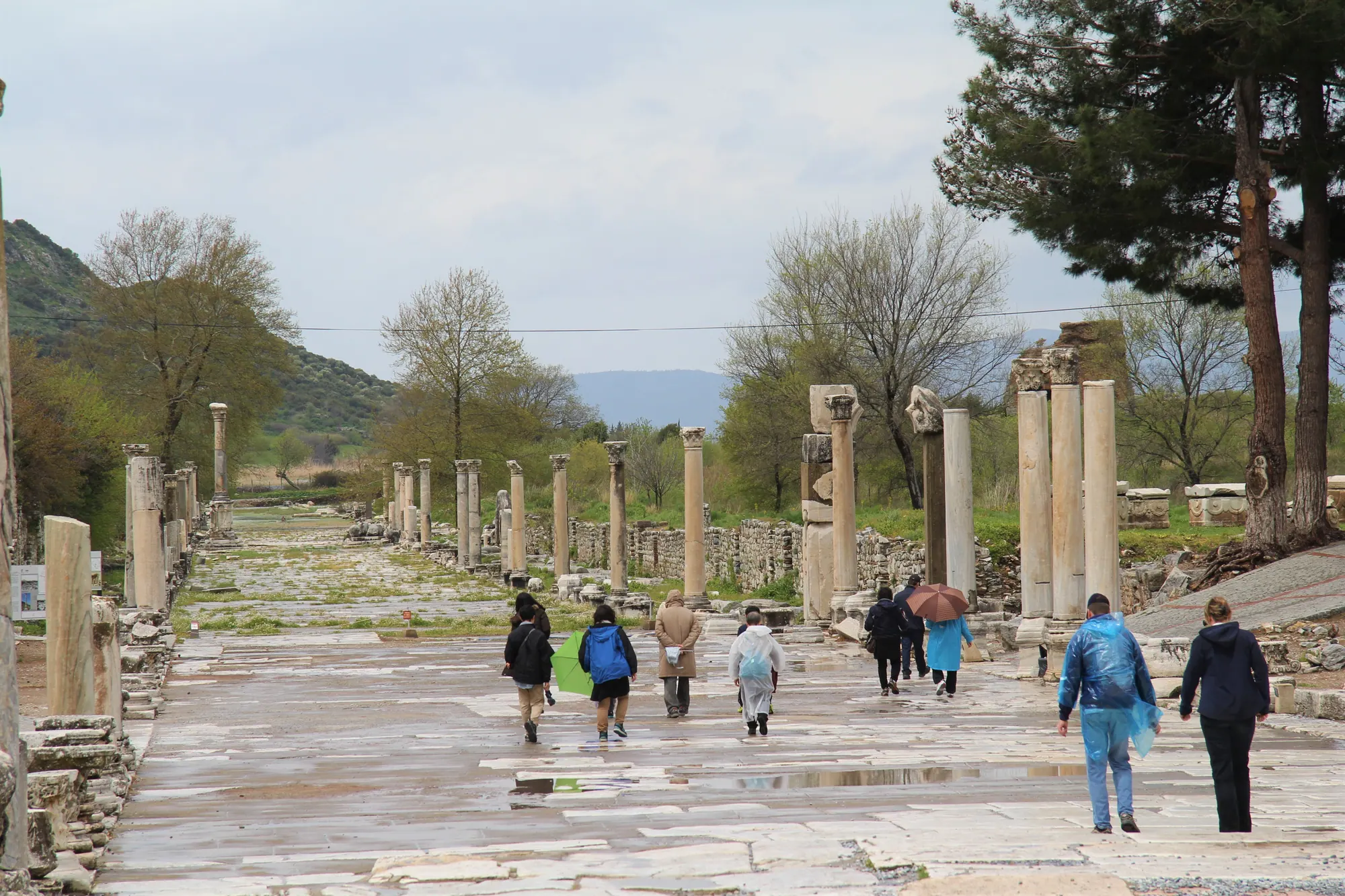
Constantine, Constantius II and Arcadius rebuilt and adorned the city after the 3rd-century damage. The colonnaded street to the harbour is still called the Arkadiane after Arcadius, who reigned from 395 to 40893. The Artemision, meanwhile, was abandoned by about 400, and its marble was carried off for other buildings, much of it to the church of St John on Ayasuluk and later to the İsa Bey Mosque94.
Ephesus hosted two church councils, in 431 and 4499. The first, now counted as the Third Ecumenical Council, opened on 22 June 431 under Cyril of Alexandria95. It deposed Nestorius, archbishop of Constantinople, and upheld the title Theotokos, “God-bearer”, for Mary96. The second met in August 449 and restored Eutyches97. Pope Leo I dismissed it as a “robber synod”. The Council of Chalcedon overturned its decisions in 451, but the Oriental Orthodox churches still accept it98.
The 6th century brought plague and grand building in the same generation. The Justinianic plague, around 542, hit the population hard99. Around the middle of the century Justinian replaced a small ruined church over the traditional grave of John the Apostle with the great domed Basilica of St John, taking Constantinople’s Holy Apostles as his model100.
Around 614/616 large parts of the city were destroyed. The cause is disputed: most accounts blame the Persian war, others an earthquake. Afterwards a new wall enclosed less than half of the old city101.
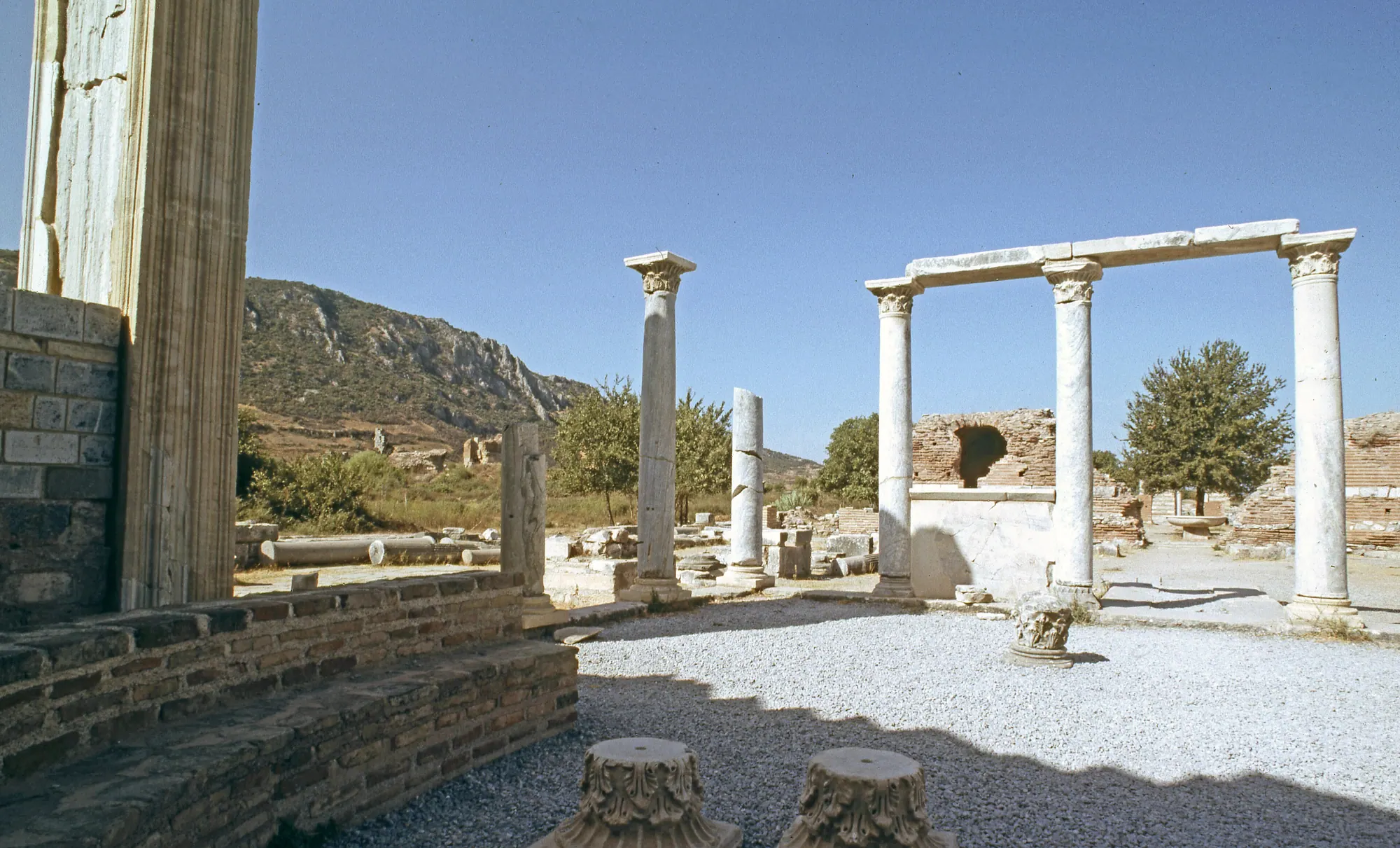
Ayasuluk: the Byzantine town on the hill
From the mid-7th century Arab fleets raided the coast; in 654/655 they attacked Ephesus, and in 781 raiders carried off about 7,000 captives102. Earthquakes, fire and economic decline in the 7th and 8th centuries broke the city into smaller centres; one scholarly model sees three, around the old harbour, on fortified Ayasuluk and on the coast at Anaia103. Settlement drifted towards Ayasuluk, which was refortified from about the 7th century100.
The old city was not simply deserted, though. Austrian excavations south of the Church of Mary found people living there until the 12th century, then mainly farming, and the last signs of any activity date from the 14th century5. The hill town took its name from the church: Hagios Theologos, “the Holy Theologian”, became Altologo in Italian mouths and Ayasuluk in Turkish ones104.
Ephesus belonged to the Thracesian theme, a Byzantine military province, from the 7th century, and in the 8th century it held a profitable annual fair105. The Paulicians, led by Chrysocheir, attacked the city in the 860s106. The Seljuk Turks took it in 1090, and a Byzantine army under John Doukas won it back in 1096/9721. The armies of the Second Crusade camped here and fought the Seljuks nearby in December 1147107. After the Fourth Crusade took Constantinople in 1204, Ephesus belonged from 1206 to the Laskarid empire of Nicaea and became a centre of learning108.

Aydınids, Timur and the Ottomans
On 24 October 1304 the town surrendered to Turkish forces under Sasa Bey, allied with the Aydınid family, and much of its Christian population was expelled, killed or enslaved10. Under the Aydınid beylik Ayasuluk became a capital and a major trading port, dealing with Venice and Genoa109.
Its finest building from those years, one of several medieval monuments around Ephesus, still stands below the castle. The inscription of the İsa Bey Mosque dates it to March 1375; it was built for the Aydınid ruler İsa Bey, and its architect was Ali ibn Mushaimish of Damascus22. İsa Bey reigned until about 1390, when the Ottoman sultan Bayezid I took Aydınid lands110. After Timur defeated the Ottomans at Ankara in 1402 he restored the Aydınid princes, and Ayasuluk suffered in the invasion111. The Ottomans returned for good under Murad II, who ended the rule of the last Aydınid prince, İzmiroğlu Cüneyd, in 1425; some sources give 142623.
By the 15th century the ancient lower city was abandoned112.

Travellers and excavators
Visitors kept coming to the ruins. Cyriacus of Ancona, the Italian antiquarian, came in the 15th century, and the Ottoman traveller Evliya Çelebi described Ayasuluk in the mid-17th113.
Modern archaeology began with a search for the lost temple. In 1863 the British railway engineer John Turtle Wood started looking for the Artemision on behalf of the British Museum, uncovering parts of the theatre and other buildings on the way114. The clue came in 1866, from an inscription in the theatre: it described statuettes carried in procession from the temple by way of the Magnesian Gate, so Wood looked for the road out of that gate and followed it115. He reached the temple’s remains on 31 December 1869, about 6 m down116.
The Austrians arrived next. Otto Benndorf of the University of Vienna proposed an excavation in 1893, digging began in 1895, and in 1898 he founded the Austrian Archaeological Institute11. Finds from the early campaigns went to Vienna until 1906; exports ended with the Ottoman antiquities law of 1906/07117. Fieldwork stopped for more than a decade with the First World War, resumed in 1926, halted again in the Second World War and restarted in 1956 with annual campaigns under Franz Miltner118.
Some of the most visible results came later still. The façade of the Library of Celsus was re-erected from its own fallen blocks between 1970 and 1978119, and Terrace House 2 received its protective roof in 1999/2000120. The work has never been free of politics: Turkey halted the Austrian excavation in 2016 and allowed it to resume in 2018121.

Ephesus today
Selçuk, the town beside the ruins that visitors walk through today, was made a district of İzmir province in 1957122. In 2015 UNESCO inscribed Ephesus on the World Heritage List12, as a property in four parts: the Çukuriçi mound, the ancient city, the House of the Virgin Mary, and Ayasuluk hill with the Artemision and what remains of the medieval town123. The reasons UNESCO gave follow the story told above: the monuments of the Roman city, a landscape shaped by the shifting coast, and religious traditions reaching from the Anatolian mother goddess to Christianity124.
In 2025 the ruins drew more visitors than any other museum or archaeological site in Turkey125. The ministry’s count for that year: 2,550,458126 (checked on ).
Dates you will often see given wrongly
Popular accounts of Ephesus repeat a handful of dates and numbers that the evidence does not support. The main ones from its history:
- Lysimachus refounded the city in the 290s or 280s BC. He did not hold Ephesus securely before then, so the date “c. 320 BC” found in some popular histories cannot be right7.
- The theatre was begun long after Lysimachus. The excavators place its start in the 2nd century BC and date its marble stage front, by inscription, to AD 85127.
- About 20,000 is the excavators’ figure for the theatre. The 24,000 and 25,000 found in many books come from older and official sources128.
- 250,000 is the top of an old estimate, not a count. Recent models for Roman Ephesus are far lower83.
- The council of 431 is counted as the third ecumenical council. Some tour sites call it the fourth95.
- Finds stopped going to Vienna in 1906, not 1923. The later date is a mistake in a widely read online summary129.
- The İsa Bey Mosque is Aydınid work of 1375. Calling it Seljuk puts it in the wrong dynasty22.
The monuments have their own crop of errors, collected in what guidebooks get wrong.

Sources
Each source is listed once. The numbers link back to the claims it supports; dates show when the source was checked.
- journals.ed.ac.uk › 6893 1, 13, 24, 25
- defc.acdh.oeaw.ac.at › cukurici-movie 1, 13, 25
- en.wikipedia.org › Çukuriçi_Höyük 1, 13, 24, 25
- Kraft, Brückner, Kayan, Engelmann 2007, Geoarchaeology 22:121-149, doi:10.1002/gea.20151 2, 3, 7, 16, 18, 27, 29, 30, 47, 50, 51, 52, 54, 55, 59, 61, 70, 78, 79, 83, 89, 94
- Stock, Pint, Horejs, Ladstätter, Brückner 2013, Quaternary International 312:57-69 2, 3, 7, 52, 78, 79
- web.archive.org › 1018 2, 123
- www.oeaw.ac.at › ephesos-bio-geo-archive 2, 103
- web.archive.org › Ephesus 3, 4, 7, 20, 22, 53, 60, 65, 100, 104, 112
- web.archive.org › prehellenistic-ephesos.html 3, 7, 52
- Strabo 14.1, Loeb tr. 3, 16, 17, 18, 19, 26, 29, 30, 40, 41, 47, 48, 49, 50, 51, 61, 70
- austriaca.at › 0xc1aa5576_0x001c9934.pdf 3, 5, 7, 20, 52, 78, 79, 100, 103, 104
- www.oeaw.ac.at › ephesos-pre-hellenistic-settlement-history 3, 52
- www.theoi.com › Pausanias1A.html 3, 53
- www.livius.org › ephesus 4, 7, 8, 9, 11, 14, 33, 37, 58
- www.oxfordreference.com › authority.20110803095428649 4
- en.wikipedia.org › Asia_(Roman_province) 4, 8, 69
- en.wikipedia.org › Ephesus 4, 6, 7, 8, 9, 10, 11, 12, 14, 15, 19, 21, 22, 23, 28, 33, 34, 37, 38, 42, 46, 50, 53, 58, 59, 60, 62, 64, 65, 67, 68, 69, 72, 73, 84, 85, 86, 87, 88, 89, 93, 100, 101, 102, 105, 107, 108, 109, 110, 111, 112, 114, 118, 121, 128
- Ladstätter 2019, Ephesos from Late Antiquity until the Middle Ages, SoSchrÖAI 58:11-72) [abstract snippet] 5, 103, 112
- web.archive.org › mittelalterforschung.html 5, 103, 112
- www.blueguides.com › the-shifting-fortunes-of-ephesus-its-rise-and-fall-and-rise 5, 23, 101, 103, 104, 109, 110, 113
- www.thebyzantinelegacy.com › ephesus 5, 10, 21, 93, 99, 100, 101, 102, 105, 106, 107, 108
- de.wikipedia.org › Ephesos 6, 7, 14, 17, 18, 20, 21, 33, 54, 58, 60, 83, 99, 101, 106, 117
- tr.wikipedia.org › Efes 6, 12, 55, 101
- www.worldhistory.org › ephesos 6, 8, 17, 19, 26, 37, 38, 42, 46, 56, 64, 71, 89, 94
- www.britannica.com › Ephesus 7
- en.wikipedia.org › Arsinoe_II 7, 53
- en.wikipedia.org › Lysimachus 7
- it.wikipedia.org › Efeso 9, 46, 83, 93, 94
- en.wikipedia.org › Aydinids 10, 23, 109, 110, 111
- www.oeaw.ac.at › Forschungsgeschichte_Ephesos.pdf 11, 12, 91, 113, 114, 118, 121
- www.ikakla.uni-halle.de › 3414769_3515270 13, 25
- Meriç 2020, TÜBA-AR 27 14, 15
- Herodotus 1.26, Godley trans. 17, 34
- fr.wikipedia.org › Éphèse 17, 20, 83
- web.archive.org › hanghaus-2-marmorsaal.html 20
- en.wikipedia.org › 262_Southwest_Anatolia_earthquake 20, 89, 90, 91
- en.wikipedia.org › John_Doukas_(megas_doux) 21
- islamansiklopedisi.org.tr › ayasuluk 22, 104, 111, 122
- islamansiklopedisi.org.tr › isa-bey-camii--izmir 22
- turkisharchaeonews.net › selçuk 22, 104, 122
- en.wikipedia.org › İsa_Bey_Mosque 22
- en.wikipedia.org › Junayd_of_Aydın 23
- www.ebi.ac.uk › fullTextXML 24
- Stock et al., Neolithic settlement sites… Çukuriçi & Arvalya) [abstract snippet; page 403] 24
- Macquarie Univ., The Coinage of Ephesus 26, 27, 50
- turkisharchaeonews.net › temple-hadrian-ephesus 28
- de.wikipedia.org › Hadrianstempel_(Ephesos) 28
- Herodotus 1.26; Pausanias 4.31.8, 7.2.6-8, 8.13.1; Callimachus Hymn 3.237ff; Strabo 4.1.4, 14.1.26 31, 48
- en.wikipedia.org › Temple_of_Artemis 31, 32, 45, 92
- www.austriaca.at › 0xc1aa5576_0x00037510.pdf 32
- de.wikipedia.org › Tempel_der_Artemis_in_Ephesos 32, 35, 36, 92
- Ohnesorg 2007, Der Kroisos-Tempel, Forschungen in Ephesos XII/4, ch. I, ÖAW 35, 116
- Cartwright 2018 35
- Pliny NH 36.95-97, Bostock-Riley tr. 36
- Graham, rev. 8 Dec 2023 39, 40, 41
- Diogenes Laertius 9.1-6, Hicks tr. 39, 40, 41
- penelope.uchicago.edu › Lysander*.html 43
- www.perseus.tufts.edu › text 43
- en.wikipedia.org › Battle_of_Notium 43
- en.wikipedia.org › Lysander 43
- Valerius Maximus 8.14.ext.5, Latin 44
- en.wikipedia.org › Herostratus 44, 45
- etheses.bham.ac.uk › Leger15PhD_Redacted.pdf 45, 92
- Appian, Mithridatic Wars 21-23 49, 62, 63
- www.theoi.com › Pausanias7A.html 53
- www.aa.com.tr › 2333476 56, 128
- austriaca.at › 7590-2 56, 127, 128
- web.archive.org › magnesian-gate.html 57
- turkisharchaeonews.net › magnesian-gate-area-ephesus 57
- en.wikisource.org › Book_33 58
- en.wikipedia.org › Asiatic_Vespers 63, 64, 65
- Appian BC 5.9 66
- penelope.uchicago.edu › ant-15.html 66
- penelope.uchicago.edu › apion-2.html 66
- www.livius.org › arsinoe-iv 66
- en.wikipedia.org › Arsinoe_IV 66
- Plutarch Antony 24, 56 67, 68
- penelope.uchicago.edu › 51*.html 69
- crossworks.holycross.edu › viewcontent.cgi 71
- penelope.uchicago.edu › 2C*.html 71
- www.ostia-antica.org › puteoli-imperial-cult.htm 71
- Brickell, citing Burrell 2004 and Friesen 1993 72, 73
- www.livius.org › ephesus-library-of-celsus 74, 75
- freidok.uni-freiburg.de › Hueber_Strocka_Die_Bibliothek_des_Celsus.pdf 74, 75, 119
- en.wikipedia.org › Tiberius_Julius_Celsus_Polemaeanus 74
- de.wikipedia.org › Celsus-Bibliothek 75, 119
- en.wikipedia.org › Library_of_Celsus 75
- www.oeaw.ac.at › research-history 76, 119, 120
- www.petersommer.com › ephesus-terrace-house-2 76
- de.wikipedia.org › Hanghäuser_von_Ephesos 76, 120
- austriaca.at › 3950-8 77
- turkisharchaeonews.net › vedius-gymnasium-ephesus 77
- de.wikipedia.org › Vediusgymnasium 77
- penelope.uchicago.edu › 16*.html 78
- web.archive.org › paleography.html 79
- bible-api.com › acts+19 80
- www.newadvent.org › act019.htm 80
- bible-api.com › 1+corinthians+16:8-9 81
- de.wikipedia.org › Marienkirche_(Ephesos) 81
- Acts 19:23-41 82
- en.wikipedia.org › Riot_of_the_Ephesian_silversmiths 82
- www.cambridge.org › div-class-title-urban-form-infrastructure-and-spatial-organi 83
- journals.plos.org › article 83
- Hanson & Ortman 2017, JRA 30:301-324 84, 85, 86, 87, 88
- www.ebi.ac.uk › fullTextXML 87
- api.figshare.com › 5576680 87
- www.oeaw.ac.at › preserving-world-cultural-heritage-austrian-researchers-star 90
- web.archive.org › Temple-of-Artemis-temple-Ephesus-Turkey 92
- www.newadvent.org › 05491a.htm 95, 96
- en.wikipedia.org › Council_of_Ephesus 95, 96
- www.newadvent.org › 05495a.htm 97, 98
- en.wikipedia.org › Second_Council_of_Ephesus 97, 98
- penelope.uchicago.edu › 5*.html 100
- en.wikipedia.org › Ayasuluk_Hill 100, 104, 111
- islamansiklopedisi.org.tr › aydinogullari 111
- 19 Feb 2023 115, 116
- de.wikipedia.org › John_Turtle_Wood 115, 116
- en.wikipedia.org › John_Turtle_Wood 115, 116
- web.archive.org › index.php 117
- www.khm.at › ephesos-museum 117, 129
- api.openalex.org 117
- en.wikipedia.org › Ephesos_Museum 117, 129
- de.wikipedia.org › Friedmund_Hueber 119
- www.selcuk.bel.tr › selcuk-belediyesi-tarihcesi 122
- www.visitizmir.org › 243 122
- web.archive.org › multiple=1 123
- goephesus.com › ephesus--unesco-world-heritage-centre 123
- whc.unesco.org › 6387 123, 124
- whc.unesco.org › 1018 123
- www.worldheritagesite.org › ephesus 124
- www.aa.com.tr › 2587714 125
- www.turizmgunlugu.com › turkiyenin-en-cok-ziyaret-edilen-muzeleri 125, 126
- www.egetelgraf.com › izmir-efes-oren-yeri-turkiyede-zirvede-174-milyon-ziyaretci 126
- turkisharchaeonews.net › great-theatre-ephesus 127, 128
- www.archaeologie-online.de › baugeschichte-des-theaters-von-ephesos-rekonstruiert-5399 128
- web.archive.org › theater.html 128
- en.wikipedia.org › Ephesus_Archaeological_Museum 129