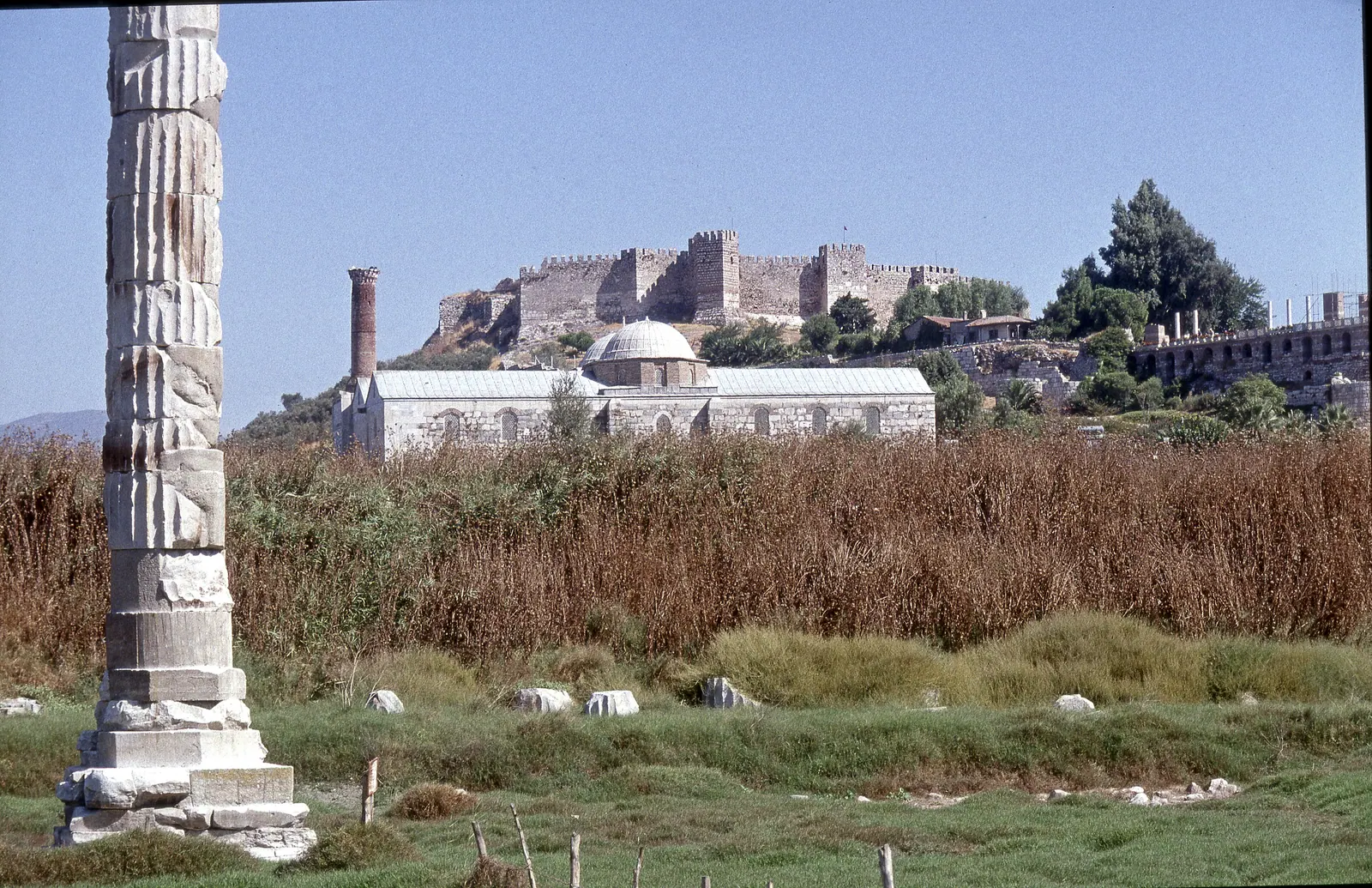
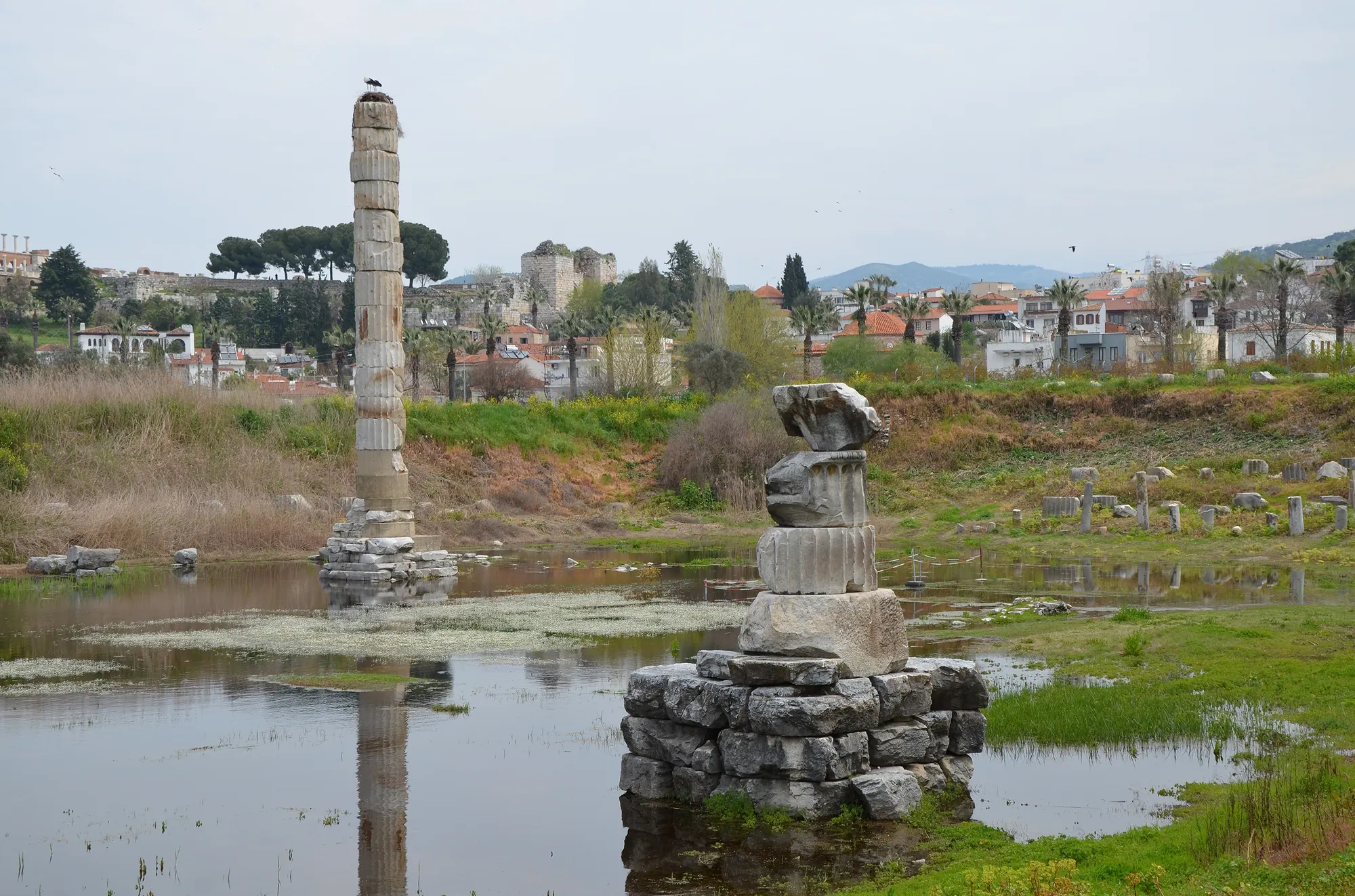
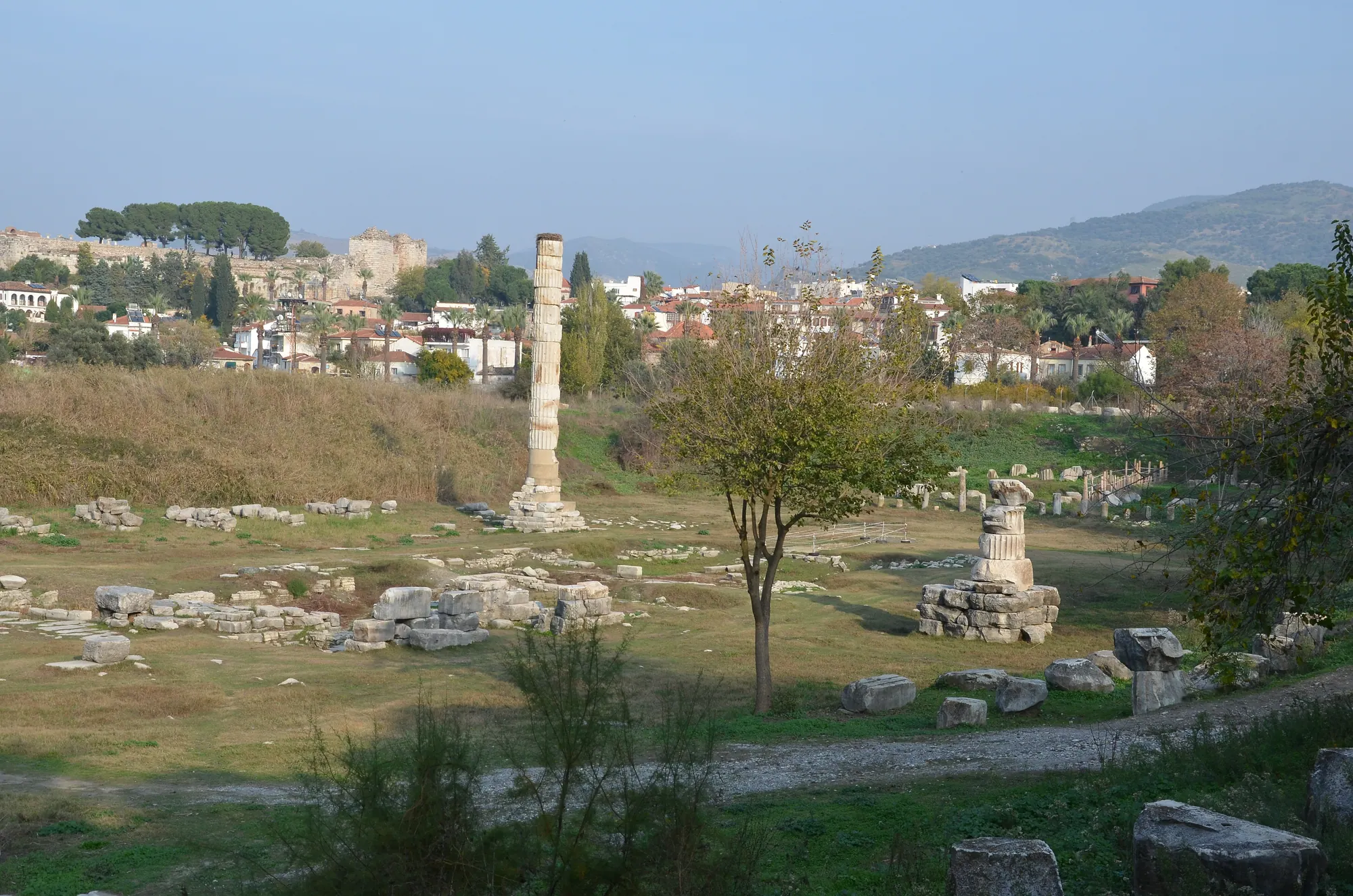
The Artemision, the sanctuary of Artemis of Ephesus, made its way onto the ancient lists of wonders: Antipater of Sidon ended his catalogue of marvels with the goddess’s house rising to the clouds, beside which everything else looked dim1. What stands on the spot today is one column, reassembled from fragments found on the site, and its drums do not all come from the same original shaft2. Between those two facts lie more than a thousand years of building, burning, rebuilding and quarrying, and a Victorian search that took six years.
UNESCO counts the temple site as part of the Ephesus World Heritage property, in the same component as Ayasuluk Hill and the medieval settlement3. It belongs, in other words, with the places around Ephesus rather than with the walled Roman city that most visitors walk through.
Where was the Temple of Artemis?
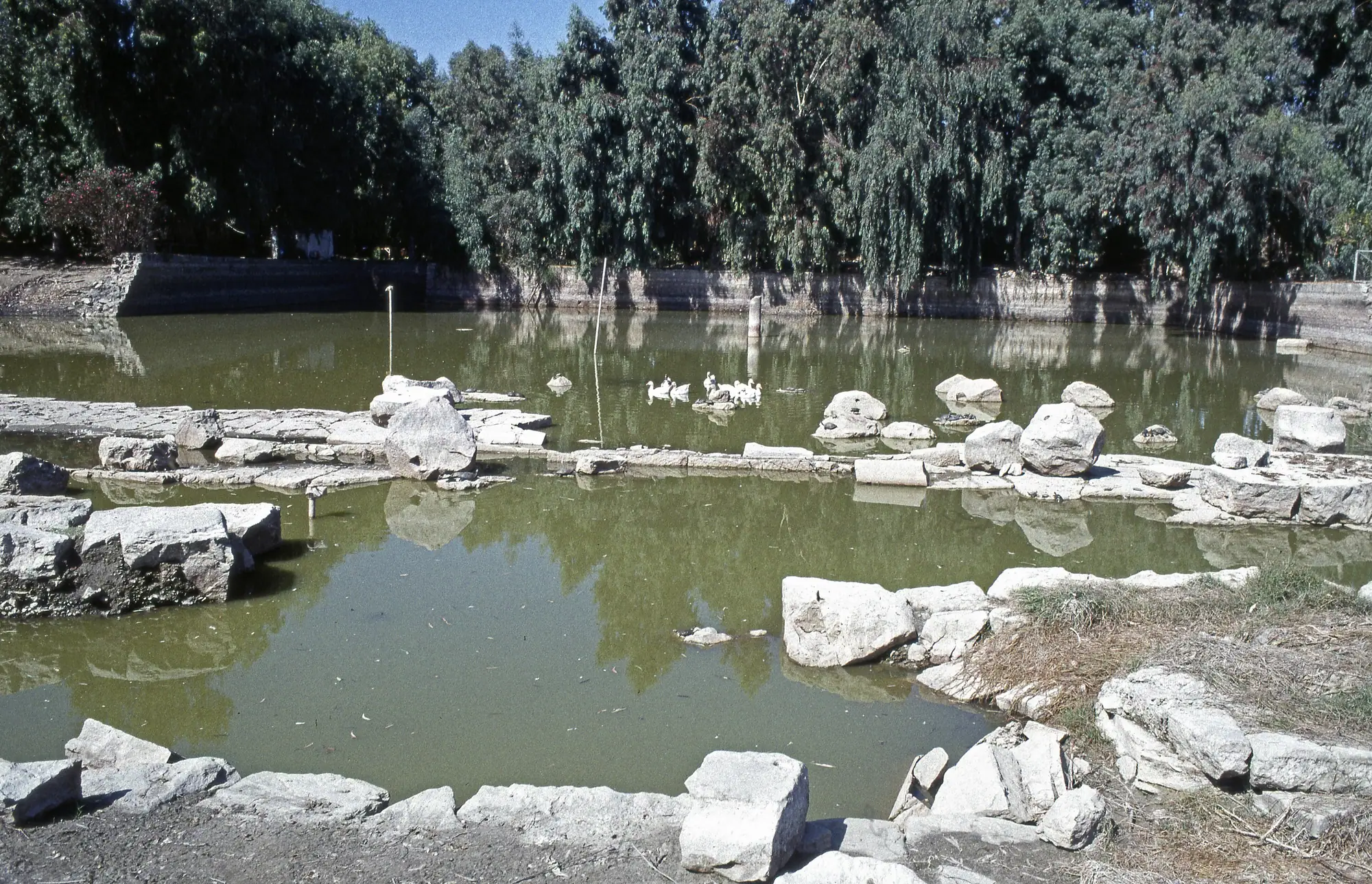
The temple stood on low, wet ground, and the ground is older as a holy place than any building on it. Pottery shows the spot was used in the Bronze Age, and the Austrian re-excavation found early Greek pottery in the terracing of the low hill on which the first temple was built11. The sanctuary never moved. Through every rebuilding, and in spite of chronic flooding, it kept exactly the same spot, which the excavator Anton Bammer read as proof that the location itself was sacred12.
The city, by contrast, moved several times over the history of Ephesus. Silt carried down by the Küçük Menderes, the ancient Cayster, has been pushing the coast westward for some seven thousand years, and every harbour had to follow it out13. In Strabo’s account the Ephesians came down from the hills in Croesus’s time to live beside the Artemision, and stayed there until Alexander14. Lysimachus, one of Alexander’s successors, then resettled them inside new walls in a valley between two hills, on the site whose Hellenistic and Roman ruins now carry the name Ephesus15. That is why the temple and the famous ruins lie apart on any map of Ephesus: the town left, and the goddess stayed.
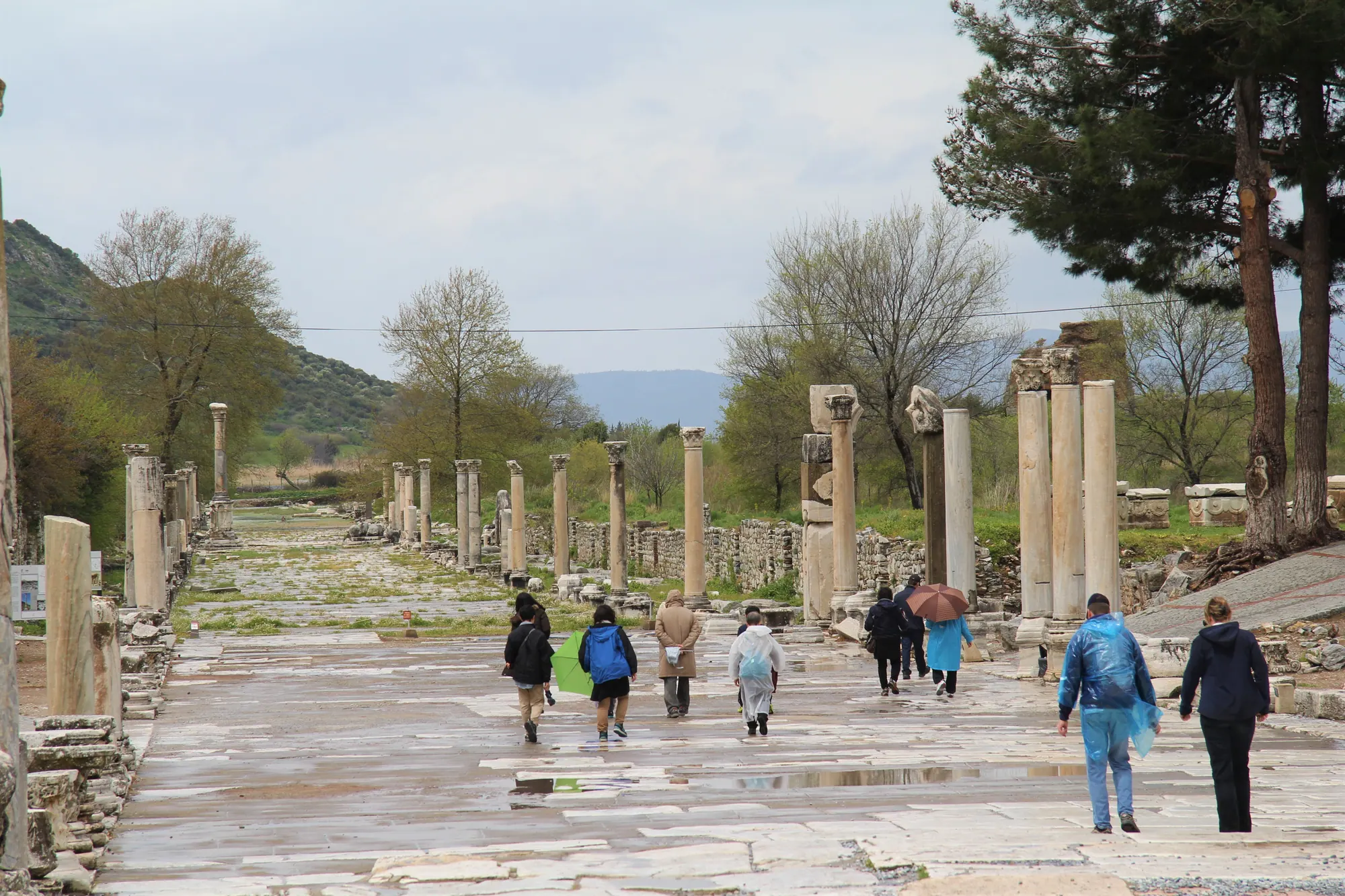
The two were still bound together by road and ritual. Curetes Street, the marble street that climbs through the Roman city, ignores the grid laid out around it, a sign of great age and of its role as a processional route for Artemis16. The gladiators’ cemetery was found in 1993 during a survey of that processional way between the Artemision and the city17.

The earliest temples
The earliest temple found is a small building known as Naos 1, with a cella ringed by four by eight wooden columns on green-schist bases, now dated about 660–640 BC5. An older dating to the 8th century BC, and the claim that it was the first temple of its kind in Ionia, have both been given up5.
The early sanctuary had a rough time. Cimmerian raiders attacked Ephesus and the sanctuary in the mid-7th century BC18, and Callinus of Ephesus, one of the earliest Greek elegiac poets whose verses survive, left a fragment urging his fellow citizens to fight them19. Bammer found more than half a metre of sand over the early temple and took it for flood debris, with drilled amber drops that he thought had once hung on the wooden cult image; later work argues the layer may instead be a deliberate fill20.

The earliest coins
The foundations of the Artemision produced some of the earliest coins known. Hogarth’s British Museum team recovered about 95 electrum coins in 1904–05, and Bammer’s Austrian team found 13 more between 1980 and 1994, 108 in all21. Among them was a small pottery jug holding a group of coins, described as the oldest known hoard of coins22; published counts for the jug vary between 17 and 1921. Hogarth’s originals went to Istanbul, and the British Museum shows electrotype copies alongside the jug23.
Some very early electrum coins carry the name of a certain Phanes, otherwise unknown; they are usually dated to the late 7th century BC and often, though not provably, attributed to Ephesus24.
Croesus and the Archaic temple
The first great temple was a Lydian king’s gift as much as a Greek city’s. Croesus of Lydia paid for some of the columns, and drums inscribed with his dedication survive6. When he besieged Ephesus, the Ephesians dedicated their city to Artemis by running a rope from the temple to the city wall, seven stades away25.
Ancient writers made the building sound superhuman. Pliny says it took 120 years to build and that all Asia contributed, a figure best taken as his, not as a measurement26. He also says it was set on marshy ground on purpose, to protect it from earthquakes, over a bed of trodden charcoal and fleeces; Austrian soundings found discoloured soil consistent with that account27. It is often called the first monumental Greek temple built of marble28, and Vitruvius tells how the marble was found: a shepherd named Pixodarus watched two rams fight, one chipped a rock, and brilliant white stone showed through, after which the Ephesians renamed him Evangelus, "bringer of good news"29. Vitruvius names the architects who began the Ionic temple as Chersiphron and Metagenes30.
Ohnesorg’s 2007 reconstruction for the Austrian Archaeological Institute gives a temple with a double ring of columns around an open-air inner court, about 106 Ionic columns roughly 19 m high, on a platform of only two steps; older books give quite different dimensions31. The column bases on the entrance side were carved with figure reliefs, and the architrave block over the central opening is estimated at about 24 tonnes, lifted onto columns nearly 20 m high32.
This is the temple of the Archaic city’s great figures. Heraclitus is said to have deposited his book in it33, and Diogenes Laertius has the philosopher playing knucklebones with boys in the temple rather than take part in politics34. When Xerxes burned the Ionian temples, Strabo says, he spared the one at Ephesus35.
Herostratus and the fire of 356 BC
The Archaic temple burned in 356 BC. Tradition, recorded by Plutarch and Cicero, held that it happened on the same day or night that Alexander the Great was born7. The coincidence is a story, not a record. Plutarch credits Hegesias of Magnesia with the quip that Artemis was too busy attending Alexander’s birth to save her temple, and calls it frigid enough to put the fire out; Cicero gives the same line to Timaeus36.
The man blamed was Herostratus, and the Ephesians banned his name. It survives only because the historian Theopompus of Chios wrote it down anyway37. Modern scholars are less sure of the story: some doubt he could have set the building alight on his own, and at least two Ephesus specialists have doubted that he did it at all38.

Rebuilding: Alexander’s offer and the women’s jewellery
Rebuilding began soon after the fire, and the Ephesians were determined to pay for it themselves. Alexander offered to cover every past and future cost if his name went up as dedicator; they refused, one of them replying that it was not fitting for a god to dedicate offerings to gods39. Strabo, following the Ephesian geographer Artemidorus, says they rebuilt with women’s jewellery, private donations and the sale of the old temple’s columns, not with Persian money held in trust40.
Strabo names the architect as Cheirocrates, the man who laid out Alexandria, usually identified with the Deinocrates known from Vitruvius41. Vitruvius adds that a temple servant named Demetrius and Paeonius of Ephesus completed the work, though it is not clear which phase of the building he means30. How long it took is also unsettled: one account has construction running for about a century and stopping with some blocks unfinished, while another scholar puts completion around 300 BC42.
The rebuilt temple rose on the same spot as its predecessors12. Coins show a large pediment pierced by three openings that were used in the cult43. Strabo says the altar was filled with works by Praxiteles44.
The best-known surviving piece is a sculpted column drum in the British Museum, excavated by Wood, about 1.82 m high and dated about 340–320 BC45. Hermes, guide of souls, leads a woman who has been named as Alcestis, Eurydice or Iphigenia, beside a winged youth with a sword who may be Death; the myth itself has never been securely identified46.

How many columns did the temple have?
The famous figure of 127 comes from Pliny, who gives the temple as 425 feet long and 225 feet wide, with 127 columns 60 feet high, each the gift of a king and 36 of them carved47. No modern reconstruction has found room for that many8.
- AncientPliny: 127 columns47
- 1870sJohn Turtle Wood’s plan: 100 columns8
- 20th centuryDinsmoor, assuming a copying error in Pliny: 117; Anton Bammer, for the later temple, also 1178
- 2007Ohnesorg: 109 at the very most8
Modern reconstructions give between 100 and 117, and the most recent no more than 1098; Ohnesorg’s own figure for the Archaic temple is about 10631. Pliny’s number is best read as part of the wonder’s reputation rather than of its plan. Dimensions in metres repeated on many websites come from older reconstructions and deserve the same caution31.
Why was it one of the Seven Wonders?
Ancient writers put its fame down to its size, its age and its goddess. Pausanias listed the Amazons who were said to have dedicated her image, the great age of the sanctuary, a temple larger than any other building, the standing of the city, and the renown of the goddess herself48. Antipater of Sidon’s epigram lists the temple among the wonders and gives it the place of honour at the end1.
Ancient tradition credited the Amazons with founding the cult: in Callimachus’s hymn they set up an image under an oak by the sea and dance a war-dance round it49. Pausanias disagreed. He held that the sanctuary was older, founded by the native Koresos and by Ephesos, son of the river Cayster, and that the Amazons only came to it as suppliants50.
The Amazons also gave the temple one of its best-known stories. Pliny tells of a contest in which great sculptors each made a bronze Amazon for the Artemision and then voted, each for the best after his own: Polyclitus came first, Phidias second, Cresilas third51. A wounded Amazon from the late Classical altar of the Artemision is among the key exhibits of the Ephesos Museum in Vienna52, not to be confused with the Ephesus Museum in Selçuk.

A sanctuary, a refuge and a bank
The Artemision was a place of asylum, where people in danger could claim the goddess’s protection, and its limits kept changing. Alexander extended the zone to one stade, Mithridates shot an arrow from the roof and claimed a little more, Mark Antony doubled it so that it took in part of the city, and Augustus cancelled the extension because it had put the city at the mercy of criminals53. In AD 22 Tiberius had the Senate review every Greek city’s claim to asylum; the Ephesians spoke first, arguing that Apollo and Artemis had been born not on Delos but in their own grove of Ortygia54. They backed that with myth: Dionysus had pardoned the Amazons who sat as suppliants at the altar, and Persians, Macedonians and Romans had all respected the sanctuary55.
It also worked as a safe deposit. Dio Chrysostom, writing around AD 100, says private citizens, foreigners, cities and kings deposited money there because no one had ever dared to violate the place, and that the Ephesians kept registers of the deposits and would not touch them even in need56. The Athenian Xenophon left Artemis’s share of his campaign spoils with Megabyzus, the temple’s warden, before 394 BC, got it back later at Olympia, and used it to build a small copy of the Ephesian temple on his estate at Scillus57. The goddess owned profitable lakes near the mouth of the Cayster; kings seized them, Rome returned them, tax-farmers took them again, and Artemidorus won them back on an embassy to Rome, for which the city put up a golden statue of him in the temple58.
Asylum had its limits. Arsinoe IV, Cleopatra’s younger sister, was paraded in Caesar’s triumph in 46 BC and then sent into exile at the Temple of Artemis59. When a priest called Megabyzus greeted her as queen, Antony summoned him to be handed over to Cleopatra, and he was spared only after the Ephesians pleaded for him60. Arsinoe was killed in 41 BC on Antony’s orders; Josephus puts the killing at Ephesus, Appian at a temple in Miletus61. The old theory that the Octagon tomb in the city was hers has been disproved: a 2025 study showed the skull found there belonged to a boy of 11 to 1462.

Festivals and processions
The festival of Artemis drew crowds of foreigners as well as citizens, and Xenophon of Ephesus says it was the custom there for young people to look for husbands and wives; his novel opens with its procession, the 14-year-old Anthia leading the girls63. A Roman edict of AD 162, preserved as an inscription, is read as extending the Artemisia to the whole month of Artemision, in March and April64.
The best-documented procession was a gift. Around AD 104 a Roman named C. Vibius Salutaris gave gold and silver images, among them Artemis with two stags, to be carried from the Artemision into the city for assemblies. They came in by the Magnesian Gate, where the young men of the city joined them, and went back out by the Coressian Gate65. Seventeen centuries later, that inscription led to the temple’s rediscovery.
Artemis of Ephesus: the goddess and her statue
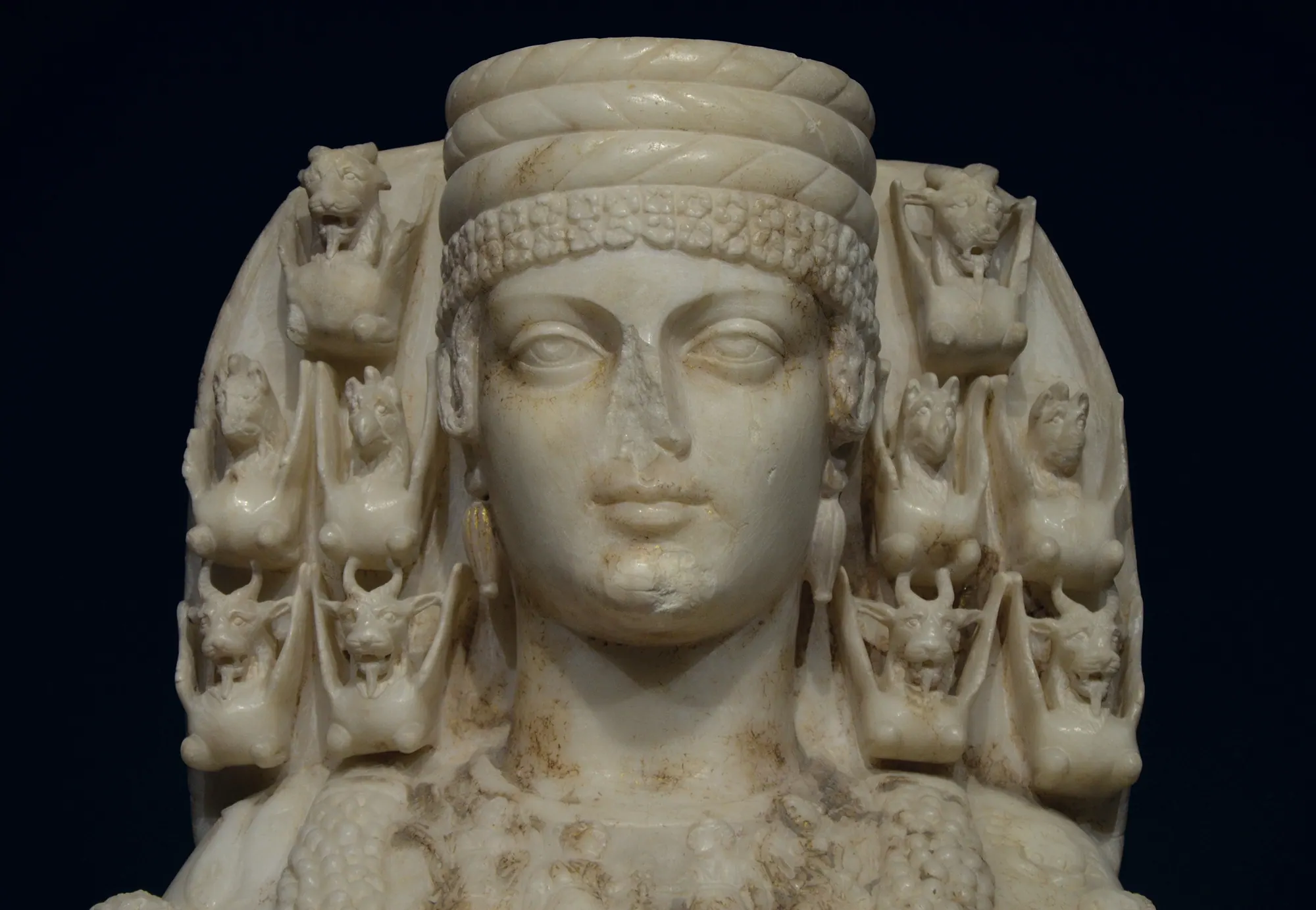
The Artemis worshipped here looked very little like the Greek huntress. She resembles Near Eastern and Anatolian goddesses more closely, and many writers link her to the Anatolian Mother Goddess, whose mural crown she shares, and to an older “Lady of Ephesus” whom the Ionian settlers identified with Artemis; that continuity is an interpretation, not an established fact66. Her cult travelled: the Phocaeans who founded Marseille took an Ephesian priestess and a copy of the cult image with them4. By the 2nd century AD Apuleius could have his hero pray to a goddess worshipped at Ephesus who then reveals herself as Isis67.
The original cult image was wooden. Pliny reports sources that said ebony, but Mucianus, who saw it, said vine wood, never replaced through the temple’s rebuildings and fed with nard through holes to preserve it68. In Acts, the town clerk calls Ephesus keeper of the temple and of the image that fell from heaven, the only evidence that Ephesians claimed a sky-fallen statue69.
The famous copies show rows of oval forms on the goddess’s chest. From late antiquity they were read as many breasts, a reading pushed by Christian writers such as Minucius Felix and Jerome, who called her Diana "multimammia"70. Modern scholars reject that reading or call it unproven, and offer ornaments hung on the wooden statue, the scrota of sacrificed bulls, eggs, amber pendants or simply regalia in its place, none of which has won general agreement71. On some copies the goddess’s skin is dark, like aged wood, while the “breasts” and clothing are another colour, which suggests costume rather than anatomy72.
On the city’s coins she wears a mural crown or a tall polos, with stags and bees beside her73. The bee was the civic badge of Ephesus on its coinage for centuries74, and Pausanias says the goddess’s attendants, who lived in ritual purity for a year, were called Essenes by the Ephesians, a word associated with the "king bee"75.
The statues in the Selçuk museum
The marble Artemis figures in the Ephesus Museum at Selçuk are Roman copies, not the cult image rescued from the fire. Franz Miltner’s Austrian team found them in 1956 in the Prytaneion, the city’s town hall: the Colossal or Great Artemis, the Beautiful Artemis and a smaller one76. The Colossal Artemis is given as 3.20 m tall77. Miltner’s diary records the Beautiful Artemis lying on its back with traces of gilding, probably a work of the 2nd century AD78.
Paul and the riot of the silversmiths
The temple’s economy is the background to the best-known episode of St Paul in Ephesus. Demetrius, a silversmith who made silver shrines of Artemis, roused his fellow craftsmen against Paul’s preaching that gods made by hand are not gods, fearing for both their trade and the goddess’s majesty79. The crowd rushed into the Great Theatre and shouted “Great is Diana of the Ephesians” (Acts 19:28, King James Version) for about two hours, until the town clerk calmed them with a warning that they could be charged with rioting80. Several details fit what is known of Ephesus, including the theatre as a place of assembly, though no silver shrines of the kind described have been found80.

Decline, quarrying and disappearance
The temple was lost slowly, over a century and more, rather than in a single act of destruction. In the 260s AD an earthquake and seaborne Gothic raids hit Ephesus hard81, and Jordanes says the Goths burned the temple of Artemis; the year is given variously as 262/263 or 267/26882. It never recovered its former state. The inner hall seems to have been partly restored, probably under Diocletian, and stayed in use through the 4th century, after which the ruins became a quarry83.
The popular claim that Christians destroyed the temple in AD 401 is not well supported83. Cyril of Alexandria credited John Chrysostom with overthrowing it, but there is little evidence for that either84. What is clear is that the site was abandoned by around 400 and its marble carted away, much of it into the Basilica of St John on Ayasuluk and later the İsa Bey Mosque85. Relief fragments from the Archaic temple have since been recovered from the basilica86.
One often-repeated story is untrue: the columns of Hagia Sophia in Istanbul did not come from the Temple of Artemis. That idea is a medieval legend, and the Byzantinist Cyril Mango called it absurd87. The stripped site sank into the marsh and was lost for centuries88.

Rediscovery: John Turtle Wood’s search
John Turtle Wood, an English architect building stations for the Smyrna–Aydın railway, gave up that work in 1863 to look for the temple, with a British Museum permit and a small allowance in return for rights to the finds89. On the way he uncovered parts of the Great Theatre90. The clue came from an inscription: in February 1866 he found there the Salutaris text describing images carried from the temple through the Magnesian Gate, reasoned that a road from that gate would lead to the temple, found the road in 1867 and followed it91.
He struck the temple on 31 December 1869, some 6 m down9. Wood dug until 1874, when the British Museum stopped paying after its keeper Charles Newton judged more finds unlikely, and he published Discoveries at Ephesus in 187792.
Others followed. The newly begun Austrian excavation worked briefly in the Artemision in May and June 189593, part of the fieldwork that Otto Benndorf of Vienna had proposed in 189394. Hogarth’s British Museum team dug the foundations in 1904–05, and the Austrians returned under Bammer between 1980 and 199421.
Where the finds are now
Finds from the temple are spread across at least four museums in three countries. Those from the older excavations are divided between the British Museum, the Istanbul Archaeological Museums and the Ephesos Museum in Vienna; those from the newer excavations, together with the Roman Artemis statues, are in the Ephesus Museum at Selçuk95. The sculpted column drum is in the British Museum96. Hogarth’s coin originals are in Istanbul, with electrotypes in London23.
Vienna received Ephesus finds only until 1906, and the British Museum’s came mainly from Wood’s and Hogarth’s campaigns97. The museum in Selçuk has a gallery of Artemision finds and another on Artemis and the imperial cult98.

The site today
All that stands is a single column rebuilt from fragments2, in a marshy field10. Entry, going by the Ministry of Culture and Tourism fee lists: not listed in the Ministry tariff10 (checked on ). Prices for the ticketed monuments nearby are kept on tickets and opening hours, and the road and rail approach on getting to Ephesus.
Sources
Each source is listed once. The numbers link back to the claims it supports; dates show when the source was checked.
- anthologiagraeca.org › urn:cts:greekLit:tlg7000.tlg001.ag:9.58 1
- www.livius.org › seven-wonders-of-the-ancient-world 1
- en.wikipedia.org › Temple_of_Artemis 1, 2, 4, 5, 11, 12, 20, 24, 25, 28, 34, 38, 39, 42, 48, 49, 50, 56, 63, 64, 66, 67, 68, 69, 70, 71, 72, 73, 83, 84, 87, 92
- de.wikipedia.org › Tempel_der_Artemis_in_Ephesos 2, 5, 6, 11, 20, 26, 27, 29, 30, 31, 32, 41, 42, 43, 51, 59, 83, 86, 93, 95
- Cartwright 2018 2, 6, 8, 32, 39, 47, 64, 84, 87
- web.archive.org › multiple=1 3
- web.archive.org › 1018 3, 13
- whc.unesco.org › 6387 3
- de.wikipedia.org › Ephesos 3, 14, 18, 81
- en.wikipedia.org › Ephesus 3, 18, 82, 90, 94
- Herodotus 1.26; Pausanias 4.31.8, 7.2.6-8, 8.13.1; Callimachus Hymn 3.237ff; Strabo 4.1.4, 14.1.26 4, 25, 35, 40, 44, 48, 49, 50, 53, 54, 55, 58, 66, 75
- archaeopresspublishing.com › 661 5, 20, 21, 24, 42, 92
- www.austriaca.at › 0xc1aa5576_0x00037510.pdf 5, 11, 20
- Ohnesorg 2007, Der Kroisos-Tempel, Forschungen in Ephesos XII/4, ch. I, ÖAW 6, 8, 9, 12, 31, 43, 86, 92
- Cicero ND 2.69 7, 36
- Plutarch, Alexander 3, Greek 7, 36
- 19 Feb 2023 9, 21, 22, 23, 65, 89, 91
- de.wikipedia.org › John_Turtle_Wood 9, 88, 89, 91, 92
- en.wikipedia.org › John_Turtle_Wood 9, 65, 88, 89, 91, 92
- dosim.ktb.gov.tr › muze-ve-oren-yeri-ucretleri.html 10
- izmir.ktb.gov.tr › izmir-ili-muze-ve-oren-yerleri-giris-ucreti-tarifesi.html 10
- en.wikipedia.org › İsa_Bey_Mosque 10
- Kraft, Brückner, Kayan, Engelmann 2007, Geoarchaeology 22:121-149, doi:10.1002/gea.20151 13, 14, 15, 82, 85
- Stock, Pint, Horejs, Ladstätter, Brückner 2013, Quaternary International 312:57-69 13, 15
- www.oeaw.ac.at › ephesos-bio-geo-archive 13
- Strabo 14.1, Loeb tr. 14, 15, 19, 35, 39, 40, 41, 44, 53, 58
- web.archive.org › Ephesus 15, 81
- web.archive.org › prehellenistic-ephesos.html 15
- austriaca.at › 0xc1aa5576_0x001c9934.pdf 15, 81
- www.oeaw.ac.at › ephesos-pre-hellenistic-settlement-history 15
- www.theoi.com › Pausanias1A.html 15
- turkisharchaeonews.net › curetes-street-ephesus 16
- de.wikipedia.org › Kuretenstraße 16
- os.pennds.org › 2006_160_2-3_KanzGrossschmidt.pdf 17
- journals.plos.org › article 17
- www.livius.org › ephesus 18, 94
- en.wikipedia.org › Callinus 19
- www.academia.edu › Electrum_Coins_and_Their_Archaeological_Context_The_Case_of_ 21, 24
- Robinson 1951, JHS 71:156-167 22, 23
- Pliny NH 36.95-97, Bostock-Riley tr. 26, 27, 47
- Vitruvius 7.praef.16 28, 30
- Vitruvius 10.2.11-15 29
- Graham, rev. 8 Dec 2023 33
- Diogenes Laertius 9.1-6, Hicks tr. 33, 34
- Valerius Maximus 8.14.ext.5, Latin 37
- en.wikipedia.org › Herostratus 37, 38
- etheses.bham.ac.uk › Leger15PhD_Redacted.pdf 38, 42, 65, 67, 83, 88
- web.archive.org › G_1872-0803-9 45
- www.britishmuseum.org › G_1872-0803-9 45, 96
- museum.classics.cam.ac.uk › sculptured-column-drum-ephesus 45, 46, 96
- British Museum object text 45, 46
- Pliny NH 34.53 51
- en.wikipedia.org › Amazon_statue_types 51
- www.getty.edu › 1-plattner-gschwantler-vak 52
- www.khm.at › ephesos-museum 52, 97
- en.wikipedia.org › Ephesos_Museum 52, 97
- Tacitus Annals 3.60-61 53, 54, 55
- Dio Chrysostom Or. 31.54-55 56
- Xenophon Anabasis 5.3.4-13 57
- www.theoi.com › ArtemisCult2.html 57
- en.wikipedia.org › Arsinoe_IV 59, 61
- www.worldhistory.org › Arsinoe_IV 59, 60, 61, 62
- Appian BC 5.9 60, 61
- reporting Weber et al., Scientific Reports, Jan 2025 62
- www.nature.com › s41598-024-83870-x 62
- archive.org › bim_eighteenth-century_xenophons-ephesian-hist_xenophon-of-e 63
- www.loebclassics.com › pb_LCL069.201.xml 63, 67
- en.wikipedia.org › Xenophon_of_Ephesus 63
- archive.org › cu31924008628301_djvu.txt 65, 92
- www.cambridge.org › 7A700C9DE0BB71BAEE159CF16C370D54 65
- LiDonnici 1992, HTR 85:389-411 66, 70, 71, 72
- tr.wikipedia.org › Efes_Müzesi 66, 78
- www.gutenberg.org › pg1666.txt 67
- Pliny NH 16.213-215 68
- Acts 19:23-41 69, 79, 80
- turkisharchaeonews.net › ephesus-museum-selçuk 71, 76, 78, 95
- de.wikipedia.org › Ephesos-Museum_Selçuk 71, 76, 77, 78
- Markowitz 2019 73, 74, 75
- Macquarie Univ., The Coinage of Ephesus 73, 74
- austriaca.at › 0xc1aa5576_0x0022b560.pdf 76, 78
- turkisharchaeonews.net › public-buildings-north-state-agora-ephesus 77
- de.wikipedia.org › Prytaneion_von_Ephesos 77
- tr.wikipedia.org › Efes 77
- en.wikipedia.org › Riot_of_the_Ephesian_silversmiths 79, 80
- web.archive.org › hanghaus-2-marmorsaal.html 81
- en.wikipedia.org › 262_Southwest_Anatolia_earthquake 81, 82
- fr.wikipedia.org › Éphèse 81
- www.worldhistory.org › ephesos 82, 85
- web.archive.org › Temple-of-Artemis-temple-Ephesus-Turkey 83
- it.wikipedia.org › Efeso 85
- www.oeaw.ac.at › Forschungsgeschichte_Ephesos.pdf 90, 94
- turkisharchaeonews.net › temple-artemis-ephesus 93
- en.wikipedia.org › Ephesus_Archaeological_Museum 97, 98
- muze.gov.tr › muze-detay 98