Most mistakes about Ephesus are not inventions. They are older findings the excavators have since revised, traditions retold as history, or one scholar’s estimate copied until it hardened into a single number. No book or website is named here, because what matters is the evidence rather than who repeated the mistake. Every correction rests on at least two independent publishers, listed in the sources at the foot of the page, under the site’s sourcing rules.
A correction is not always a new certainty. Where specialists still disagree, the answer below is a range or an open question.
The Great Theatre and the lower city
How many people did the Great Theatre hold?
About 20,000, if the excavators’ own figure is followed. Officials and many guides still give 24,000, and 25,000 is common too1. The excavators’ estimate describes the building after its Roman enlargement, when the auditorium was nearly 150 m across, which put the Great Theatre among the biggest in Roman Asia Minor2. It has no need of an inflated seat count.
Did Lysimachus build the theatre?
Probably not, on current excavation evidence. The Austrian publication puts the start of work between about 175 and 150 BC3, more than a century after Lysimachus fell at Corupedium in 281 BC4. The three-storey marble stage building, once thought to have reached its full height only in the 2nd century AD, is now dated by its building inscription to AD 855, and the excavators separate eight phases of construction and use, running from the Hellenistic period into Byzantine times6.
Did St Paul preach in the Great Theatre?
Not according to Acts. In its account of the silversmiths’ riot, the mob dragged Paul’s companions Gaius and Aristarchus into the theatre and chanted for Artemis for some two hours, while the disciples and some friendly Asiarchs kept Paul himself away, until the town clerk sent everyone home7. The theatre of that story is identified with the one whose remains stand today8, so the building is right. The sermon is not in the text.
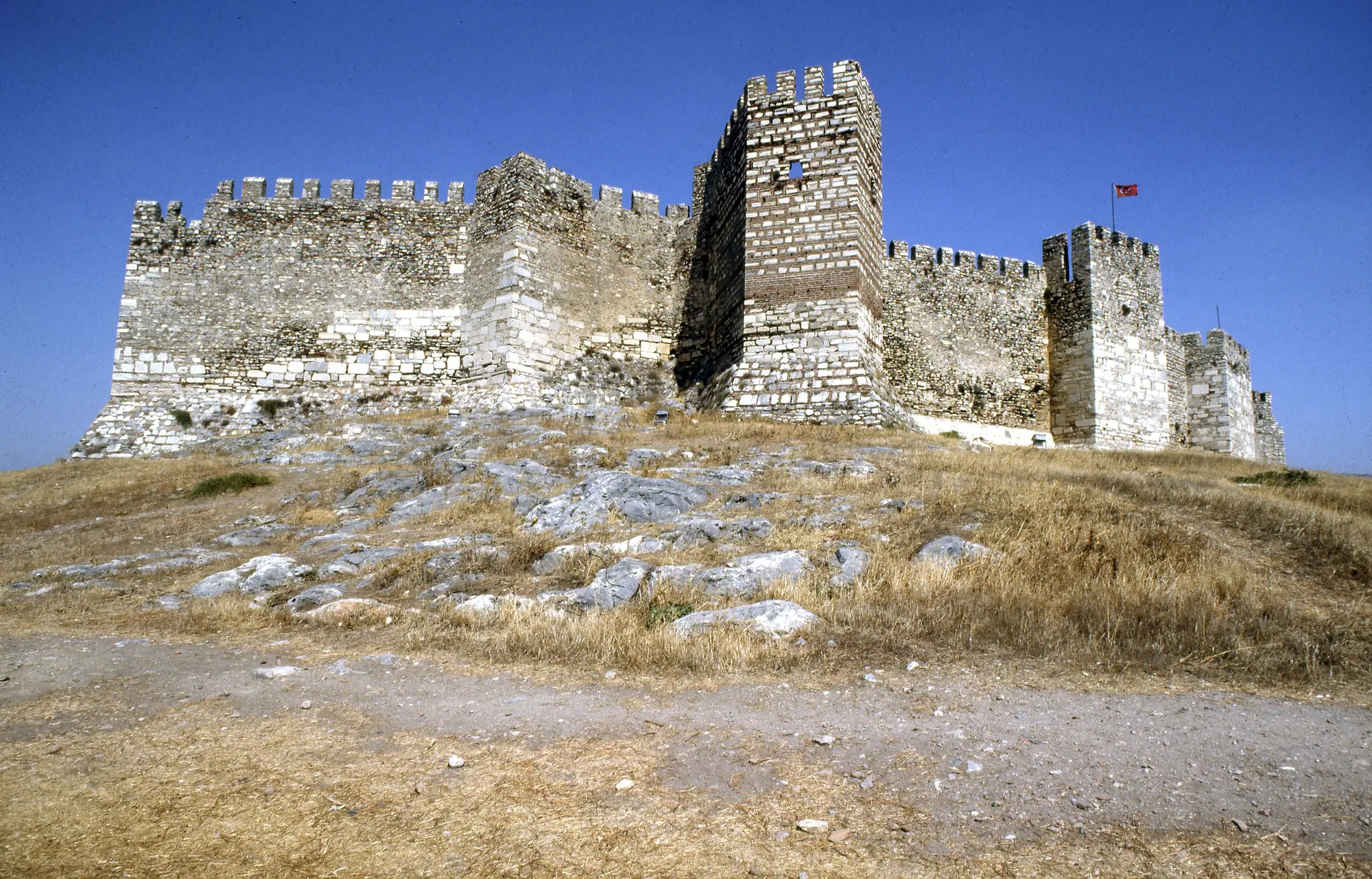
Was Paul held in “St Paul’s Prison”?
Nothing supports it. The structure that carries the name is a tower from the Hellenistic walls, standing on a hill near the old harbour9. Acts never mentions Paul being locked up in Ephesus, no ancient or archaeological evidence connects him with the tower, and the tale that he was held there before being shipped to Rome contradicts Acts, which starts that voyage at Caesarea10.
A genuine scholarly argument lies behind the legend, though it is a different one. Some scholars hold that Paul was imprisoned somewhere in Ephesus and wrote Philippians or Philemon there, while most still favour Rome11. Even if that is right, it gives no reason to point at this tower12.
Is the carving on Marble Street the first advertisement in history?
No one has shown that it is. The carving in the pavement, with a foot and a woman’s head among its shapes, is often billed as the world’s first advertisement and a pointer to a brothel. What it meant is uncertain, and the “first advertisement” label has no support1314.
Was the building by the public latrine a brothel?
Very probably not. Franz Miltner put forward the brothel idea in 1957 on the strength of the inscription from the latrine next door15. Werner Jobst looked again and concluded in 1976/77 that a public brothel could not have stood there16. A survey of the building in 2000–2001 then revealed a peristyle house of about 742.5 m², later extended to 879.5 m² with a vaulted suite for receiving guests and an apsidal dining hall with a mosaic floor, and in the end divided into workshops17. A small figure of Priapus or Bes found nearby is often produced as evidence, but such figures are ordinary finds in private houses18.
When was the gladiator cemetery found?
In 1993, during survey work for the processional road from the Artemision, about 300 m east of the stadium; the gladiators’ tombstones found in place date to around AD 20019. Only some 20 m² was dug, yet the layer of bones went down 3 m and contained at least 68 people, nearly all of them men between 20 and 3020.

The Library of Celsus and the upper city
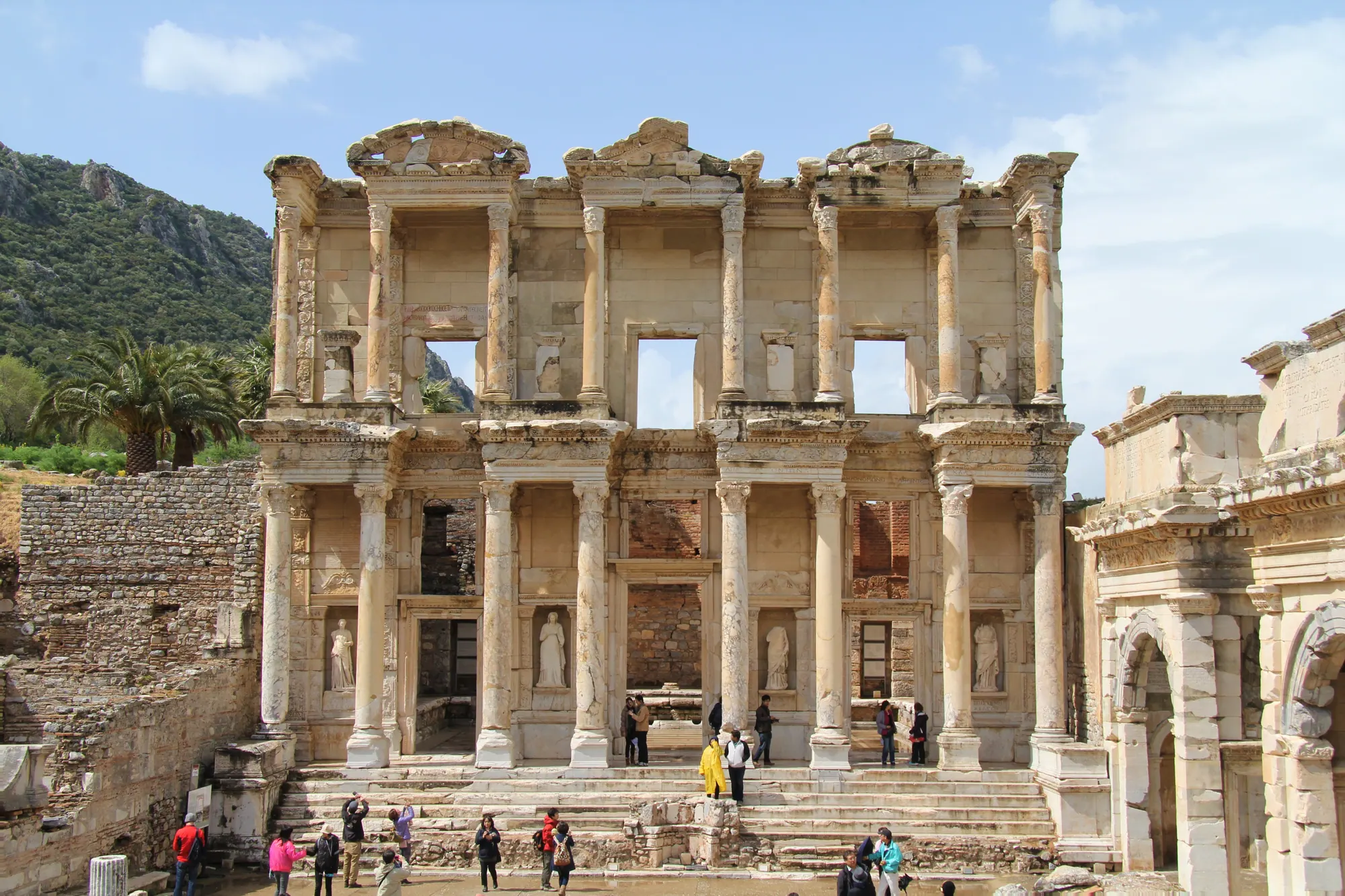
Was the Library of Celsus moved to Vienna?
The façade of the Library of Celsus never left Ephesus. It stands on its original foundations and was reassembled there between 1970 and 197821. Vienna received the four statues of virtues from its niches and some architectural pieces, a segmental pediment among them, and copies have taken their place22. They could leave because Sultan Abdülhamid II made a gift of part of the finds to Emperor Franz Joseph I23.
A Roman monument from Anatolia really was taken to a European museum, just not this one: the Market Gate of Miletus, excavated by German archaeologists and rebuilt inside the Pergamon Museum in Berlin24.
Did the Goths destroy the library?
That is the traditional story, and it now has a rival. The interior is usually said to have burned around AD 262, and whether an earthquake or the Gothic raid caused it is disputed25. The Austrian team’s current view is that an earthquake around AD 270 did the damage, and that the library was then abandoned26.
How many scrolls did the library hold?
The best estimates fall between about 10,000 and 16,000 rolls, and several are worked out by counting the book cupboards built into the walls27. That made it a large library, though far from the largest in the ancient world, where the leaders held several hundred thousand rolls28.
Were Mazaeus and Mithridates slaves?
They had been, but by the time they built their gate both were freedmen, Mazaeus freed by Augustus and Mithridates by Agrippa29. The Latin inscription on the triple gate beside the library honours Augustus, Livia, Marcus Agrippa and Julia as the pair’s patrons30. Augustus’s titles in that text are what fix the date at 4/3 BC31.
Is the Magnesian Gate part of Lysimachus’s walls?
The walls along the crest of Bülbüldağ are his32, but the gate is not. Excavations in 2008–09 showed that it went up only around 100 BC, well after his early Hellenistic defences33.
Was there a Temple of Isis on the State Agora?
It is far from certain. The small temple at the centre of the agora carried the Isis label for decades, but scholars now lean towards an Augustan sanctuary, perhaps for the deified Julius Caesar and Roma, perhaps for Augustus34.
Is the Temple of Hadrian really a temple of Hadrian?
The name is less secure than the building’s fame. Varius’s dedication couples the emperor with Artemis and the Ephesian people35, and whether the building served Hadrian’s cult is questioned; many scholars look for that temple elsewhere in the city36.
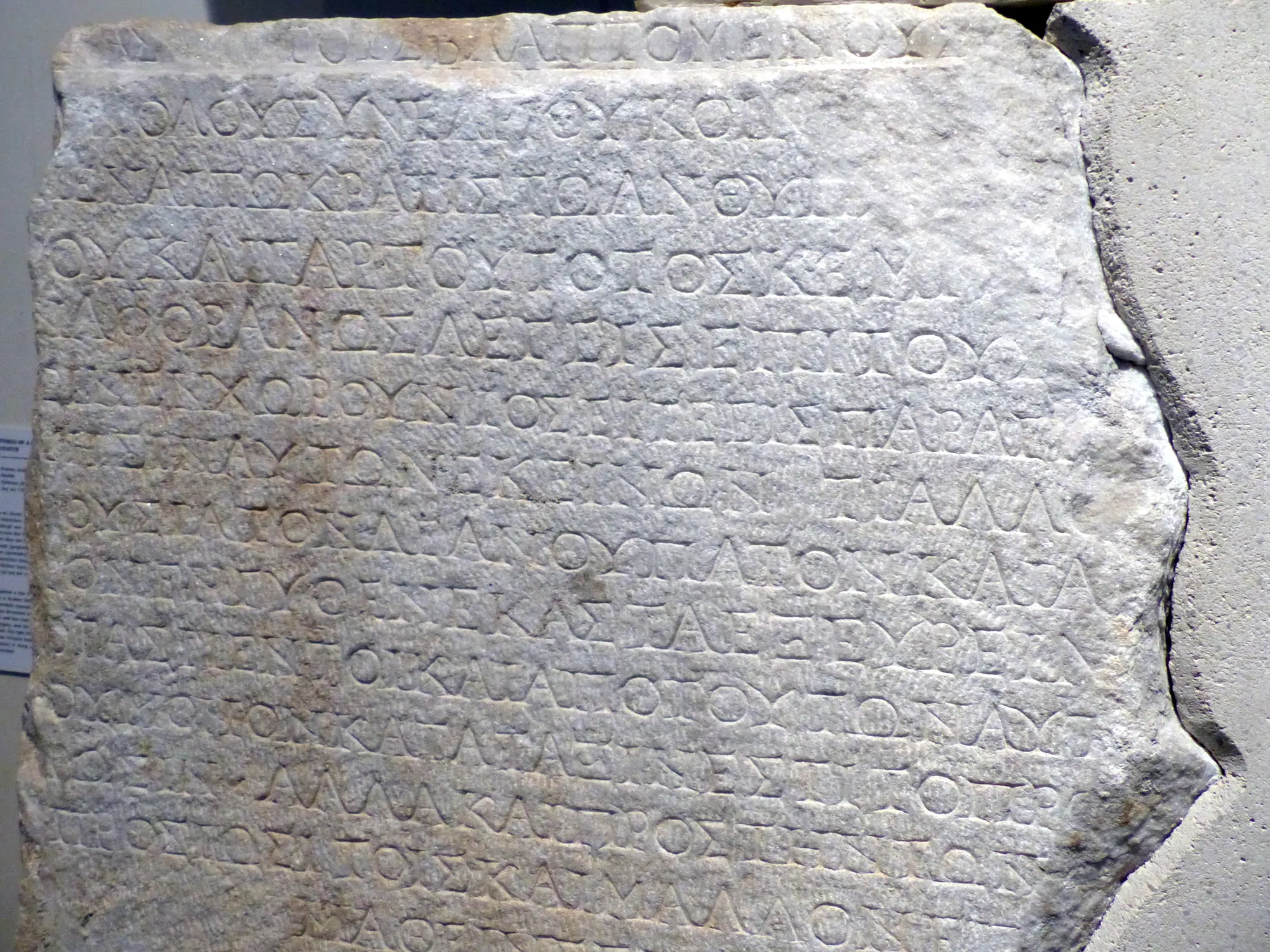
The well-known frieze of Androclus hunting the boar is not Hadrianic either. It was carved in the 3rd or 4th century, and some of it was probably brought from another building after an earthquake in the 4th century37. What stands on the Temple of Hadrian today are casts; the original slabs are in the Ephesus Museum at Selçuk38.
Are the Scholastica Baths and the Varius Baths two buildings?
They are one building under two names. Publius Quintilius Valens Varius built it at the end of the 1st century or the start of the 2nd, and two or three centuries later a Christian woman called Scholastica paid for its renovation39.
Was the Octagon the tomb of Cleopatra’s sister?
A DNA study published in 2025 says it was not. In 1990 the archaeologist Hilke Thür suggested that the eight-sided tomb on Curetes Street was that of Arsinoe IV, Cleopatra VII’s younger sister, killed in 41 BC on Mark Antony’s orders40. The new study detected a Y chromosome in both skull and thigh bone, so the person was male41: a boy aged 11 to 14, radiocarbon-dated to 205–36 BC, with severe developmental disorders42. On that evidence the authors exclude Arsinoe. Why a Roman boy was given such a conspicuous, Egyptian-looking tomb is still a puzzle43.
Was the Octagon skull lost in the Second World War?
It was never lost, though the wartime story still circulates. Keil and Theuer opened the burial chamber in 1929 and found a complete skeleton lying in a sarcophagus full of water44. Keil kept only the skull and took it first to Greifswald, then to Vienna45. There it stayed, in the University of Vienna’s anthropology collection catalogued as “Skull from Ephesus”, until it was recognised in December 202246. The remainder of the skeleton turned up in 1982, scattered in a niche of the antechamber47.
How many houses are in Terrace House 2?
Seven residential units, although there were six when the block was first built48. Each unit is a peristyle house over three terraces48, and the Terrace Houses block as a whole takes up about 4,000 m² of hillside above Curetes Street49.
When did finds from Ephesus stop going to Vienna?
In 1906, not 1923 as at least one major reference work still says50. Seven consignments reached Vienna between 1896/97 and 1906; after that the Ottoman antiquities law of 1906/07 prohibited export51. Whether that law belongs to 1906 or 1907 depends on the source52.

Artemis and her temple
Did columns from the Temple of Artemis end up in Hagia Sophia?
No. That story is a legend of the Middle Ages, and Cyril Mango, the historian of Byzantium, dismissed it as absurd53. Stone from the Temple of Artemis did travel, but only a short way: pieces of relief from the Archaic temple have come out of the walls of the Basilica of St John54, and once the sanctuary was abandoned around AD 400 its marble was quarried55.
Are the Artemis statues in Selçuk the cult statue saved from the fire?
Both are Roman works in marble, dug up by Franz Miltner’s team in 1956 inside the Prytaneion, the town hall56. The Colossal Artemis is dated to the 1st century AD, or to Trajan’s reign in some studies57, and the Beautiful Artemis to the 2nd century AD58. The cult image they imitate was made of wood59.
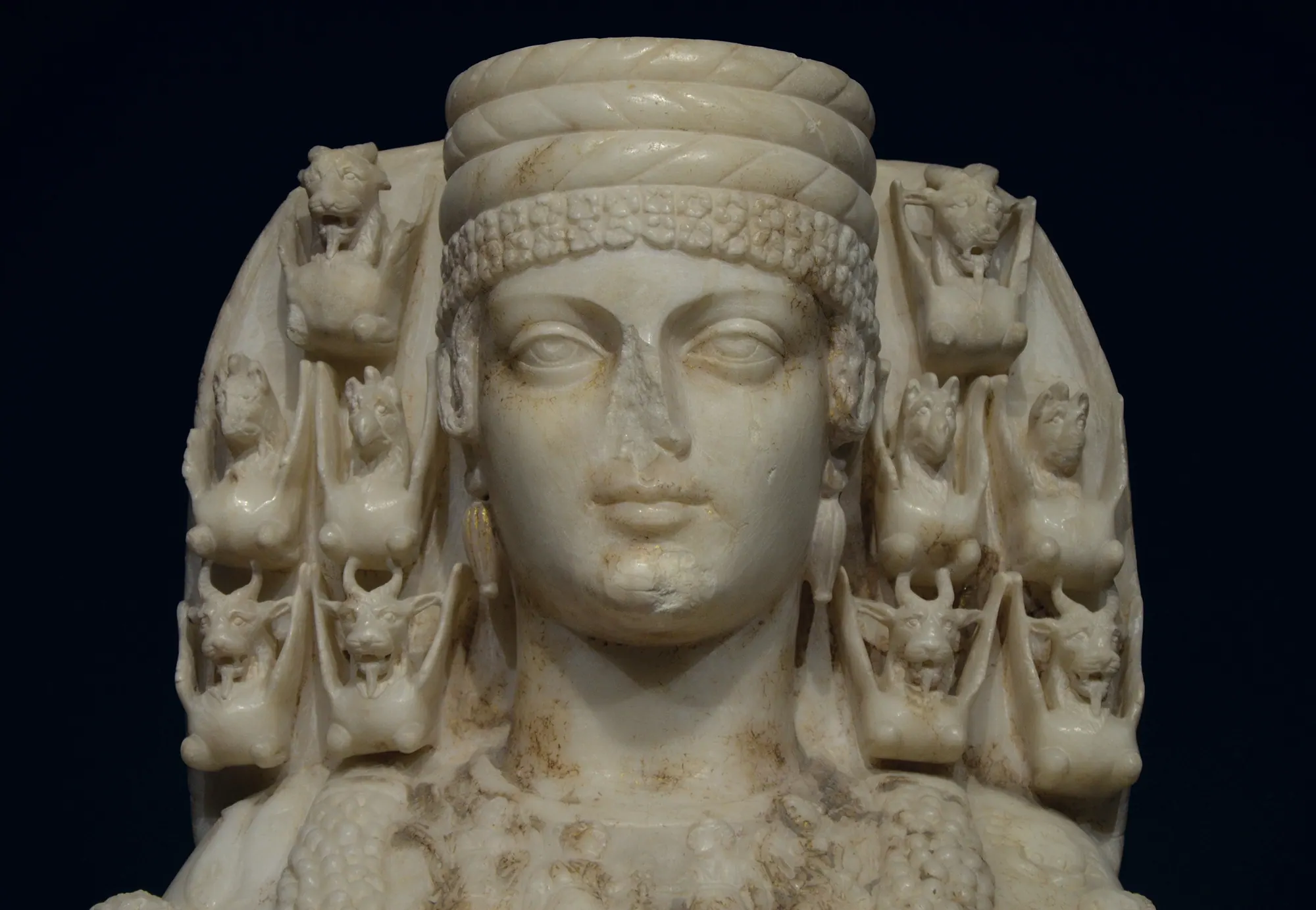
Is Artemis of Ephesus shown with many breasts?
That reading is old, but it is not the consensus. The egg-shaped bulges across her chest have been taken for breasts since late antiquity, an idea promoted by Christian writers hostile to her cult, Minucius Felix and Jerome among them60. Modern scholars reject it or call it unproven, and offer instead ornaments attached to the wooden statue, the scrota of sacrificial bulls, eggs, amber pendants, or plain regalia61. Some copies paint the goddess’s skin dark, like old wood, and give the bulges and her dress another colour, which points to costume, not anatomy62.
Did the temple have 127 columns?
That is Pliny’s figure, and no reconstruction has made it work. He gives a temple of 425 by 225 feet, with 127 columns each 60 feet tall63. Modern plans range from 100 to 117 columns, and a 2007 study argues that the ground plan could hold 109 at most64.
Is the column standing on the temple site original?
Its stones are ancient; the column is not. The lone shaft on the site was put together from assorted fragments found there, and its drums come from more than one column65.
Did the temple burn down on 21 July 356 BC?
The year is secure; the exact day is not. Herostratus set fire to the temple in 356 BC in search of fame66. Ancient authors linked the fire to the day, or the night, of Alexander the Great’s birth67, so any calendar date for the blaze rests on that tradition, not on a record of the fire.
Did Herostratus act alone?
Possibly not, and some doubt he acted at all. Modern scholars note that an arsonist would have had to reach the timber roof, and one has proposed that the temple’s own managers, knowing the foundations were subsiding, may have wanted the building gone and let Herostratus take the blame68.
Did Heraclitus say “you cannot step into the same river twice”?
Not in those words. The famous version is Plato’s paraphrase. The fragment most scholars accept as authentic says that on those who step into the same rivers, ever-different waters flow69.
History and the moving city
Did Roman Ephesus have 250,000 inhabitants?
That is the upper end of a very wide range. Recent density models give roughly 34,000 to 72,000, older works 200,000 to 250,00070, a figure inherited from earlier scholarship71. Along the way T. R. S. Broughton proposed a ceiling of 225,00072, Jerome Murphy-O’Connor 138,000 to 172,50073, and J. W. Hanson, working from density, 33,600 to 56,00074; a 2017 model by Hanson, Ortman and Lobo arrives at about 71,60075.
The claim that Ephesus was the Empire’s fourth city is a modern cliché. What the evidence allows is a place among the five largest by the 2nd century AD, with Rome, Alexandria, Antioch and Carthage76.
When did Lysimachus refound Ephesus?
Sometime in the early 3rd century BC, one of the turning points in the history of Ephesus. He first took the city in 301/300 BC but seems to have controlled it firmly only between 287 BC and his death in 281 BC77. For a while it bore the name Arsinoeia, after his queen Arsinoe II, and the new name died with him4.
Did the earthquake of AD 17 destroy Ephesus?
Tacitus does not say so. He lists the twelve cities of Asia brought down by the night-time earthquake of AD 17, and Ephesus is not one of them78. Ephesus is, however, named on a base erected at Puteoli around AD 30 in thanks to Tiberius for his help, next to Cibyra, which suffered in AD 2378.
Was Ephesus the capital of Roman Asia?
The governor was based there, but “capital” oversimplifies. Whether Ephesus formally took over from Pergamon is debated, since the proconsul came ashore at Ephesus and then travelled round the province’s court towns79.
Is the İsa Bey Mosque a Seljuk building?
It is Aydınid. The inscription above its west door records that it was built in March 1375 for İsa Bey of the Aydınid dynasty by an architect from Damascus, Ali ibn Mushaimish80. By then Ayasuluk was an Aydınid capital and a port trading with Venice and Genoa81.
When did the Turks take Ephesus?
The Seljuks held it briefly from 1090 until the Byzantines won it back in 1096/9782. The lasting change came in October 1304, when the town gave itself up to Sasa Bey and his Aydınid allies83.
Who was buried in the Belevi Mausoleum?
The occupant is unknown, and the old favourites are no longer the front runners. The Austrian Archaeological Institute’s final study dates the tomb to 310–280/270 BC and suggests it was meant for Antigonus I Monophthalmus; earlier candidates include Lysimachus and the Seleucid king Antiochus II84.
Christian traditions
The corrections in this section concern what the texts and the excavations show. They make no judgement on faith, and each tradition is described as a tradition, with its own history.
Does the Bible say that Mary lived in Ephesus?
It does not. In John’s Gospel, Jesus on the cross places his mother in the care of the beloved disciple, who takes her into his home, and that passage underlies the belief that Mary went with John85. Nor does the New Testament place John at Ephesus; that tradition appears in the late 2nd century86. In the 4th century Epiphanius of Salamis was already pointing out that Scripture takes John to Asia without saying that Mary went too87.
No early church writer puts Mary at Ephesus. The idea surfaces among Syriac authors of the 8th and 9th centuries, whereas a tradition both older and much more widespread locates her death and burial in Jerusalem88. Early Byzantine pilgrims came to Ephesus for John’s tomb, not for any place linked to Mary89.
Has the Catholic Church declared the House of the Virgin Mary authentic?
No. The Church has never pronounced on whether Mary lived or died at the house, while allowing and encouraging pilgrimage to it90. The first pilgrimage received Leo XIII’s blessing in 1896; Pius XII recognised the site as a place of pilgrimage in 1951, and in 1961 John XXIII attached a permanent plenary indulgence91.
The identification goes back to the visions of the German Augustinian nun Anne Catherine Emmerich, recorded by the poet Clemens Brentano92. Adriano Prandi, an Italian archaeologist, dated the chapel to the 13th century and placed it over an older structure, whereas earlier investigators had suggested the 5th to 7th century93. Christians pray at the House of the Virgin Mary, and so do Muslims, for whom Maryam is honoured as the mother of Isa94.
When did the popes visit Ephesus?
Three popes have come. Paul VI visited Ephesus and the House of Mary on 26 July 196795. John Paul II said Mass at the house on 30 November 197996, and Benedict XVI on 29 November 200697. Leo XIV’s visit to Turkey in November 2025 left Ephesus out98.
How many church councils met at Ephesus?
Two. The first, called by Emperor Theodosius II, opened on 22 June 431 and is counted as the Third Ecumenical Council99; it deposed Nestorius and confirmed Mary’s title Theotokos, "God-bearer"100. The second met in 449101. Pope Leo I branded it a “robber synod” and the Council of Chalcedon cancelled its decisions in 451, though the Oriental Orthodox churches still accept it102.
Did the council of 431 meet in the Church of Mary?
Tradition says so, but the question is open. Recent excavation results suggest that the hall of the Church of Mary, one of the landmarks of sacred Ephesus, was turned into a church for the council itself, and that a dedication to Mary cannot be earlier than about AD 500103.
Is the Gate of Persecution named after Christian martyrs?
Only through a misreading. The fortified entrance to the St John precinct owes its name to 18th-century travellers who mistook its reused Roman reliefs, scenes from the Trojan War, for the torments of Christian martyrs104.
Was the Letter to the Ephesians written to the church in Ephesus?
Not necessarily. The oldest and most reliable manuscripts lack the words “in Ephesus”, and the letter greets nobody by name, so it reads more like a circular for several congregations105. Who wrote it is also argued over: it carries Paul’s name, but many critical scholars doubt that he was the author106. The one letter certainly addressed to the city’s Christians is in Revelation, and the church of Ephesus receives both praise and rebuke there107.
Is the cave of the Seven Sleepers at Ephesus the cave in the Qur’an?
That depends on whose tradition you follow. Christians took the Ephesus site as theirs, but most Muslims locate the cave of the Qur’an at Tarsus or Afşin; al-Raqim near Amman, Damascus and Nakhchivan have their own claims108. The Qur’an itself leaves the number of sleepers open, reporting guesses of three, five or seven, with their dog, and saying that God knows best109.

Where these corrections come from
Each answer above draws on the same fact register as the rest of the site, and the numbered sources beside each claim lead to the publications behind it: excavation reports, museum catalogues, ancient authors, Church documents and official records. When new work changes the picture, as the 2025 study of the Octagon did, the correction here changes with it. Anyone who thinks one of these answers is itself wrong can report it through the corrections form.
Report a mistake
Tell us what is wrong and on which page, with a source if you have one. We check every report against the sources in the register and reply to you.
Sources
Each source is listed once. The numbers link back to the claims it supports; dates show when the source was checked.
- www.aa.com.tr › 2333476 1, 3
- www.archaeologie-online.de › baugeschichte-des-theaters-von-ephesos-rekonstruiert-5399 1, 2, 6
- web.archive.org › theater.html 1
- austriaca.at › 7590-2 1, 3, 5, 6
- turkisharchaeonews.net › great-theatre-ephesus 1, 2, 5
- en.wikipedia.org › Ephesus 1, 4, 7, 37, 38, 66, 70, 72, 73, 74, 75, 76, 77, 79, 80, 81, 82, 83
- austriaca.at › 8268-9 2
- www.worldhistory.org › ephesos 3, 55, 66, 78
- Kraft, Brückner, Kayan, Engelmann 2007, Geoarchaeology 22:121-149, doi:10.1002/gea.20151 4, 32, 55, 71, 77
- Strabo 14.1, Loeb tr. 4, 66
- Macquarie Univ., The Coinage of Ephesus 4
- www.biblegateway.com › passage 7, 12
- de.wikipedia.org › Ephesos 7, 32, 39, 51, 70, 71, 77, 82
- www.newadvent.org › 05490a.htm 8, 86, 105, 106
- en.wikipedia.org › Acts_19 8
- www.bestephesustours.com › the-city-walls-of-ephesus-magnesia-gate.html 9
- www.viaurbis.com › the-hellenistic-city-wall 9
- bible-api.com › acts+19 10
- etsjets.org › files_JETS-PDFs_61_61-3_JETS_61.3_549-558_White.pdf 10, 11
- de.wikipedia.org › Marienkirche_(Ephesos) 11, 12, 103
- www.livius.org › ephesus-marble-street 13
- www.theephesus.com › brothel-of-ephesus 13, 15, 16, 17, 18
- api.openalex.org 14, 51
- www.austriaca.at › 0xc1aa5576 0x00043046.pdf 15, 16, 17
- muze.gov.tr › muze-detay 18
- muze.gov.tr › muze-detay 18
- os.pennds.org › 2006_160_2-3_KanzGrossschmidt.pdf 19, 20
- journals.plos.org › article 19, 71
- pubmed.ncbi.nlm.nih.gov › 16289900 20
- www.oeaw.ac.at › preserving-world-cultural-heritage-austrian-researchers-star 21, 22, 26, 27
- freidok.uni-freiburg.de › Hueber_Strocka_Die_Bibliothek_des_Celsus.pdf 21, 27, 28
- www.khm.at › arete-kelsou-51900 22
- www.khm.at › celsusbibliothek-segmentgiebel-50740 22
- turkisharchaeonews.net › library-celsus-ephesus 22
- www.khm.at › ephesos-museum 23, 52
- turkisharchaeonews.net › treasures-ephesus-ephesos-museum-vienna 23
- www.geschichtewiki.wien.gv.at › Ephesos_Museum 23, 52
- en.wikipedia.org › Ephesos_Museum 23, 50, 51, 52
- www.smb.museum › sammlung 24
- www.smb.museum › sammlung 24
- en.wikipedia.org › Market_Gate_of_Miletus 24
- de.wikipedia.org › Celsus-Bibliothek 25, 27, 28
- en.wikipedia.org › 262_Southwest_Anatolia_earthquake 25, 26
- en.wikipedia.org › Library_of_Celsus 25, 27
- www.worldhistory.org › Library_of_Celsus 25, 27
- www.livius.org › ephesus-gate-of-mazaeus-and-mithridates-inscription-1 29, 30, 31
- www.livius.org › ephesus-gate-of-mazaeus-and-mithridates-inscription-3 29
- www.livius.org › ephesus-marble-street-inscription-of-mithradates 29
- turkisharchaeonews.net › gate-mazaeus-and-mithridates-ephesus 29, 30
- en.wikipedia.org › Marcus_Vipsanius_Agrippa 31
- web.archive.org › magnesian-gate.html 33
- turkisharchaeonews.net › magnesian-gate-area-ephesus 33
- doi.org › hist.2020.848 34
- www.austriaca.at › 0xc1aa5576_0x00185c50.pdf 34
- turkisharchaeonews.net › public-buildings-north-state-agora-ephesus 34
- turkisharchaeonews.net › state-agora-ephesus 34
- www.turkishmuseums.com › 1 35
- turkisharchaeonews.net › temple-hadrian-ephesus 35, 36, 37, 38
- de.wikipedia.org › Hadrianstempel_(Ephesos) 35, 36, 37, 38, 39
- de.wikipedia.org › Ephesos-Museum_Selçuk 38, 52, 56, 57, 58, 61
- turkisharchaeonews.net › scholastica-baths-ephesus 39
- www.oeaw.ac.at › cleopatras-sister-remains-missing-1 40, 41, 42, 43, 44, 45, 46, 47
- turkisharchaeonews.net › octagon-ephesus 40, 44
- de.wikipedia.org › Kuretenstraße 40
- en.wikipedia.org › Arsinoe_IV 40
- pmc.ncbi.nlm.nih.gov › PMC11723936 41, 42, 43, 44, 45, 46, 47
- www.oeaw.ac.at › forschungen-in-ephesos 48
- www.petersommer.com › ephesus-terrace-house-2 48, 49
- de.wikipedia.org › Hanghäuser_von_Ephesos 48, 49
- www.oeaw.ac.at › research-history 49
- www.khm.at › ephesos-museum 50, 51
- en.wikipedia.org › Ephesus_Archaeological_Museum 50
- web.archive.org › index.php 51
- en.wikipedia.org › Temple_of_Artemis 53, 59, 60, 61, 62, 65, 68, 69
- Cartwright 2018 53, 63, 64, 65
- Ohnesorg 2007, Der Kroisos-Tempel, Forschungen in Ephesos XII/4, ch. I, ÖAW 54, 64
- de.wikipedia.org › Tempel_der_Artemis_in_Ephesos 54, 65
- it.wikipedia.org › Efeso 55, 71
- austriaca.at › 0xc1aa5576_0x0022b560.pdf 56, 57, 58
- turkisharchaeonews.net › ephesus-museum-selçuk 56, 57, 58, 61
- tr.wikipedia.org › Efes_Müzesi 58
- Pliny NH 16.213-215 59
- LiDonnici 1992, HTR 85:389-411 60, 61, 62
- Pliny NH 36.95-97, Bostock-Riley tr. 63
- Cicero ND 2.69 67
- Plutarch, Alexander 3, Greek 67
- etheses.bham.ac.uk › Leger15PhD_Redacted.pdf 68
- en.wikipedia.org › Herostratus 68
- Graham, rev. 8 Dec 2023 69
- www.cambridge.org › div-class-title-urban-form-infrastructure-and-spatial-organi 71
- fr.wikipedia.org › Éphèse 71
- Hanson & Ortman 2017, JRA 30:301-324 72, 73, 74, 75, 76
- www.ebi.ac.uk › fullTextXML 75
- api.figshare.com › 5576680 75
- Stock, Pint, Horejs, Ladstätter, Brückner 2013, Quaternary International 312:57-69 77
- web.archive.org › Ephesus 77, 79, 80
- web.archive.org › prehellenistic-ephesos.html 77
- www.britannica.com › Ephesus 77
- www.livius.org › ephesus 77, 79
- austriaca.at › 0xc1aa5576_0x001c9934.pdf 77
- en.wikipedia.org › Arsinoe_II 77
- en.wikipedia.org › Lysimachus 77
- crossworks.holycross.edu › viewcontent.cgi 78
- penelope.uchicago.edu › 2C*.html 78
- www.ostia-antica.org › puteoli-imperial-cult.htm 78
- www.oxfordreference.com › authority.20110803095428649 79
- en.wikipedia.org › Asia_(Roman_province) 79
- islamansiklopedisi.org.tr › ayasuluk 80
- islamansiklopedisi.org.tr › isa-bey-camii--izmir 80
- turkisharchaeonews.net › selçuk 80
- en.wikipedia.org › İsa_Bey_Mosque 80
- www.blueguides.com › the-shifting-fortunes-of-ephesus-its-rise-and-fall-and-rise 81
- en.wikipedia.org › Aydinids 81, 83
- www.thebyzantinelegacy.com › ephesus 82, 83
- en.wikipedia.org › John_Doukas_(megas_doux) 82
- austriaca.at › 7758-6 84
- de.wikipedia.org › Mausoleum_von_Belevi 84
- en.wikipedia.org › Belevi_Mausoleum 84
- bible-api.com › john+19:25-27 85
- www.vatican.va › hf_ben-xvi_hom_20061129_ephesus.html 85, 96, 97
- web.archive.org › Saint-John-the-Apostle 86
- www.newadvent.org › 0103303.htm 86
- www.newadvent.org › 250105.htm 86
- www.austriaca.at › 0xc1aa5572 0x0014a7d8.pdf 87, 88, 89, 90, 91, 92, 93, 94
- de.wikipedia.org › Haus_der_Mutter_Maria 87, 88, 91, 93, 94
- en.wikipedia.org › Tomb_of_the_Virgin_Mary 88
- en.wikipedia.org › Basilica_of_St._John 89
- en.wikipedia.org › House_of_the_Virgin_Mary 90, 91, 95, 97
- fr.wikipedia.org › Maison_de_la_Vierge_Marie 90, 93
- en.wikipedia.org › Anne_Catherine_Emmerich 92
- www.hzmeryemanaevi.com › en 94
- www.vatican.va › hf_p-vi_spe_19670726_fedeli-efeso.html 95
- www.vatican.va › pontificato_gp2_en.html 96
- www.vatican.va › hf_jp-ii_hom_19791130_turkey-efeso.html 96
- www.hzmeryemanaevi.com › papa-ii-yuhanna-pavlus 96
- www.vaticannews.va › schedule-for-pope-leo-s-first-international-journey.html 98
- en.wikipedia.org › 2025_visit_by_Pope_Leo_XIV_to_Turkey_and_Lebanon 98
- www.newadvent.org › 05491a.htm 99, 100
- en.wikipedia.org › Council_of_Ephesus 99, 100, 103
- www.newadvent.org › 05495a.htm 101, 102
- en.wikipedia.org › Second_Council_of_Ephesus 101, 102
- whc.unesco.org › 6387 103
- www.romeartlover.it › Efeso5.html 104
- de.wikipedia.org › Johanneskirche_(Ephesos) 104
- en.wikipedia.org › Epistle_to_the_Ephesians 105, 106
- bible-api.com › revelation+2:1-7 107
- en.wikipedia.org › Seven_churches_of_Asia 107
- www.kulturportali.gov.tr › yedi-uyuyanlar-magarasi 108, 109
- en.wikipedia.org › Seven_Sleepers 108, 109
- api.alquran.cloud › en.sahih 109