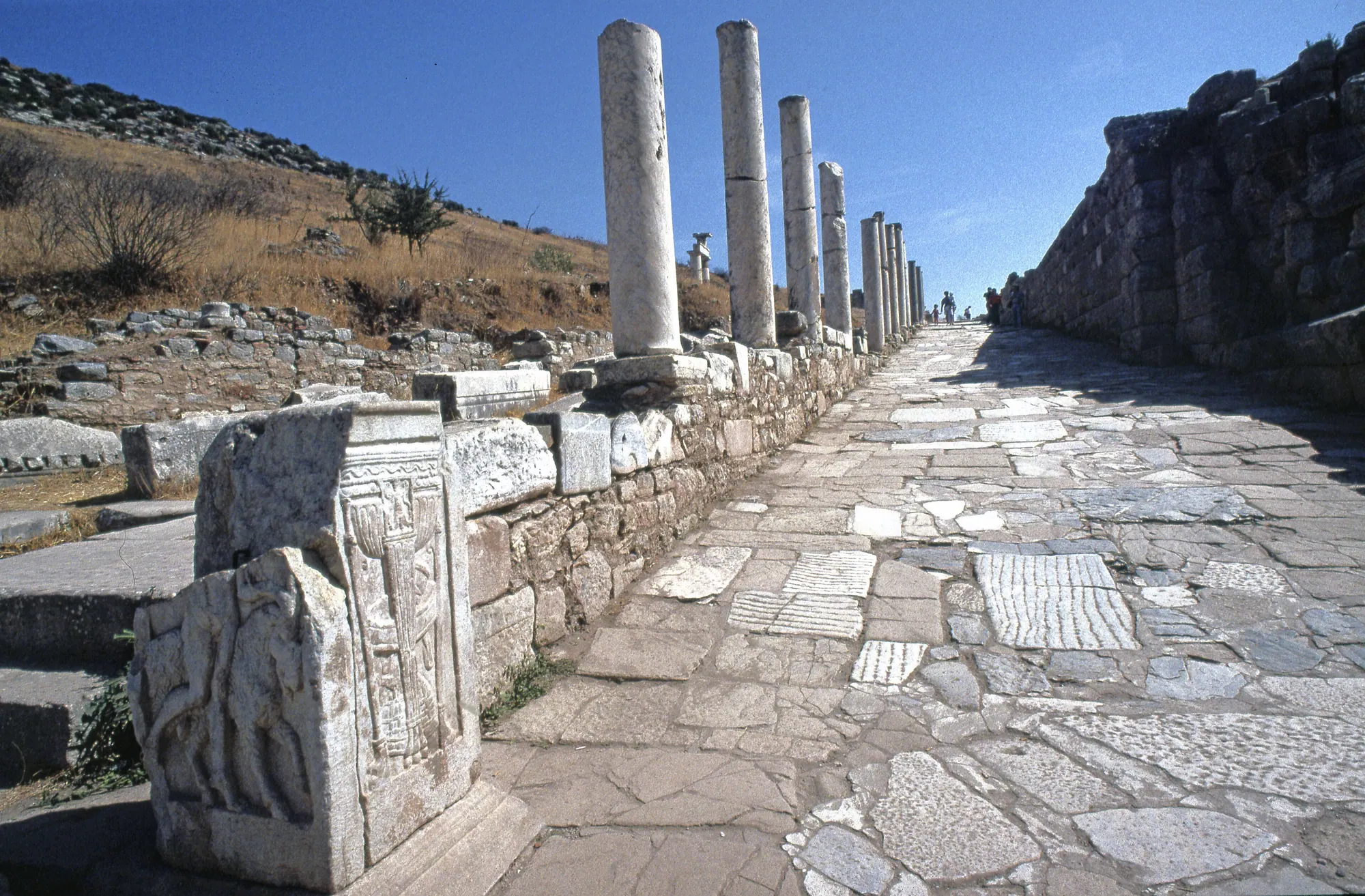
The ruins of Ephesus are an open-air archaeological site beside Selçuk, entered through one of two gates with ticket offices: the Lower Gate on the town side to the north and the Upper Gate to the south1. The ancient city is one part of a larger World Heritage property, inscribed by UNESCO in 20152, and a visit is shaped by which gate you use, the season, the ships in port at Kuşadası and how much of the wider property you want to see.
What is there to see at Ephesus?
UNESCO’s World Heritage property has four parts: the prehistoric mound of Çukuriçi Höyük, the ancient city itself, Ayasuluk Hill with the site of the Artemision and the medieval town, and the House of the Virgin Mary8. The criteria under which it was listed single out the Library of Celsus, the Temple of Hadrian, the Serapeion and Terrace House 2 for their architecture, and the Church of Mary and the Basilica of St John for the city’s religious history9.
Inside the gates, the ancient city unfolds along one route, from the civic buildings of the upper city down to the Library of Celsus, the Great Theatre and the long street to the old harbour. Off that route, and on a separate ticket10, the Terrace Houses fill the hillside above Curetes Street; Terrace House 2 alone is a block of about 4,000 m²11.

Which gate to start from
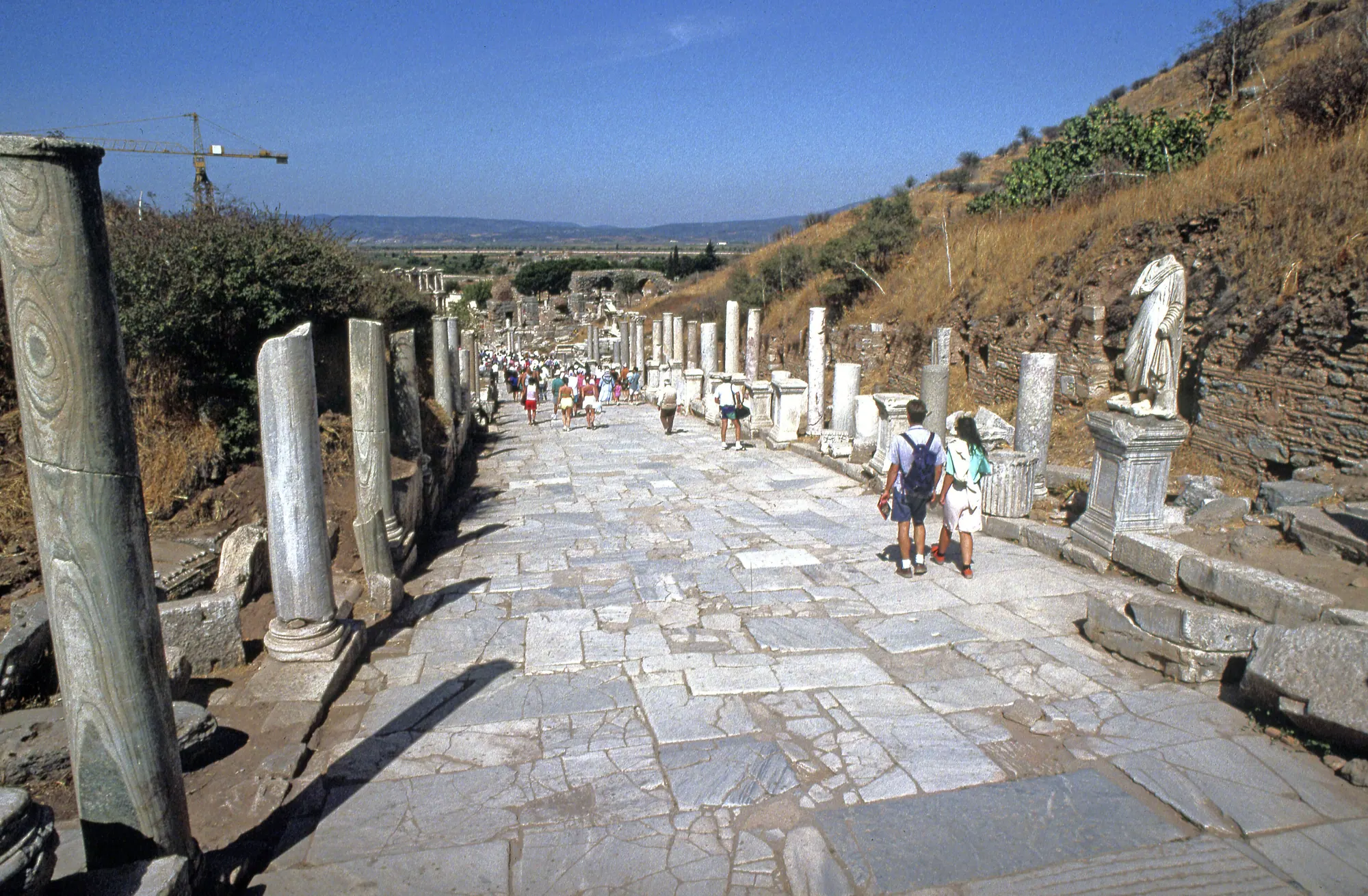
The Upper Gate makes the easier walk, provided someone can collect you at the other end. Curetes Street, which links the upper city to the library, drops from about 30 m above sea level at the Hercules Gate to under 10 m at the Library of Celsus12, so a visit from the south runs downhill. Starting at the Lower Gate turns that into a climb, which in July is a real consideration.
Today’s upper entrance is not where the ancient road left the city. The Magnesian Gate, the largest of the city gates, lies some 300 m further south13.
Planning the day: three shapes of visit
These run from the tightest to the most complete.
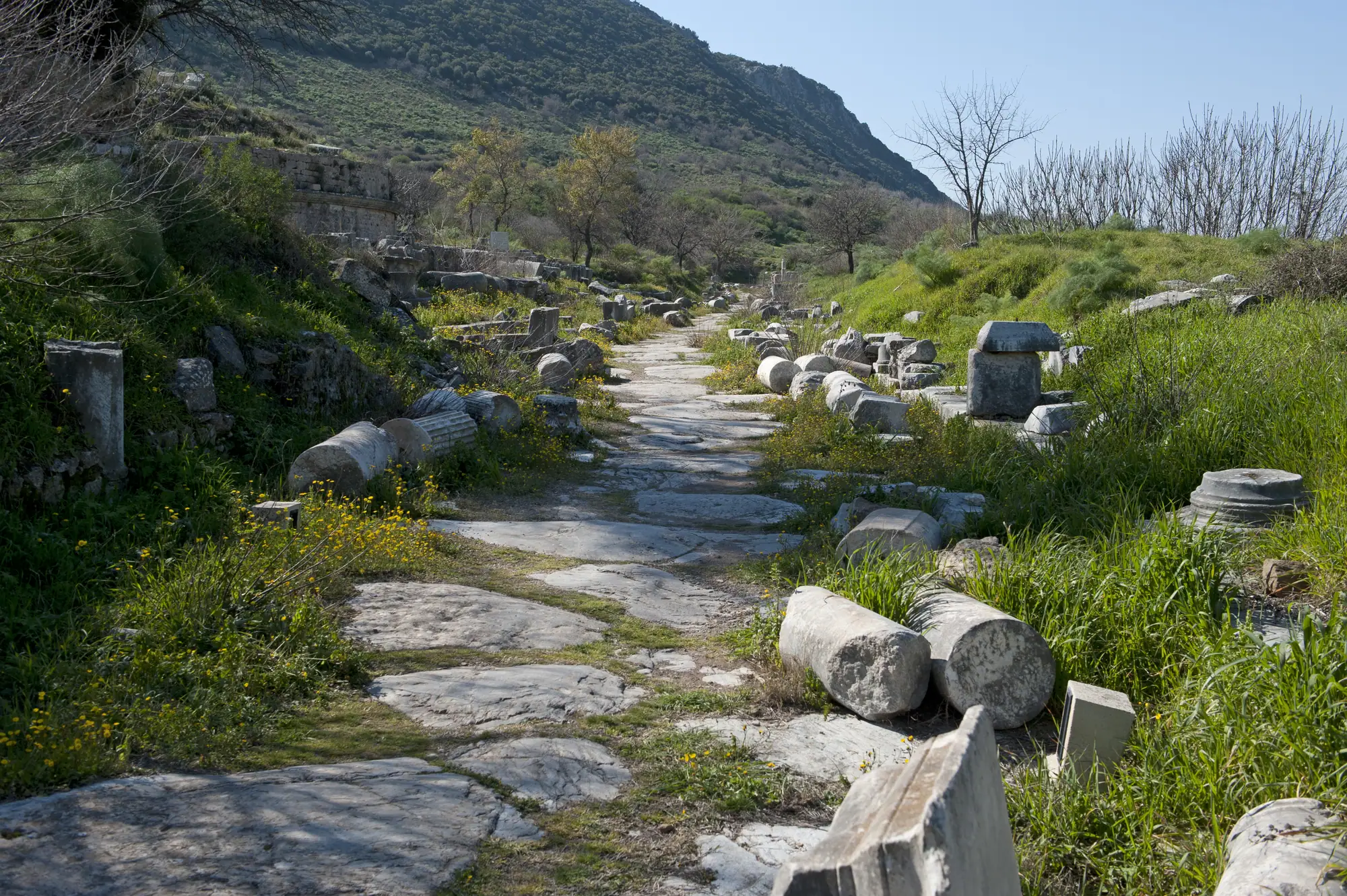
- The ancient city alone. Enter at the Upper Gate, walk down through the upper city, Curetes Street and the library to the theatre, and leave by the Lower Gate. This is the shape that suits a cruise-day visit from Kuşadası, where the port is about 19 km from the Lower Gate14.
- Adding the Terrace Houses and a shrine or museum. The Terrace Houses open off Curetes Street; the House of the Virgin Mary lies some 5 km up the road from the Upper Gate15, close enough to visit first and then drive down to the ruins.
- A full day with Selçuk. Finish in town, where the Ephesus Museum holds the Roman Artemis statues from the Prytaneion16 and the original frieze slabs of the Temple of Hadrian17, and Ayasuluk Hill carries the Basilica of St John18. The İsa Bey Mosque, built in 1375, stands below the hill19.
Weather and the best months
April, May, September and October are the comfortable months, with average daily highs at the site of about 20 °C, 26 °C, 30 °C and 24 °C respectively20. July and August are the hottest, averaging about 35.6 °C in July, and some 17 to 18 days in each reach 35 °C or more4. Almost all the rain falls between October and April5, and winter days reach only 12 to 14 °C20.
Crowds follow the ships. In 2025 no museum or archaeological site in Turkey drew more visitors than Ephesus: 2,550,4583 (checked on ). The 2019 total, for comparison: 1,810,79121 (checked on ). Cruise passengers made up most of the visitors, according to the museum director in 202222.
Summer evenings offer a way round both the heat and the ship crowds. The ancient city reopens after dark as a night museum, and the 2026 season runs from 1 June to 1 October6.

Tickets, in brief
The ancient-city ticket includes the Ephesus Experience Museum23, and foreign visitors’ prices include the Ministry’s audio guide wherever there is one24. The Terrace Houses need their own ticket or one of the two 72-hour combined tickets23, and a new tariff takes effect on 1 April 202710.

Getting there, in brief
The road from İzmir Adnan Menderes Airport covers about 62 km7. The İZBAN commuter train goes as far as Selçuk, with a change at Tepeköy25, and the station is about 3.5 km on foot from the Lower Gate26. Ship passengers land at Kuşadası, 19 km from the Lower Gate and 23 km from the Upper14.

The site plan
Ephesus is a sequence of streets rather than a single monument, so a site plan earns its place before you arrive. Curetes Street follows the valley from the Hercules Gate down to the library27, and beyond the theatre the colonnaded Harbour Street, rebuilt by the emperor Arcadius, heads for the old harbour28, now a small marshy lake29.
Beyond the ancient city
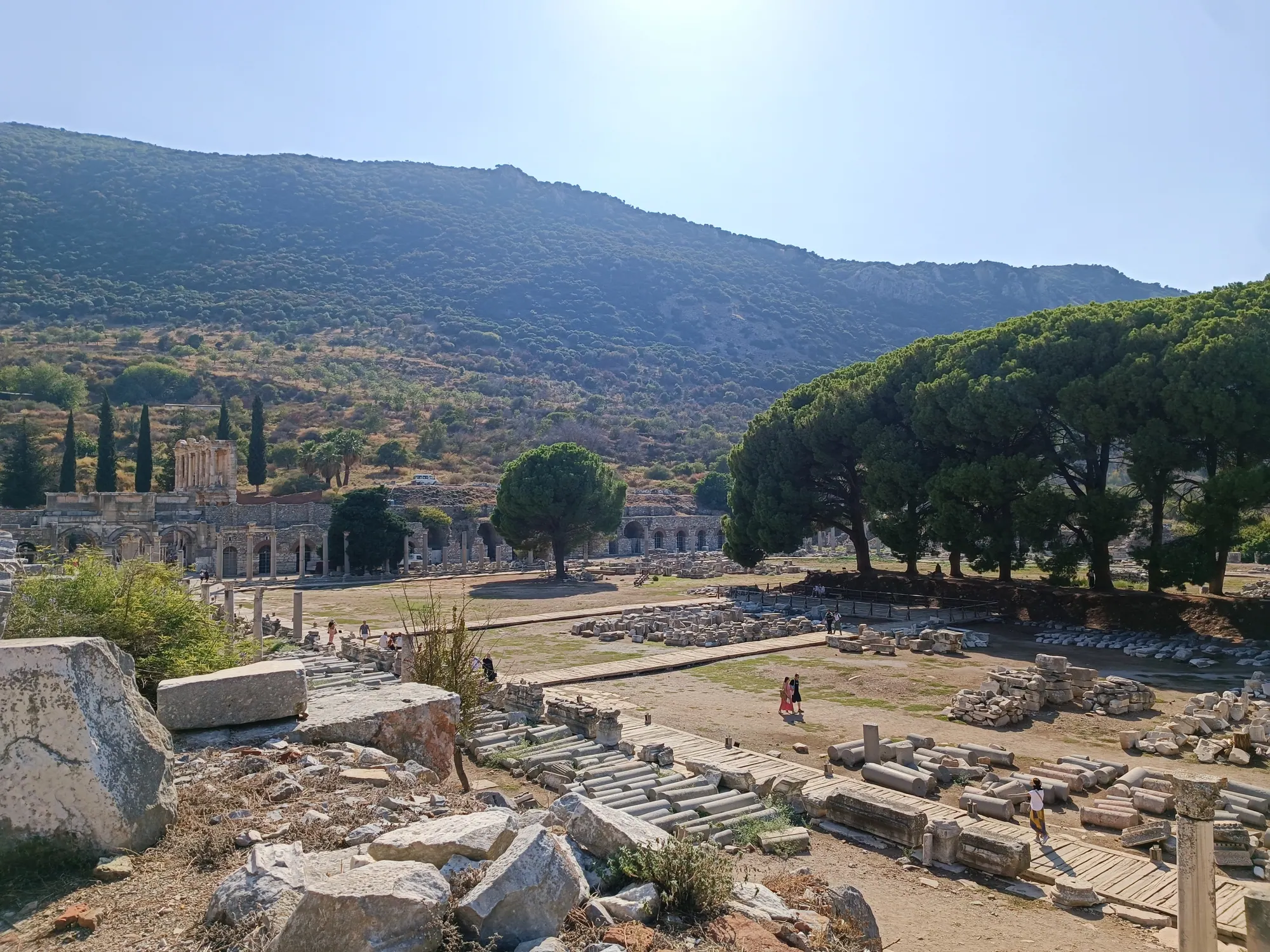
A second day’s worth of sites lies within a few kilometres, gathered on places around Ephesus.
- The House of the Virgin Mary. A small chapel high on Bülbüldağ, south of the ruins30, reachable only by car, taxi or on foot15. Muslim visitors come to pray here as well as Christians31.
- The Temple of Artemis. A single column, pieced together from fragments, stands in the field where the temple was32.
- Ayasuluk Hill. The Byzantine fortress and Justinian’s 6th-century Basilica of St John, raised over the traditional tomb of the apostle18.
- Şirince. A hill village about 8 km east of Selçuk, named one of UN Tourism’s Best Tourism Villages in 202333.

Licensed guides
Only a licence holder with a current working card may guide in Turkey, and only in the languages on that card, under Law 6326 on tourist guiding as amended in 202434. TUREB, the union of tourist guides, runs a public database that can be used to check a guide’s licence35; the licence number is a safer search than a name.
In this section

Tickets and hours
What an Ephesus ticket includes, the 72-hour combined tickets, MuseumPass and MüzeKart, free entry, the night museum and the prices set for April 2027.
Getting there
How to reach Ephesus by road and rail: distances from İzmir airport, Kuşadası and Bodrum, the İZBAN change at Tepeköy, and the walk from Selçuk station.

From Kuşadası cruise port
Kuşadası cruise port is 19 km from Ephesus. Which gate to use, the downhill route, summer heat, ship-day crowds and what the ticket covers on a day ashore.

Map of Ephesus
Where everything is at Ephesus: both gates, the upper city, Curetes Street, the theatre and harbour, the sites beyond the walls and the distances between.


Sources
Each source is listed once. The numbers link back to the claims it supports; dates show when the source was checked.
- OpenStreetMap nodes: Lower Gate 37.9454,27.3421; Upper Gate 37.9355,27.3462; Selçuk station 37.9509,27.3729 1
- muze.gov.tr › muze-detay 1, 6, 24
- turkishmuseums.com › 4 1, 6
- www.oeaw.ac.at › Forschungsgeschichte_Ephesos.pdf 2
- en.wikipedia.org › Ephesus 2, 17, 19, 28, 29
- tr.wikipedia.org › Efes 2, 16
- www.egetelgraf.com › izmir-efes-oren-yeri-turkiyede-zirvede-174-milyon-ziyaretci 3
- www.turizmgunlugu.com › turkiyenin-en-cok-ziyaret-edilen-muzeleri 3, 22
- ERA5 reanalysis, grid 37.945N 27.345E, daily 1996-2025, our aggregation 4, 5, 20
- www.mgm.gov.tr › il-ve-ilceler-istatistik.aspx 4, 5, 20
- www.mgm.gov.tr › il-ve-ilceler-istatistik.aspx 4, 5, 20
- www.cumhuriyet.com.tr › gece-muzeciliginin-2026-seruveni-basladi-uzmanlar-cumhuriyet 6
- www.hzmeryemanaevi.com › location 7, 15
- OSRM car/foot profiles over OpenStreetMap, our query 2026-09-14 7, 14, 15, 26
- web.archive.org › multiple=1 8
- web.archive.org › 1018 8
- goephesus.com › ephesus--unesco-world-heritage-centre 8
- whc.unesco.org › 6387 8, 9, 29
- whc.unesco.org › 1018 8
- www.worldheritagesite.org › ephesus 9
- dosim.ktb.gov.tr › muze-ve-oren-yeri-ucretleri.html 10
- www.tursab.org.tr › 3ce94ed3-2265-4180-8a87-594371bcf0b5.pdf 10, 24
- www.tursab.org.tr › fd72b227-0a27-46f5-b7e8-25fe4f9a17d5.pdf 10
- www.tursab.org.tr › 2027-yili-muze-ve-orenyeri-giris-ucretleri-hakkinda-duyuru 10
- www.oeaw.ac.at › research-history 11
- www.petersommer.com › ephesus-terrace-house-2 11
- de.wikipedia.org › Hanghäuser_von_Ephesos 11
- www.austriaca.at › 9783700183419 12
- turkisharchaeonews.net › curetes-street-ephesus 12, 27
- web.archive.org › magnesian-gate.html 13
- turkisharchaeonews.net › magnesian-gate-area-ephesus 13
- en.wikipedia.org › House_of_the_Virgin_Mary 15
- turkisharchaeonews.net › public-buildings-north-state-agora-ephesus 16
- de.wikipedia.org › Ephesos-Museum_Selçuk 16, 17
- de.wikipedia.org › Prytaneion_von_Ephesos 16
- turkisharchaeonews.net › temple-hadrian-ephesus 17
- de.wikipedia.org › Hadrianstempel_(Ephesos) 17
- muze.gov.tr › muze-detay 18
- en.wikipedia.org › Ayasuluk_Hill 18
- web.archive.org › Ephesus 19
- islamansiklopedisi.org.tr › ayasuluk 19
- islamansiklopedisi.org.tr › isa-bey-camii--izmir 19
- turkisharchaeonews.net › selçuk 19
- en.wikipedia.org › İsa_Bey_Mosque 19
- www.aa.com.tr › 1700209 21
- www.hurriyet.com.tr › efeste-ziyaretci-rekoru-1-milyon-810-bin-kisi-41418147 21
- www.aa.com.tr › 2587714 22
- www.ephesustoursbylocals.com › entrance-fees 23
- dosim.ktb.gov.tr › 132665,kambine-biletpdf.pdf 23
- izmir.ktb.gov.tr › izmir-ili-muze-ve-oren-yerleri-giris-ucreti-tarifesi.html 24
- muze.gov.tr › muze-detay 24
- muze.gov.tr › muze-detay 24
- www.izban.com.tr › SeferSaatleri.aspx 25
- en.wikipedia.org › Selçuk_railway_station 25
- en.wikipedia.org › İZBAN 25
- de.wikipedia.org › Kuretenstraße 27
- turkisharchaeonews.net › arcadiane-harbour-street-ephesus 28
- turkisharchaeonews.net › harbour-ephesus 29
- www.austriaca.at › 0xc1aa5572 0x0014a7d8.pdf 30, 31
- de.wikipedia.org › Haus_der_Mutter_Maria 30, 31
- www.hzmeryemanaevi.com › en 31
- de.wikipedia.org › Tempel_der_Artemis_in_Ephesos 32
- en.wikipedia.org › Temple_of_Artemis 32
- Cartwright 2018 32
- dergipark.org.tr › 4430684 33
- www.selcuk.gov.tr › sirince 33
- en.wikipedia.org › Şirince 33
- tr.wikipedia.org › Şirince 33
- www.mevzuat.gov.tr › 1.5.6326.pdf 34, 35
- RehberVeritabani guide database link 34, 35
- www.tureb.org.tr › RehberVeritabani 35