
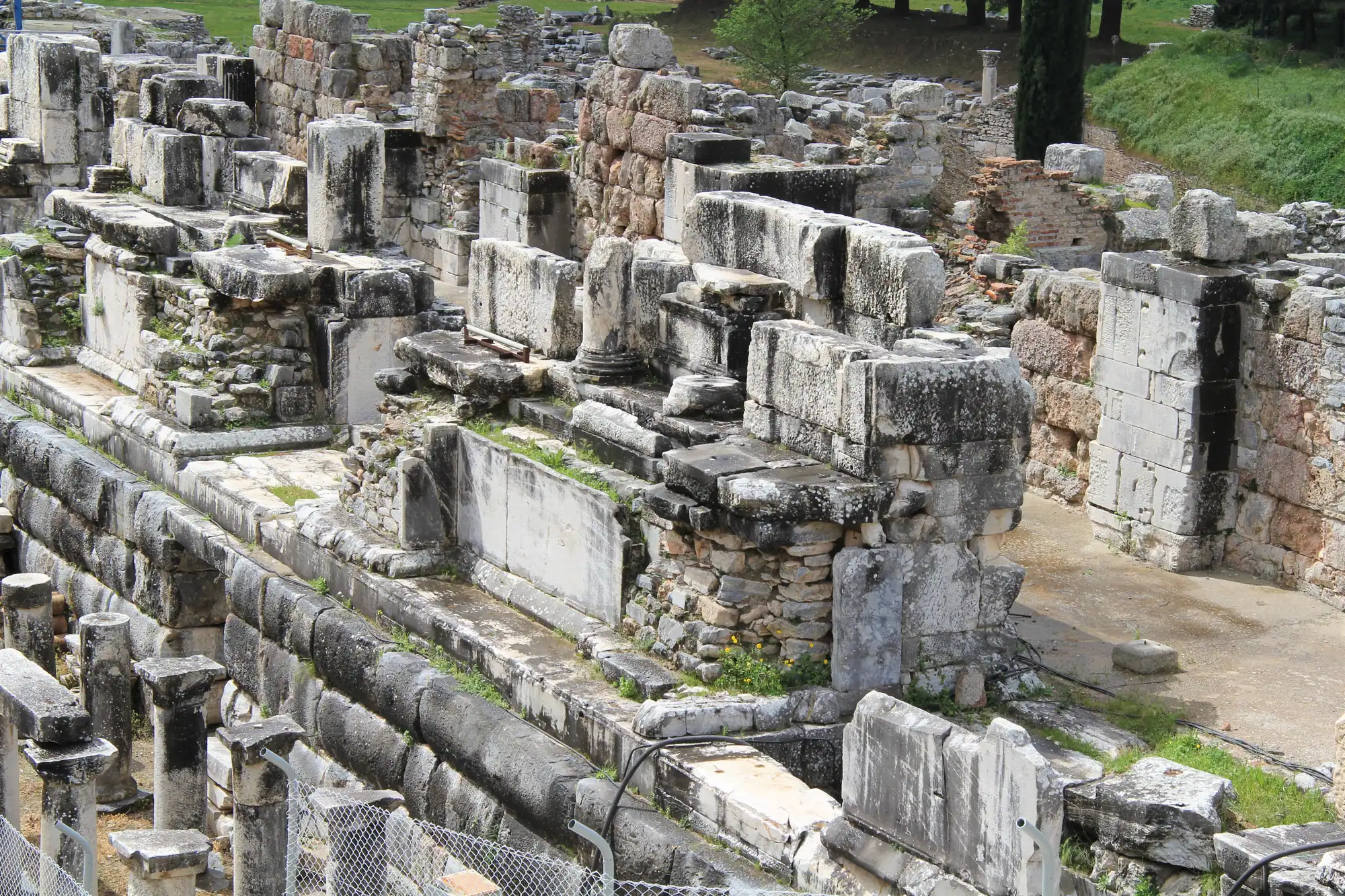
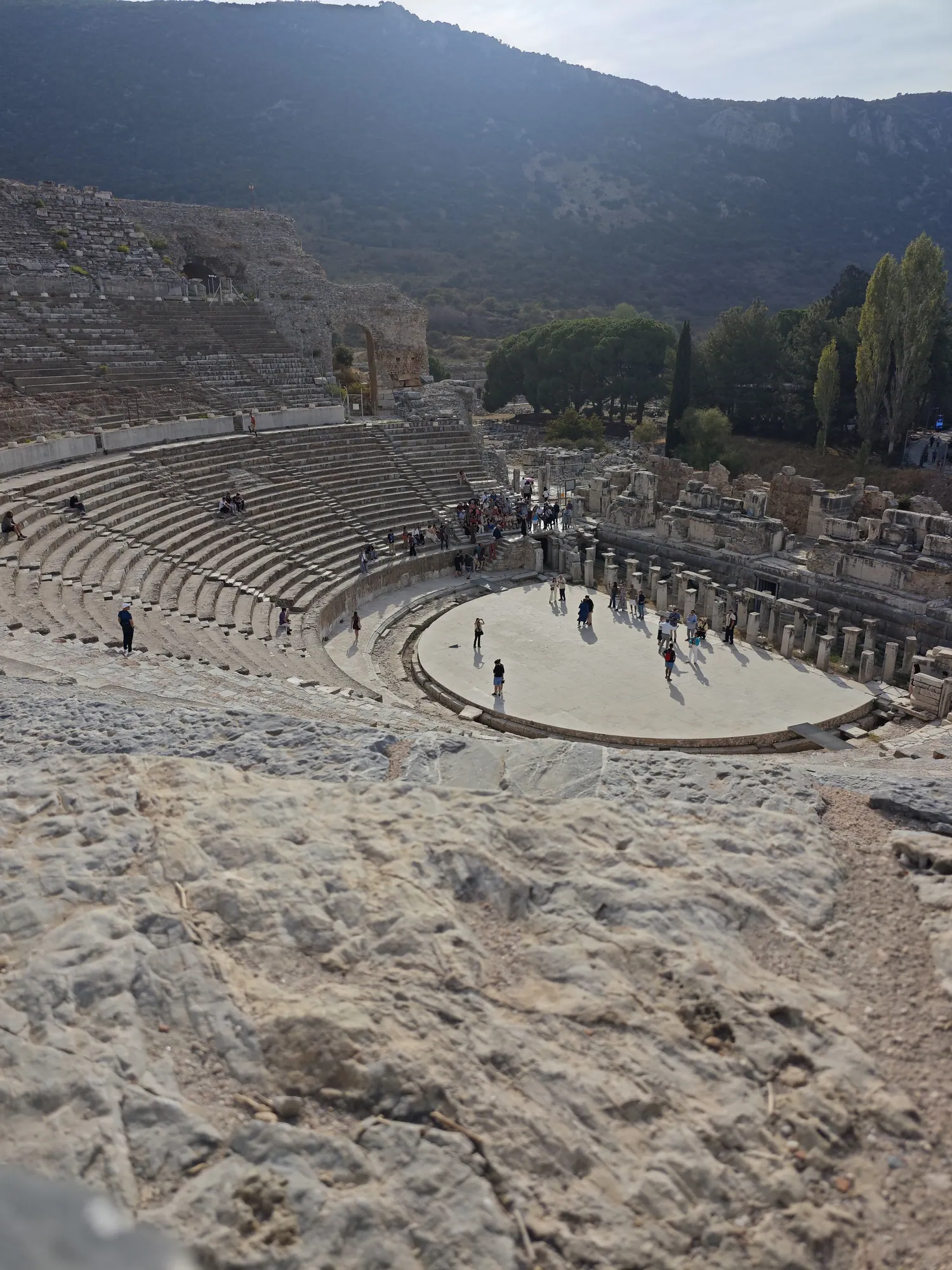
The Great Theatre sits where Marble Street comes down from the square below Curetes Street1 and the colonnaded Harbour Street sets off west towards the old port2. Its auditorium grew in Roman times to a diameter of close to 150 m3. This is the theatre of Acts 19, into which a crowd poured to shout for Artemis4, and it is also where the man who later found the lost Temple of Artemis picked up the clue that led him there5.
The excavators’ own numbers differ from the popular ones. On their reading, work began in the 2nd century BC rather than under Lysimachus6, and the theatre held about 20,000 people rather than 25,0007.
When was the Great Theatre built?
On the Austrian excavators’ dating, building work started in the second quarter of the 2nd century BC6. That is more than a century after Lysimachus refounded the city on its present site12, and yet many guides still credit the building to him. Popular accounts give a date around 300–290 BC, which the excavators’ final publication does not support6.
Most of what stands today is Roman. The seating was extended several times, a process that began in the 1st century AD and ran on into the first half of the 2nd3. The three-storey marble stage building, the scaenae frons that closed the view behind the performers, carries a building inscription on the architrave of its lower storey that dates it to AD 85, under the Flavian emperors. The excavators treat that Flavian remodelling as the most far-reaching of all8. An older chronology, still common in guidebooks, spread the stage building across Claudius, Nero and Trajan; the 2017 publication replaces it8.
Across its whole life the excavators distinguish eight phases of building or use, running from Hellenistic times to the Byzantine era9. The auditorium itself was studied between 2003 and 2011, and that research was published, open-access, in 202213.
Seats and size
The excavators put the Roman theatre, after its enlargement, at about 20,000 seats7. Turkish officials and many other sources say about 24,000, a good number of guides say 25,000, and the Austrian institute’s own former web page once offered a range of 21,000 to 25,0007.
This page follows the lowest figure because it comes out of the full building study. None of that makes the theatre small: the excavators count it among the largest theatre spaces in Roman Asia Minor3. The inflated numbers are one of the errors taken apart in what guidebooks get wrong.
Did St Paul preach in the theatre?
Acts does not say so. In its account, Paul never goes inside14. The story in Acts 19:23–41 opens in the workshops: Demetrius, whose trade was silver shrines of the goddess, turns the other craftsmen against Paul’s preaching11. Gaius and Aristarchus, two of the men travelling with Paul, were seized and hauled along as the crowd surged into the theatre14. Paul wanted to go in after them, but his disciples would not let him, and some Asiarchs who were friends of his also kept him away14.
For about two hours the crowd kept up the cry “Great is Artemis of the Ephesians!” (Acts 19:34, World English Bible), until the town clerk calmed them down with a warning that the city could face a charge of riot15. Older English versions, the King James and the Douay among them, call the goddess Diana11.
The theatre in Acts is identified with this one, whose remains are visible today4. Some details of the scene fit Ephesus independently of the text: the theatre as the place where the people assembled, and an inscription attesting a guild of silversmiths. No silver shrines of the kind Demetrius made have been found15. How closely the account records real events is a question for New Testament scholarship, and what is set out here is what the text says14. The riot is one episode in the longer story of St Paul in Ephesus.

The inscription that led to the Temple of Artemis
The theatre was dug early, and not for its own sake. John Turtle Wood was searching for the Temple of Artemis on behalf of the British Museum from 1863 and partly uncovered the Great Theatre along the way16. He began work on it in earnest in February 18665.
On the eastern wall of the theatre’s southern entrance he found a long text cut in stone about a Roman benefactor, Gaius Vibius Salutaris. Its decrees name the consuls of AD 104, under Trajan, and record his endowment: statuettes in gold and silver, including an Artemis between two stags, which were to travel between the goddess’s sanctuary and this building whenever the citizens met here17. The route was laid down too. The images entered by the Magnesian Gate, picked up an escort of ephebes, the city’s young men in training, and left again by the Coressian Gate17.
Wood saw that the text was also a map. A road leaving the Magnesian Gate ought to lead to the sanctuary, so he looked for that road, found it in 1867 and followed it18. On New Year’s Eve 1869 he reached the temple itself16.
Harbour Street and the missing sea
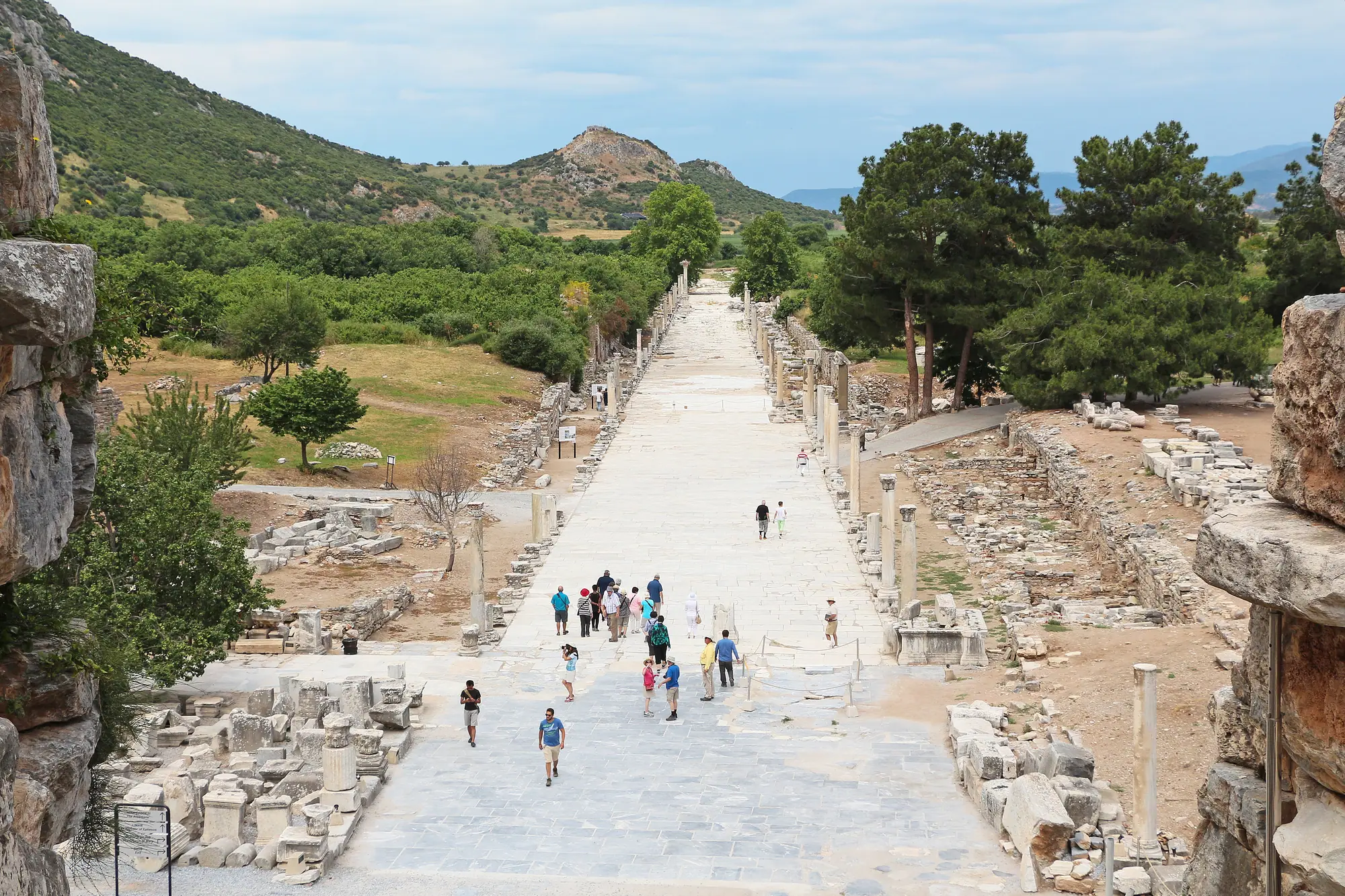
From the theatre a colonnaded avenue runs west towards where the harbour lay. Its ancient name, the Arkadiane, comes from the emperor Arcadius (395–408), who rebuilt the street and raised its level2. Published lengths vary between a little over 500 m and 570 m, with a roadway of roughly 11 m and porticoes of about 5 m on each side19. Late antique inscriptions show that this ceremonial route, from the Arkadiane up through Curetes Street, had lamps along it20.
At the western end, the Middle Harbour Gate opened onto the quay through three passages21. No quay is left to stand on. The river mouth silted up, the sea has retreated about 5 km, and the old basin is now a small marshy lake22. Beside the street, close to the theatre, lie the only partly excavated remains of the Theatre Gymnasium, one of the city’s four large Roman bath-gymnasia23. In the other direction, Marble Street leads down to the Library of Celsus, and the rest of the Roman centre is mapped out in the guide to the ancient city.
Earthquakes and abandonment
The theatre’s last centuries were spent patching earthquake damage. Its high entrances were walled up after one such episode, and around the beginning of the 7th century AD it was given up altogether10, one of the late chapters in the wider history of Ephesus.
Concerts in the Great Theatre
In modern times the theatre became a stage again, though less and less often. From 2003 the Ministry of Culture cut back the events held there because of structural problems24. In 2018 it closed to all concerts and performances for restoration, and it reopened on 24 August 2021 with Verdi’s La Traviata, part of the 4th International Ephesus Opera and Ballet Festival, for an audience capped at 2,400–2,500 under COVID rules25.
In June 2025 the ministry cancelled concerts that had already sold tickets at the ancient theatres of Ephesus and Bodrum. The reasons it gave were restoration work and the lack of permission from the conservation board. Press reports and some artists connected the cancellations with a reported blacklist of performers who had supported Ekrem İmamoğlu; that link is a report, not an established fact26.
Seeing the theatre today
The walking route through the site, the two gates and any current closures are set out on visiting Ephesus and the site map. Prices and opening hours, dated and sourced, are on tickets and opening hours.

Sources
Each source is listed once. The numbers link back to the claims it supports; dates show when the source was checked.
- www.livius.org › ephesus-marble-street 1
- en.wikipedia.org › Head_of_Eutropius 1
- turkisharchaeonews.net › arcadiane-harbour-street-ephesus 2, 19, 20, 21
- en.wikipedia.org › Ephesus 2, 7, 14, 16, 22
- www.archaeologie-online.de › baugeschichte-des-theaters-von-ephesos-rekonstruiert-5399 3, 7, 9, 10, 13
- austriaca.at › 8268-9 3, 13
- turkisharchaeonews.net › great-theatre-ephesus 3, 7, 8, 10
- www.newadvent.org › 05490a.htm 4
- en.wikipedia.org › Acts_19 4
- archive.org › discoveriesateph00wood_djvu.txt 5
- web.archive.org › excavation-history.html 5
- en.wikipedia.org › John_Turtle_Wood 5, 17, 18
- en.wikipedia.org › Temple_of_Artemis 5
- www.aa.com.tr › 2333476 6, 7, 24, 25
- austriaca.at › 7590-2 6, 7, 8, 9
- www.worldhistory.org › ephesos 6
- web.archive.org › theater.html 7
- bible-api.com › acts+19 11
- www.newadvent.org › act019.htm 11
- Kraft, Brückner, Kayan, Engelmann 2007, Geoarchaeology 22:121-149, doi:10.1002/gea.20151 12
- Stock, Pint, Horejs, Ladstätter, Brückner 2013, Quaternary International 312:57-69 12
- web.archive.org › Ephesus 12
- web.archive.org › prehellenistic-ephesos.html 12
- Strabo 14.1, Loeb tr. 12
- austriaca.at › 0xc1aa5576_0x001c9934.pdf 12
- www.oeaw.ac.at › ephesos-pre-hellenistic-settlement-history 12
- www.theoi.com › Pausanias1A.html 12
- www.biblegateway.com › passage 14
- de.wikipedia.org › Ephesos 14, 23
- Acts 19:23-41 15
- en.wikipedia.org › Riot_of_the_Ephesian_silversmiths 15
- www.oeaw.ac.at › Forschungsgeschichte_Ephesos.pdf 16
- archive.org › cu31924008628301_djvu.txt 17
- etheses.bham.ac.uk › Leger15PhD_Redacted.pdf 17
- www.cambridge.org › 7A700C9DE0BB71BAEE159CF16C370D54 17
- 19 Feb 2023 17, 18
- de.wikipedia.org › John_Turtle_Wood 18
- www.hurriyetdailynews.com › restoration-to-revive-roman-bath-complex-in-ephesus-204032 19
- www.bestephesustours.com › harbour-street-arcadiane-in-ephesus.html 20
- www.cambridge.org › ceremonial_armatures_porticated_streets_and_their_architectu 20
- api.crossref.org › 1874-6772_seg_a49_1486 20
- www.austriaca.at › 0xc1aa5576_0x00185c50.pdf 21, 23
- turkisharchaeonews.net › harbour-ephesus 21, 22
- whc.unesco.org › 6387 22
- de.wikipedia.org › Vediusgymnasium 23
- www.aa.com.tr › 2334867 24, 25
- www.dailysabah.com › 2300-year-old-iconic-ephesus-theatre-reopens-for-visitors 24, 25
- www.birgun.net › antik-yasak-her-yeri-sardi-632204 26
- www.turizmgazetesi.com › 89200 26