
The church of Ephesus was the Christian community of the Roman city of Ephesus, and it comes first among the seven churches of the province of Asia to which the Book of Revelation opens with letters1. It already existed before Paul’s long stay in the city2, which scholars date to the mid-50s AD3. The letter to it in Revelation 2:1–7 praises its hard work and endurance, then rebukes it for abandoning its "first love"4.
Who founded the church at Ephesus?
Acts names no founder, only a couple and a preacher who were in the city before Paul settled there. On his first, short visit Paul left Priscilla and Aquila behind8. While he was away, Apollos, a Jew from Alexandria, taught in Ephesus and was taken aside by the same pair for further instruction, so the community was older than Paul’s long stay2. When Paul came back he spent three months in the synagogue and two years teaching in the hall of Tyrannus9.
Later generations filled in the line of leaders. Eusebius records the tradition that Timothy was the first bishop of Ephesus, and 1 Timothy portrays Paul asking him to stay there5. The church’s link with John also rests on tradition rather than scripture: the New Testament is silent on where John lived and died, and the earliest writers to place him at Ephesus are Irenaeus and Polycrates, bishop of the city, towards the end of the 2nd century10.

What does Revelation 2 say to Ephesus?
The letter praises the Ephesian church before it warns it. It commends the church’s toil and endurance, its testing and rejection of false apostles, and its hatred of the practices of the Nicolaitans4. Then comes the charge, which the King James Version renders “thou hast left thy first love”. Unless the church repents, its lampstand will be removed from its place4.
Ephesus heads the list of seven: Ephesus, Smyrna, Pergamum, Thyatira, Sardis, Philadelphia and Laodicea1.
The city behind the letter
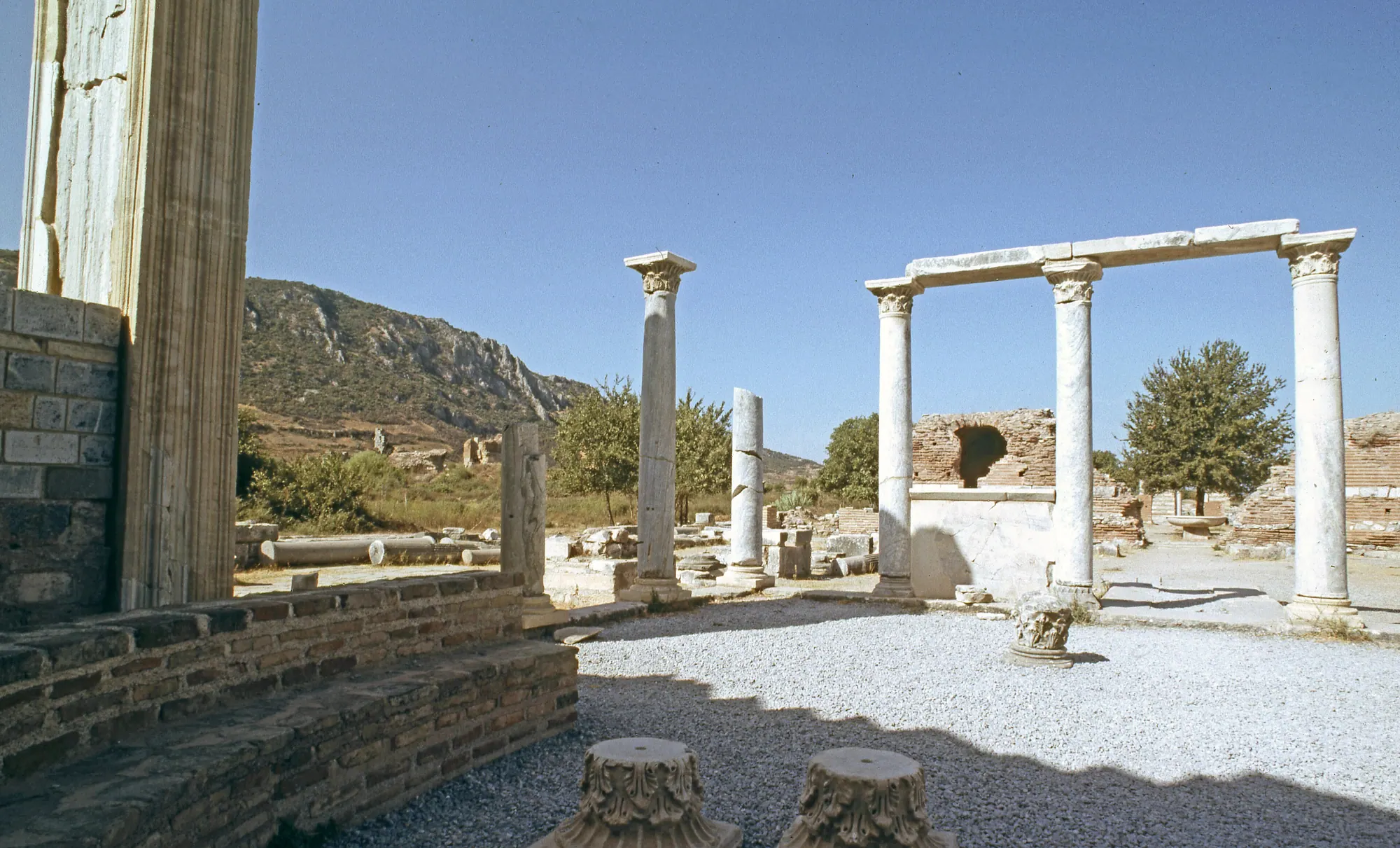
Three sides of first-century Ephesus help in reading the letter: its goddess, its emperors and its harbour.
Artemis. The city’s pride was its goddess. In Acts the town clerk quiets the rioters by reminding them that Ephesus guards the temple of Artemis and her sky-fallen image11. The Temple of Artemis was also a bank: Dio Chrysostom says it held large sums deposited by Ephesians, foreigners, cities and kings12. The craftsmen who rioted against Paul made their living from miniature silver shrines of the goddess, and it was their trade they feared for13.
The emperors. In 29 BC Octavian allowed the Romans of Asia to set up a sanctuary of Dea Roma and the deified Julius Caesar at Ephesus14. In AD 89/90 the Temple of the Sebastoi was dedicated, making Ephesus neokoros, official temple warden of the imperial cult, for the first time15. After Domitian’s memory was condemned, the cult was redirected to the Flavian family as a whole16. The title then multiplied: “twice neokoros” under Hadrian, “thrice” from AD 211, and briefly “four times” under Elagabalus, a record in the Roman East17.
Trade and government. Strabo, writing under Augustus or Tiberius, calls Ephesus the largest trading centre of Asia this side of the Taurus mountains18. It was the seat of the Roman governor of Asia, though whether it was formally the capital is debated19. The customs law for the province, revised in AD 62 under Nero, survives in an Ephesian inscription20. Keeping ships moving took constant work: from Nero’s reign onwards governors and benefactors paid to clear the silting harbour21.
The Christians were a small group in a big city. Quite how big is argued over; even the lowest modern estimates probably mean tens of thousands of people, and older figures run far higher22.
Meeting places
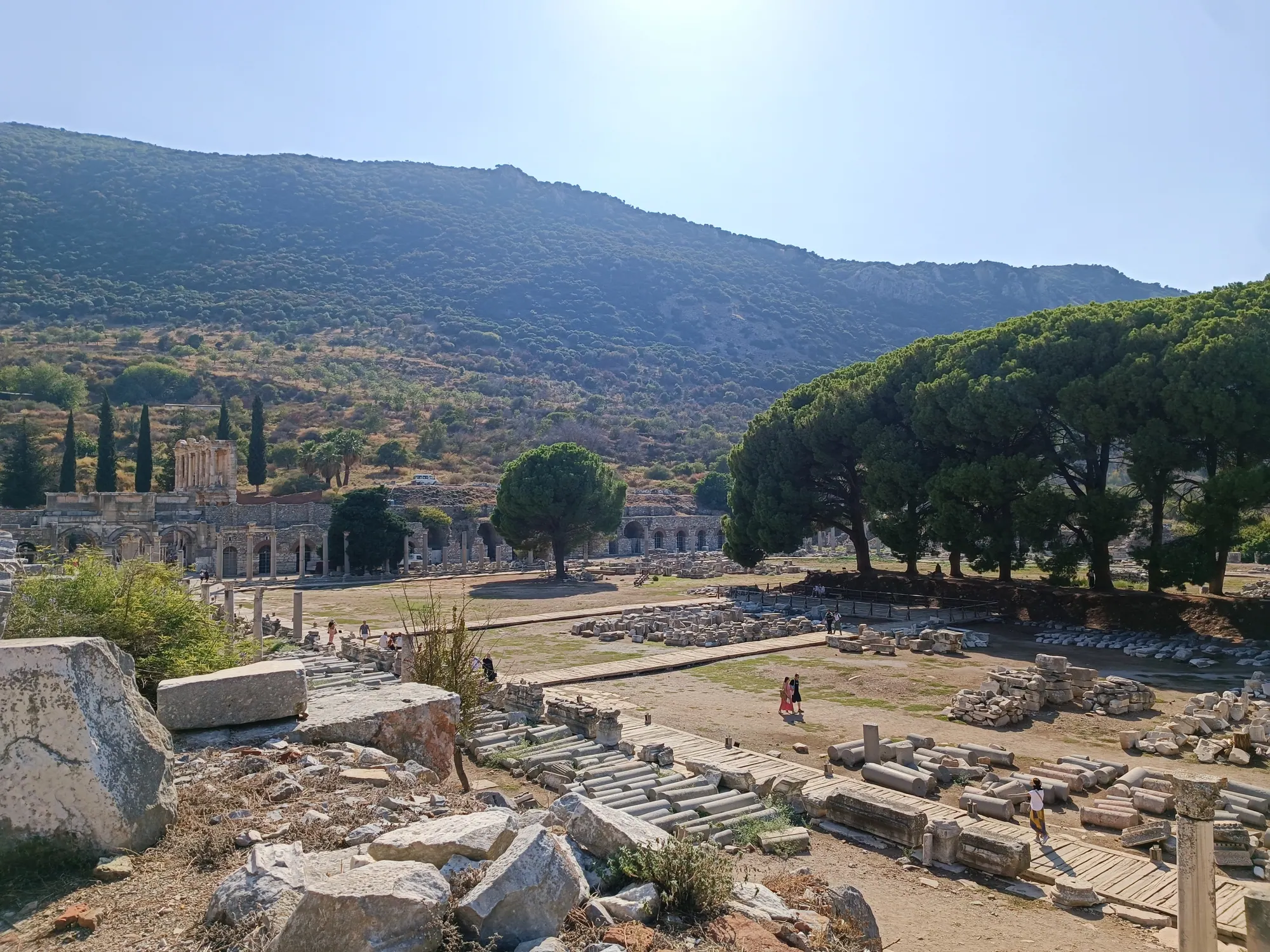
The one meeting place Acts names is the lecture hall of Tyrannus, and it has never been securely identified; even who Tyrannus was is unclear6. When Paul wrote 1 Corinthians from Ephesus, he sent greetings from Aquila and Priscilla23, which tells us who was there but not where they gathered.
The church building most often linked with Christian Ephesus belongs to a much later age. The Church of Mary near the harbour was fitted into a long Roman hall, about 263 m by 30 m24. It is usually dated to the early 5th century, though excavation suggests its dedication to Mary may be no earlier than about AD 50025.
Letters to the Ephesians
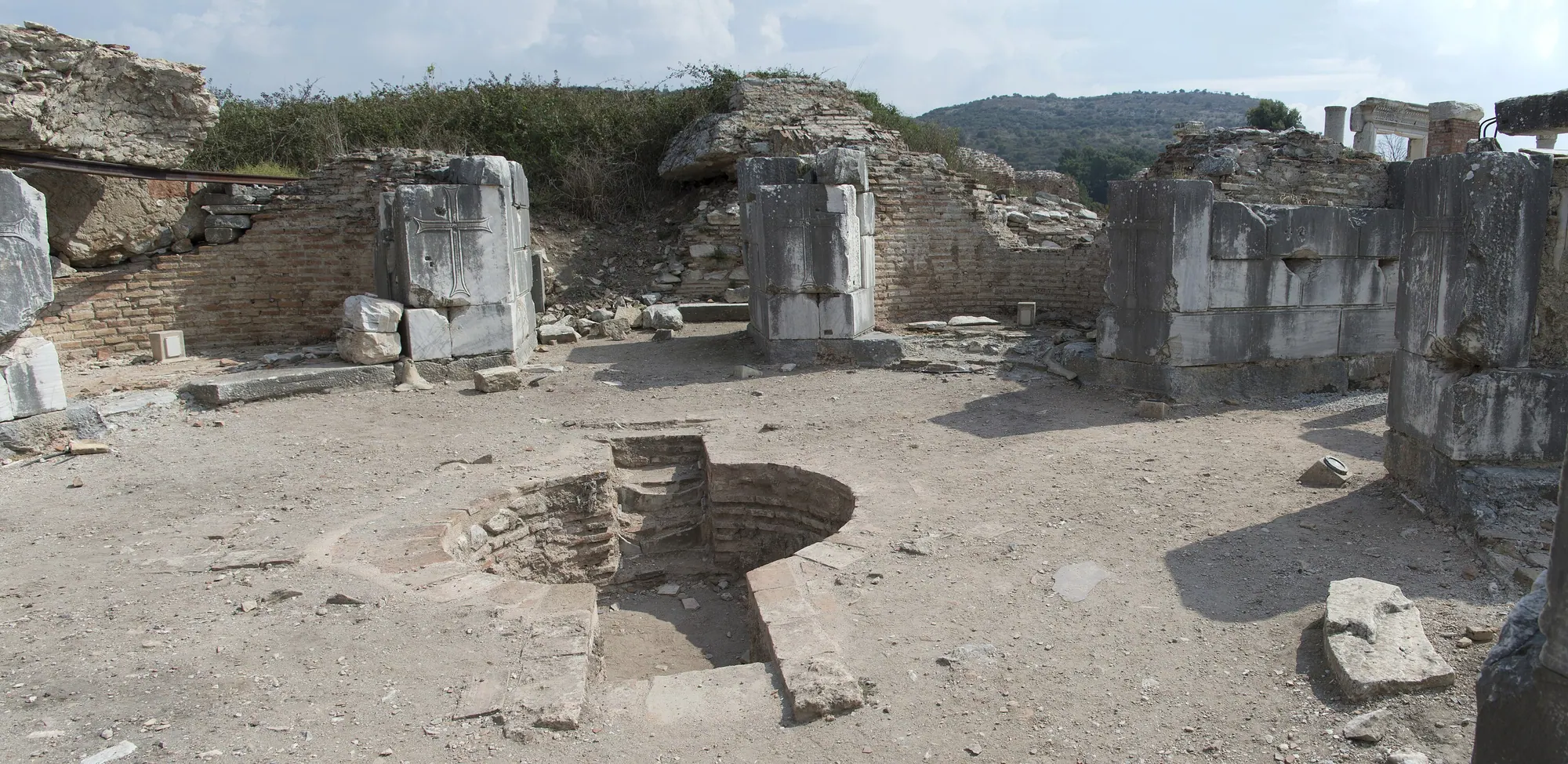
Two early letters bear the name of the Ephesians. The New Testament letter names Paul as author, but its authorship is one of the most debated in the canon26, and the words “in Ephesus” are absent from its earliest manuscripts, so it may have been written for several churches27. The other came from Ignatius of Antioch, who wrote to the Ephesians from Smyrna while under guard on the road to Rome, probably early in the 2nd century, and praised their bishop Onesimus28.
By the 190s the church had a dynasty of leaders. Polycrates, bishop of Ephesus, wrote that seven of his relatives had been bishops before him, and that John and a daughter of the apostle Philip were buried in the city29. He called a synod of Asian bishops to defend the Quartodeciman date of Easter30.
The later church
In Byzantine times Ephesus drew pilgrims above all to John’s tomb on Ayasuluk hill31, where Justinian built a domed basilica over the grave32; the Basilica of St John still stands in ruins there. Two councils met in the city. The first, in 431, deposed Nestorius and upheld the title Theotokos for Mary33. The second, in 449, was annulled at Chalcedon two years later34.
Chalcedon also cost Ephesus its rank: canon 28 placed Asia under Constantinople, though the metropolitan still had some 36 bishops under him in the 6th century35. Arab fleets raided the city from the 650s onwards36, and the Seljuks captured it in 1090. Latin bishops held the see from 1318 to 1411, and in 1439 Mark of Ephesus led Orthodox opposition to union at the Council of Florence37. By then Ayasuluk had been in Aydınid hands since 1304, when much of its Christian population was driven out, killed or enslaved38, a turning point in the wider history of Ephesus.

Seeing the church’s Ephesus today
A visitor can stand in the Great Theatre, identified with the theatre of the riot in Acts39, see the remains of the Church of Mary in its Roman hall24 and climb Ayasuluk to the crypt of John under the ruined basilica40. The painted grotto and the tower wrongly called Paul’s prison belong to Paul’s years in Ephesus, and the wider map of scripture and tradition in the city to Sacred Ephesus.
Sources
Each source is listed once. The numbers link back to the claims it supports; dates show when the source was checked.
- bible-api.com › revelation+1:11 1
- en.wikipedia.org › Seven_churches_of_Asia 1, 4
- bible-api.com › acts+18:18-28 2, 8
- www.newadvent.org › 05490a.htm 2, 10, 26, 27, 30, 35, 37, 39
- bible-api.com › acts 19:8 3
- www.newadvent.org › 11567b.htm 3
- tyndalebulletin.org › 29221.pdf 3
- de.wikipedia.org › Marienkirche_(Ephesos) 3, 8, 23, 24, 25
- en.wikipedia.org › Acts_19 3, 6, 39
- bible-api.com › revelation+2:1-7 4
- bible-api.com › 1+timothy+1:3 5
- www.newadvent.org › 250103.htm 5
- www.freebiblecommentary.org › VOL03B_19.html 6
- www.livius.org › ephesus 7, 19
- en.wikipedia.org › Ephesus 7, 14, 17, 19, 22, 36, 38
- it.wikipedia.org › Efeso 7
- bible-api.com › acts+19 9
- www.newadvent.org › act019.htm 9
- web.archive.org › Saint-John-the-Apostle 10
- www.newadvent.org › 0103303.htm 10
- www.newadvent.org › 250105.htm 10, 29
- Acts 19:23-41 11, 13
- en.wikipedia.org › Temple_of_Artemis 11, 12
- Dio Chrysostom Or. 31.54-55 12
- en.wikipedia.org › Riot_of_the_Ephesian_silversmiths 13
- penelope.uchicago.edu › 51*.html 14
- en.wikipedia.org › Asia_(Roman_province) 14, 19
- doi.org › hist.2020.848 15
- en.wikipedia.org › Temple_of_the_Sebastoi 15, 16
- turkisharchaeonews.net › trajans-nymphaeum-ephesus 16
- Brickell, citing Burrell 2004 and Friesen 1993 17
- Kraft, Brückner, Kayan, Engelmann 2007, Geoarchaeology 22:121-149, doi:10.1002/gea.20151 18, 21
- Strabo 14.1, Loeb tr. 18
- web.archive.org › Ephesus 19
- www.oxfordreference.com › authority.20110803095428649 19
- web.archive.org › BP000006.pdf 20
- api.crossref.org › 9780199551514.001.0001 20
- turkisharchaeonews.net › harbour-ephesus 20
- Stock, Pint, Horejs, Ladstätter, Brückner 2013, Quaternary International 312:57-69 21
- penelope.uchicago.edu › 16*.html 21
- austriaca.at › 0xc1aa5576_0x001c9934.pdf 21
- de.wikipedia.org › Ephesos 22
- bible-api.com › 1+corinthians+16:8-9 23
- www.cambridge.org › 988373D4ACA691E1D027C304C3E87088 24, 25
- de.wikipedia.org › Haus_der_Mutter_Maria 25
- en.wikipedia.org › Epistle_to_the_Ephesians 26, 27
- www.newadvent.org › 0104.htm 28
- en.wikipedia.org › Ignatius_of_Antioch 28
- en.wikipedia.org › Polycrates_of_Ephesus 29, 30
- en.wikipedia.org › Third_Council_of_Ephesus 30, 35
- www.austriaca.at › 0xc1aa5572 0x0014a7d8.pdf 31
- en.wikipedia.org › Basilica_of_St._John 31
- kar.kent.ac.uk › LAAJ_009_11-Karydis.pdf 32
- www.kulturportali.gov.tr › ayasuluk-tepesi-ve-st-jean-aniti-oren-yeri- 32, 40
- turkisharchaeonews.net › basilica-saint-john-and-ayasuluk-fortress 32, 37, 40
- www.newadvent.org › 05491a.htm 33
- en.wikipedia.org › Council_of_Ephesus 33
- www.newadvent.org › 05495a.htm 34
- en.wikipedia.org › Second_Council_of_Ephesus 34
- www.thebyzantinelegacy.com › ephesus 36, 38
- en.wikipedia.org › Aydinids 38
- de.wikipedia.org › Johanneskirche_(Ephesos) 40