
Ephesus is named in the Acts of the Apostles1, in Paul’s first letter to the Corinthians, which he wrote there2, in 1 Timothy3 and in the Book of Revelation, where it heads the list of seven churches4. The letter to the Ephesians carries the city’s name too, although the words “in Ephesus” are missing from its earliest manuscripts5. Around those texts grew traditions about John, Mary and the Seven Sleepers, two church councils met in the city6, and in 1375 an Aydınid ruler built a mosque below the hill where John’s tomb stood78.
Where is Ephesus in the Bible?
Ephesus appears in five New Testament books, and the fullest account, in Acts, belongs to Paul’s long stay in the mid-50s AD9. The table sets each passage against the ground: what the text reports, and what, if anything, can still be seen.
| Passage | What the text reports | On the ground today |
|---|---|---|
| Acts 18:19–21 | Paul’s first, brief visit: he leaves Priscilla and Aquila in the city, speaks in the synagogue and sails on, promising to return1 | — |
| Acts 18:24–28 | Apollos, a Jew from Alexandria, teaches in Ephesus and is taught further by Priscilla and Aquila12 | — |
| Acts 19 | Three months in the synagogue, then two years of daily teaching in the lecture hall of Tyrannus13 | The hall has never been securely identified14 |
| Acts 19 | Former magicians burn their books, valued at fifty thousand pieces of silver15 | — |
| Acts 19:23–41 | The silversmiths’ riot and two hours of shouting in the theatre16 | The Great Theatre17 |
| Acts 19:35 | The town clerk’s speech: Ephesus as guardian of the goddess’s temple and her heaven-sent image18 | The site of the Artemision |
| Acts 20:16–38 | Paul bypasses Ephesus and calls its elders to Miletus for a farewell19 | — |
| 1 Corinthians 16:8, 19 | Written from Ephesus; Paul will stay until Pentecost2 | — |
| Ephesians 1:1 | The greeting, with “in Ephesus” absent from the oldest copies; no one is greeted by name5 | — |
| 1 Timothy 1:3 | Paul asks Timothy to remain at Ephesus3 | — |
| Revelation 2:1–7 | The letter to the church of Ephesus: praise, then a rebuke for leaving its "first love"20 | — |
One passage often linked with Ephesus does not mention it. John 19:26–27, in which the dying Jesus places his mother in the Beloved Disciple’s care, is the root of the belief that Mary went with John21. Epiphanius of Salamis observed as early as the 4th century that Scripture takes John to Asia but is silent about Mary going with him22. Nor does the New Testament put John himself at Ephesus; that tradition first appears in writers of the later 2nd century23.
Paul in Ephesus
Paul’s stay in Ephesus lasted more than two years, three months in the synagogue and then two years in the hall of Tyrannus13, a stay he himself later remembered as three years24. It ended in trouble. A silversmith named Demetrius stirred up his fellow craftsmen against Paul’s preaching, and the crowd poured into the theatre16. Paul stayed outside, held back by his disciples and by friendly Asiarchs, officials of the province25. The building they packed was the Great Theatre, which still stands17.
Two places carry Paul’s name without evidence to match. The hilltop tower called “St Paul’s Prison” is part of the Hellenistic city wall26, and nothing in Acts has Paul imprisoned in the city27. The painting of Paul and Thecla in the Grotto of St Paul, a real cave church, shows that he was venerated here centuries later28. Whether he also wrote Philippians or Philemon from an Ephesian prison is a scholarly argument that has never been settled29.

The church of Ephesus and Revelation 2
The church of Ephesus was older than Paul’s long stay12, and Eusebius passes on the tradition that Timothy became its first bishop3. When Revelation addresses it, the letter praises its endurance and its stand against false apostles and the Nicolaitans, then threatens to take away its lampstand unless it repents20.
That church lived in a city with other loyalties. Ephesus prided itself on Artemis and her image18, and in AD 89/90 it became temple warden of the imperial cult30, an honour it later held several times over31.
St John and the basilica on Ayasuluk
Christian tradition identifies John, son of Zebedee, with the Beloved Disciple, the author of the Fourth Gospel and John of Patmos, though many modern scholars regard some or all of them as different people32. At Ephesus his grave was honoured on Ayasuluk hill, and medieval pilgrims told of a healing dust that rose from it33. This tomb, and no site connected with Mary, was what drew early Byzantine travellers: Egeria meant to visit in the 380s, and Willibald came in 724–72610.
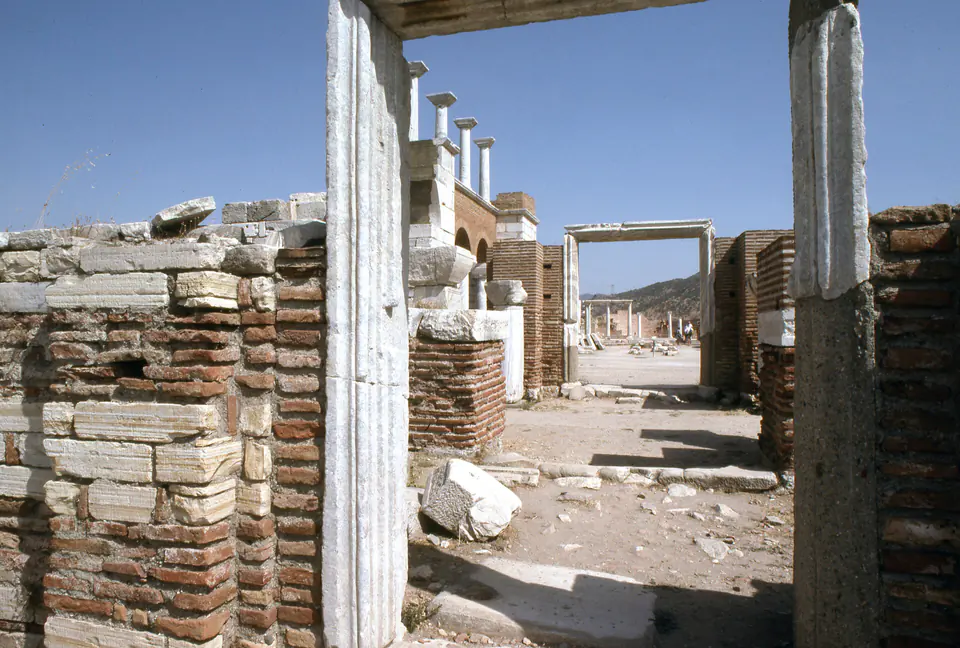
Even the hill is named after him: Ayasuluk is a worn-down form of Hagios Theologos, the title given to John34. Over the tomb Justinian raised the domed, cross-shaped Basilica of St John35, with the grave in a crypt beneath the central dome36. The church was already ruined by the end of the Middle Ages, shaken by an earthquake and laid waste by Timur’s troops in 140237.
The House of the Virgin Mary
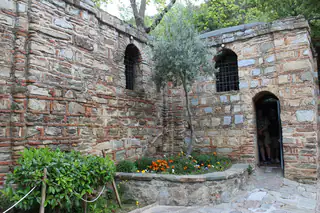
On the mountain south of the ancient city stands Meryem Ana Evi, the House of the Virgin Mary, a small chapel38. It owes its fame to a 19th-century book: the visions of Anne Catherine Emmerich, a bedridden German nun, taken down by the poet Clemens Brentano39. A French priest went looking with the book in 188140, and in 1891 Lazarist priests from Smyrna found the ruin again41.
No early church writer puts Mary in Ephesus; the older tradition, and the more widely followed, sets her death and burial in Jerusalem42. The Catholic Church encourages pilgrimage to the house but has made no ruling on whether she lived there43. For Muslim visitors, who honour Maryam as the mother of Isa, it is a place of prayer too44.

The Church of Mary and the councils of 431 and 449
The Council of Ephesus, counted as the Third Ecumenical Council, was summoned by Emperor Theodosius II. Cyril of Alexandria opened it on 22 June 431 without waiting for John of Antioch and his bishops45. Nestorius, archbishop of Constantinople, had preferred to call Mary Christotokos; the council removed him and affirmed her title Theotokos, "God-bearer"46. About 160 bishops sat that first morning and 198 signed the deposition by evening; John of Antioch arrived five days later and held a rival meeting of about 43 bishops that deposed Cyril in turn47. The quarrel was eased by the Formula of Reunion in 433, and the Church of the East still does not accept the council48.
A second council met in August 449 under Dioscorus of Alexandria, restored Eutyches and deposed Flavian of Constantinople49. Pope Leo I called it a latrocinium, a robbers’ synod, and two years later Chalcedon overturned its decisions. It is still rejected by Catholics, the Orthodox and most Protestants, and still accepted by the Oriental Orthodox churches50.
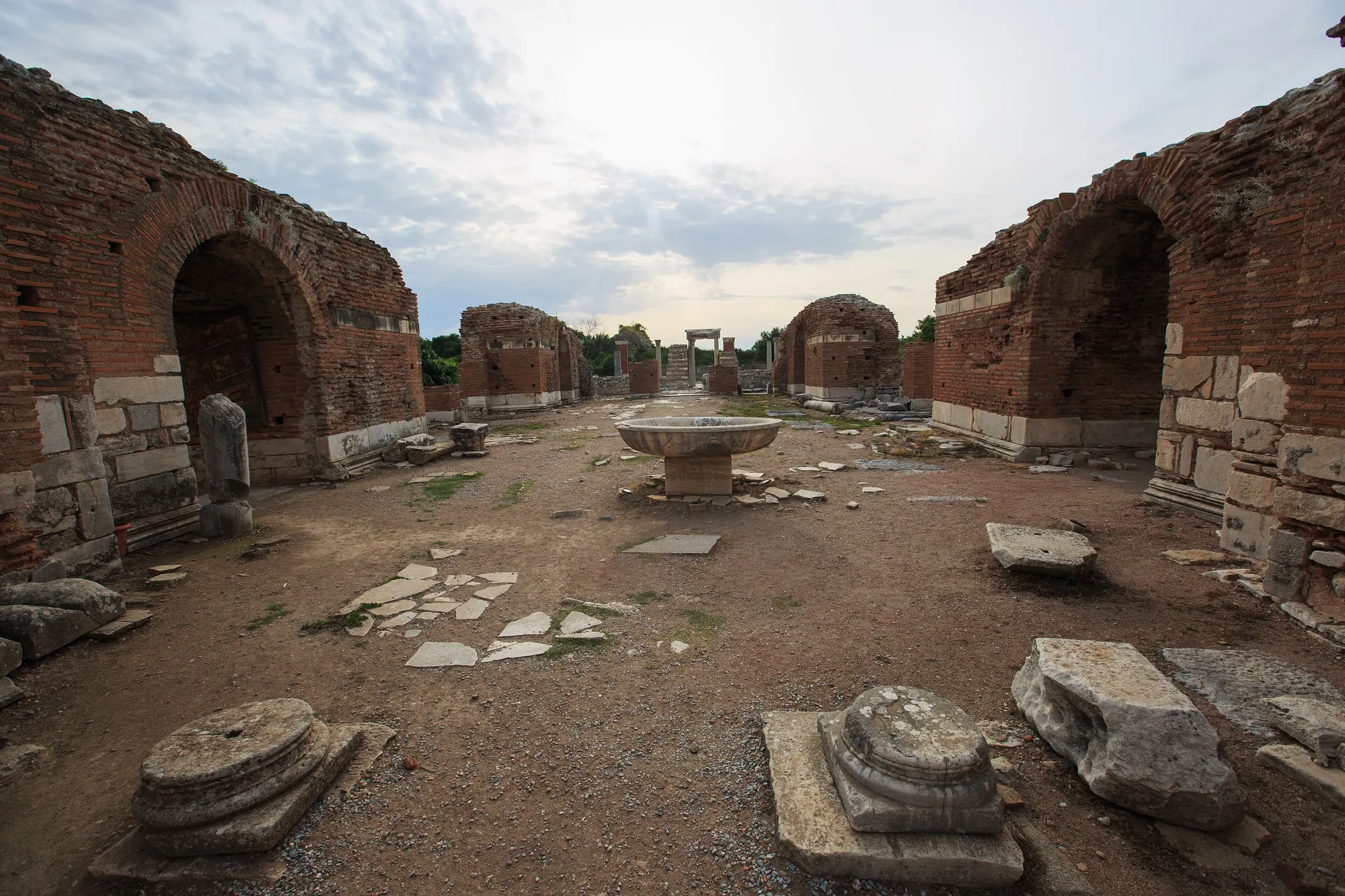
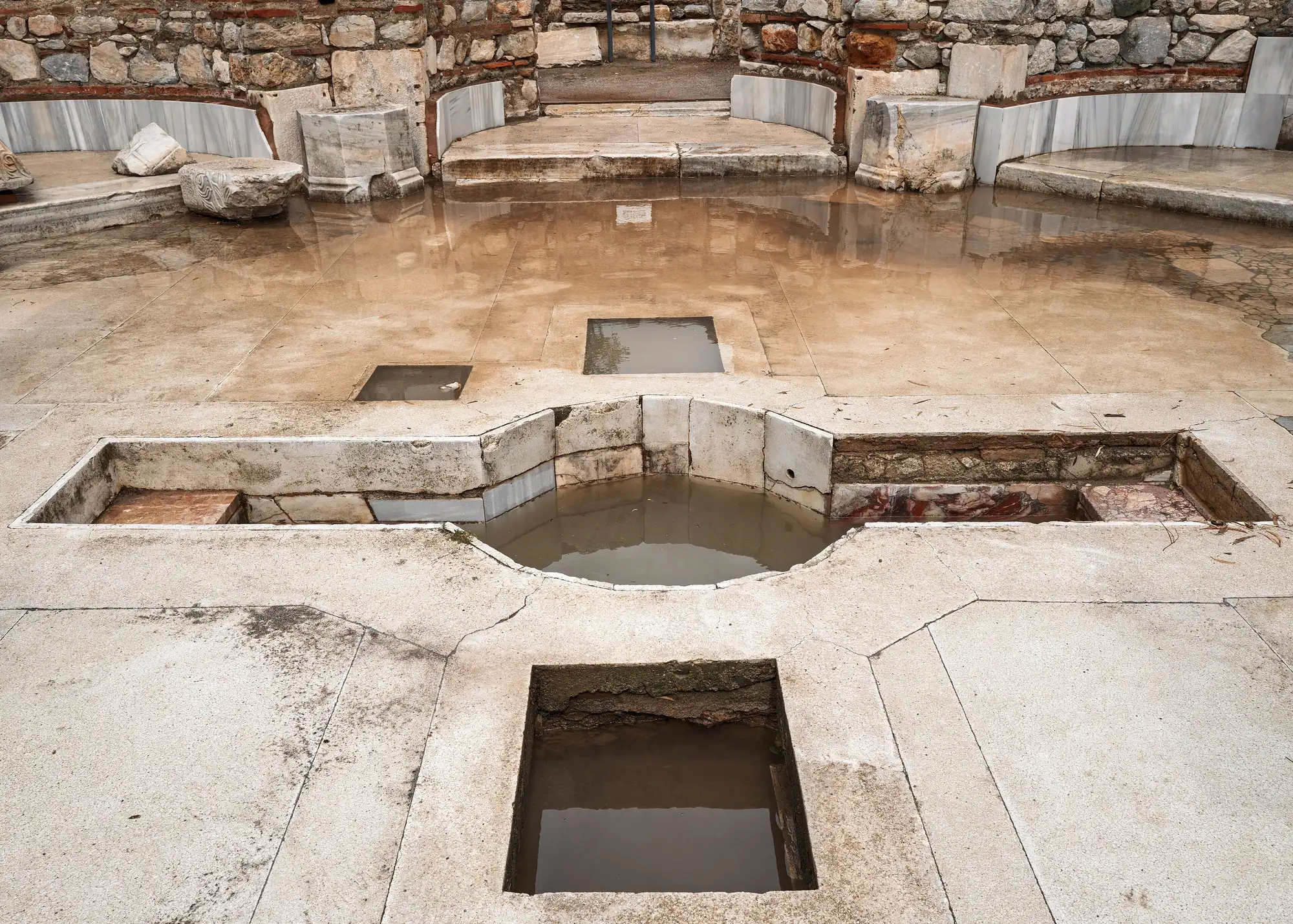
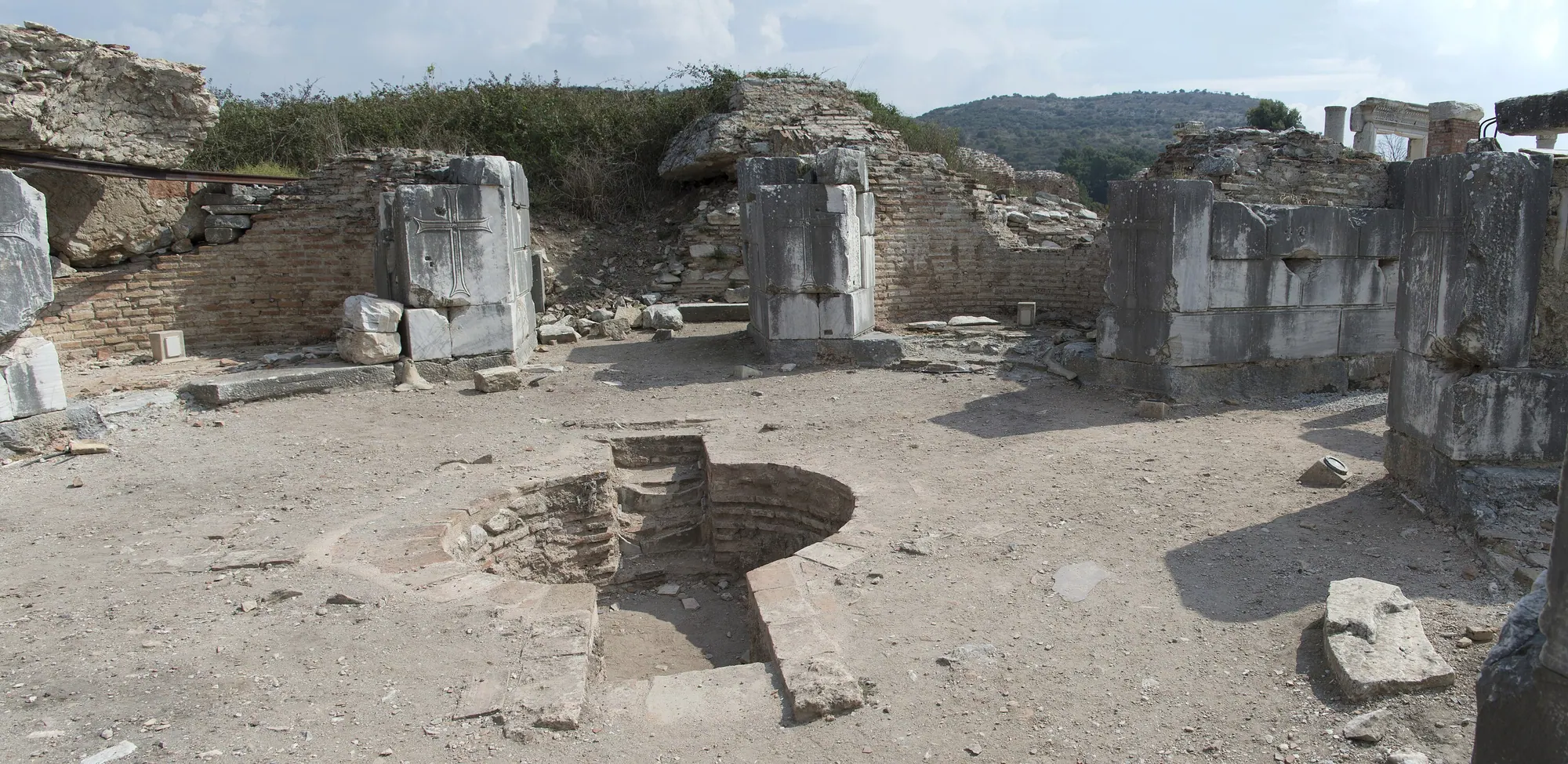
The building traditionally named as the venue is the Church of Mary near the harbour, fitted into the long southern hall of the precinct of Zeus Olympios and Hadrian, itself about 263 m long51. Whether it was already a church dedicated to Mary in 431 is uncertain: excavation suggests the hall was converted for the council and could not have carried Mary’s name before about AD 50052. On its west side is an octagonal baptistery53. When UNESCO inscribed Ephesus, it counted this church, the Basilica of St John and both councils among the city’s religious traditions54.

The Seven Sleepers
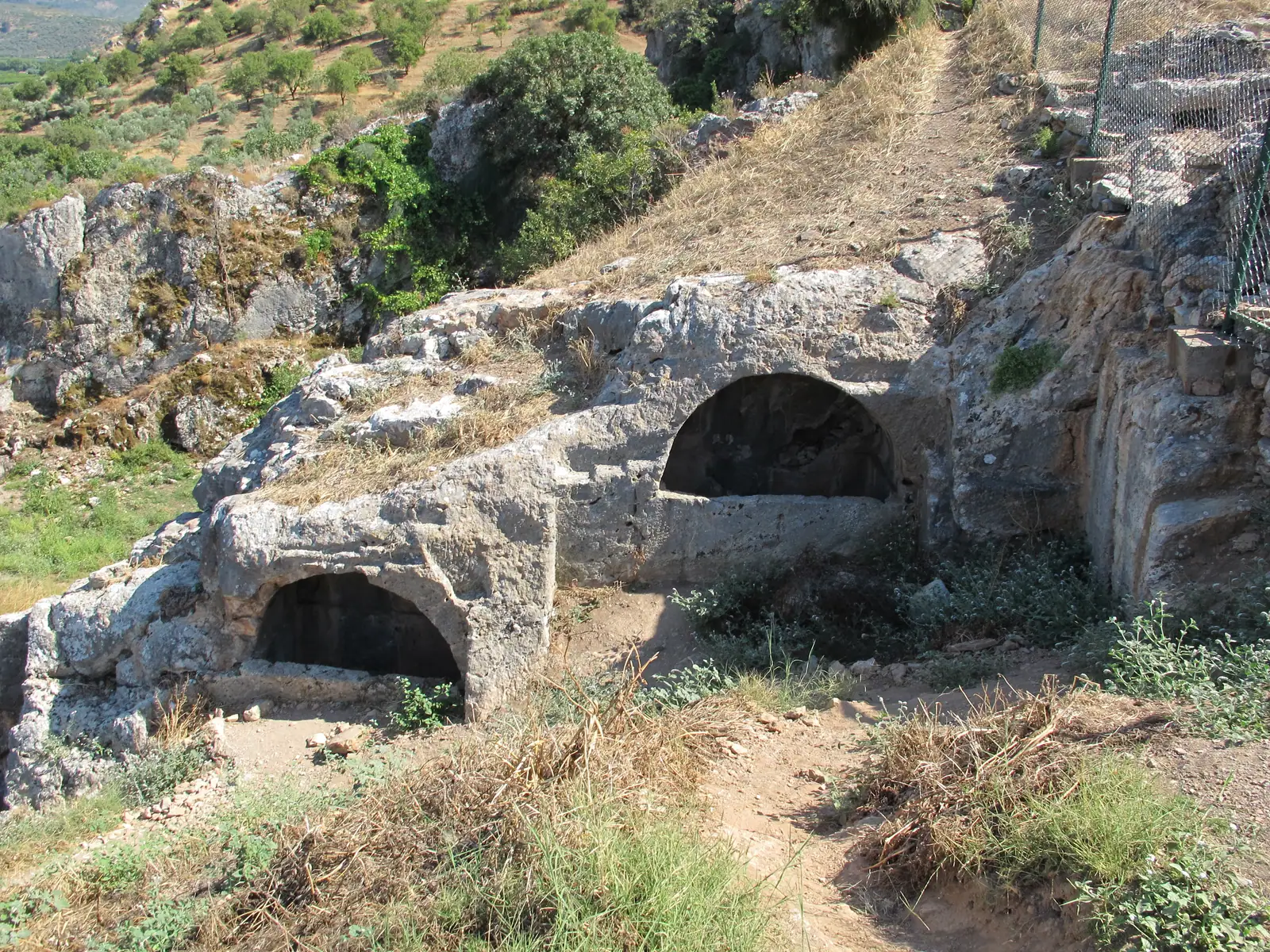
In the Christian legend, young believers of Ephesus fleeing the persecution of Decius (249–251) took refuge in a cave, were sealed inside, and woke under Theodosius II (408–450) as a sign that the body will rise again55. The oldest surviving telling is a Syriac poem by Jacob of Serugh, and in the 6th century Gregory of Tours carried the story to the Latin West56. Accounts cannot even agree how long the sleep lasted: 373 years in Gregory, about 200 in the Turkish Ministry’s version57.
The Qur’an tells a version in Sura 18, al-Kahf58. It does not fix the number of sleepers and says that God knows best; Islamic tradition usually takes seven and names their dog Qitmir59. The site at Ephesus is a late-antique cemetery and cave church on the eastern slope of Panayırdağ, dug by Austrian archaeologists in the late 1920s60. They uncovered hundreds of 5th- and 6th-century burials, some with inscriptions calling on the Sleepers61. Ephesus is not the only claimant: the Ministry notes that Muslims mostly identify the cave with Tarsus or Afşin, and there are rival sites near Amman, in Damascus and in Nakhchivan62.
Bishops, synods and a see in decline
By the 190s the bishops of Ephesus were a family affair, and their bishop Polycrates claimed John as one of the city’s dead63. Polycrates also led the Asian bishops in defending the Quartodeciman Easter, and Ephesus hosted a further council in 47564. For Byzantine pilgrims the city meant three graves above all: John’s, the Seven Sleepers’ and Timothy’s memorial65.
After Chalcedon the see answered to Constantinople, though it kept dozens of bishoprics under it into the 6th century66. Arab raids began in the 650s67, the Seljuks took Ephesus in 1090, and in 1439 its metropolitan, Mark of Ephesus, became the leading Orthodox voice against union at Florence68.
Ayasuluk under the Aydınids
Ayasuluk passed to the Aydınids in 1304, when Sasa Bey’s forces took the town69. For a while St John’s basilica served as a mosque8, until İsa Bey had a new one built at the foot of the hill in 1375, the work of an architect from Damascus7. Marble from the abandoned Artemision had already gone into the basilica, and some of it went into the mosque as well70.

Artemis: the older sacred Ephesus
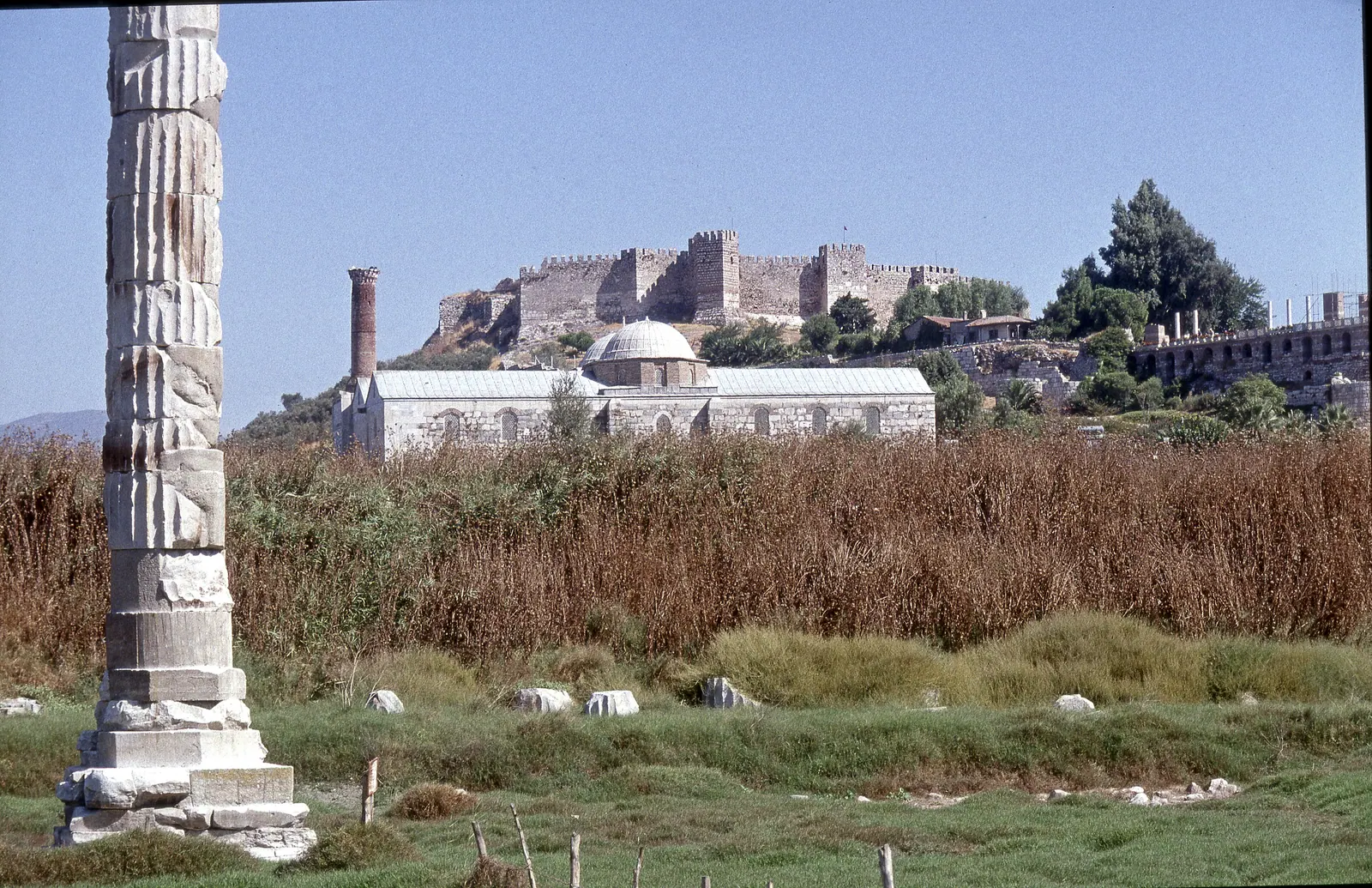
Long before any church, Ephesus was the city of Artemis. The riot in Acts turned on her: Demetrius feared for his trade and for the goddess’s majesty71. Her temple became a quarry, and carved fragments of its Archaic phase have been recovered from the Basilica of St John72. UNESCO’s third criterion for the site traces this religious continuity from Cybele and Meter to Christianity54, beginning at the Temple of Artemis.
Visiting the sacred sites
The sacred sites are spread over several kilometres. The Great Theatre stands in the ancient city17 and the Church of Mary near its old harbour51; the Basilica of St John is on Ayasuluk hill with the İsa Bey Mosque below it8; and the House of the Virgin Mary is up on Bülbüldağ, a drive from the Upper Gate73 and itself one of the four parts of the World Heritage property11.
Opening times and entry charges change and are kept on one page, Ephesus tickets and opening hours; routes from İzmir, Selçuk and Kuşadası are on Getting to Ephesus, and the hill of Ayasuluk and its neighbours on Around Ephesus.

In this section
House of the Virgin Mary
Meryem Ana Evi above Ephesus: a nun's visions, the 1891 rediscovery, what archaeology dates, what the Church has said, and why Muslims pray here too.
Basilica of St John
The Basilica of St John on Ayasuluk Hill: the tradition of John's tomb, Justinian's domed church, the Gate of Persecution, the castle and how to visit.

St Paul in Ephesus
Paul's years in Ephesus from Acts and his letters: the hall of Tyrannus, the silversmiths' riot, the prison debate and the grotto painted with Thecla.

Church of Ephesus
The church of Ephesus from Acts to Revelation 2: who founded it, what the letter says, and the city of Artemis, emperors and trade its Christians lived in.


Sources
Each source is listed once. The numbers link back to the claims it supports; dates show when the source was checked.
- bible-api.com › acts+18:18-28 1, 12
- de.wikipedia.org › Marienkirche_(Ephesos) 1, 2, 9, 29, 51, 52, 53
- bible-api.com › 1+corinthians+16:8-9 2
- bible-api.com › 1+timothy+1:3 3
- www.newadvent.org › 250103.htm 3
- bible-api.com › revelation+1:11 4
- en.wikipedia.org › Seven_churches_of_Asia 4, 20
- www.newadvent.org › 05490a.htm 5, 12, 17, 19, 23, 24, 32, 53, 64, 66, 68
- en.wikipedia.org › Epistle_to_the_Ephesians 5
- www.livius.org › ephesus 6
- en.wikipedia.org › Ephesus 6, 7, 25, 31, 67, 69
- it.wikipedia.org › Efeso 6, 70
- web.archive.org › Ephesus 7, 34
- islamansiklopedisi.org.tr › ayasuluk 7, 34
- islamansiklopedisi.org.tr › isa-bey-camii--izmir 7
- turkisharchaeonews.net › selçuk 7, 34
- en.wikipedia.org › İsa_Bey_Mosque 7
- izmir.ktb.gov.tr › stjean-kilisesi-ve-ayasuluk-tepesi-kazisi--selcuk.html 8
- www.kulturportali.gov.tr › ayasuluk-tepesi-ve-st-jean-aniti-oren-yeri- 8, 35, 36
- turkisharchaeonews.net › basilica-saint-john-and-ayasuluk-fortress 8, 33, 35, 36, 37, 68
- bible-api.com › acts 19:8 9
- www.newadvent.org › 11567b.htm 9
- tyndalebulletin.org › 29221.pdf 9
- en.wikipedia.org › Acts_19 9, 14, 15, 17
- www.austriaca.at › 0xc1aa5572 0x0014a7d8.pdf 10, 22, 38, 39, 40, 42, 43, 44, 65
- en.wikipedia.org › Basilica_of_St._John 10
- web.archive.org › multiple=1 11
- web.archive.org › 1018 11
- goephesus.com › ephesus--unesco-world-heritage-centre 11
- whc.unesco.org › 6387 11, 54
- whc.unesco.org › 1018 11
- bible-api.com › acts+19 13, 15, 16, 27
- www.newadvent.org › act019.htm 13, 16
- www.freebiblecommentary.org › VOL03B_19.html 14
- Acts 19:23-41 18, 71
- en.wikipedia.org › Temple_of_Artemis 18
- bible-api.com › acts+20:16-38 19, 24
- bible-api.com › revelation+2:1-7 20
- bible-api.com › john+19:25-27 21
- www.vatican.va › hf_ben-xvi_hom_20061129_ephesus.html 21
- de.wikipedia.org › Haus_der_Mutter_Maria 22, 38, 40, 41, 42, 44, 52
- web.archive.org › Saint-John-the-Apostle 23
- www.newadvent.org › 0103303.htm 23
- www.newadvent.org › 250105.htm 23, 63
- www.biblegateway.com › passage 25
- de.wikipedia.org › Ephesos 25
- www.bestephesustours.com › the-city-walls-of-ephesus-magnesia-gate.html 26
- www.viaurbis.com › the-hellenistic-city-wall 26
- etsjets.org › files_JETS-PDFs_61_61-3_JETS_61.3_549-558_White.pdf 27, 29
- www.archaeologie-online.de › apostel-paulus-unter-tuenche-760 28
- www.bibleplaces.com › the-grotto-of-saint-paul-in-ephesus 28
- austriaca.at › 0xc1aa5572_0x001e1d58.pdf 28
- doi.org › hist.2020.848 30
- en.wikipedia.org › Temple_of_the_Sebastoi 30
- Brickell, citing Burrell 2004 and Friesen 1993 31
- en.wikipedia.org › John_the_Apostle 32, 33
- www.blueguides.com › the-shifting-fortunes-of-ephesus-its-rise-and-fall-and-rise 34
- austriaca.at › 0xc1aa5576_0x001c9934.pdf 34
- en.wikipedia.org › Ayasuluk_Hill 34
- kar.kent.ac.uk › LAAJ_009_11-Karydis.pdf 35
- de.wikipedia.org › Johanneskirche_(Ephesos) 36, 37
- en.wikipedia.org › Anne_Catherine_Emmerich 39
- en.wikipedia.org › House_of_the_Virgin_Mary 40, 41, 43, 73
- turkisharchaeonews.net › house-virgin-mary-ephesus 41
- en.wikipedia.org › Tomb_of_the_Virgin_Mary 42
- fr.wikipedia.org › Maison_de_la_Vierge_Marie 43
- www.hzmeryemanaevi.com › en 44
- www.newadvent.org › 05491a.htm 45, 46, 47, 48
- en.wikipedia.org › Council_of_Ephesus 45, 46, 47, 48
- www.newadvent.org › 05495a.htm 49, 50
- en.wikipedia.org › Second_Council_of_Ephesus 49, 50
- www.cambridge.org › 988373D4ACA691E1D027C304C3E87088 51, 52
- www.worldheritagesite.org › ephesus 54
- www.newadvent.org › 05496a.htm 55, 56
- www.kulturportali.gov.tr › yedi-uyuyanlar-magarasi 55, 57, 59, 60, 61, 62
- en.wikipedia.org › Seven_Sleepers 55, 56, 57, 58, 59, 60, 61, 62, 65
- api.alquran.cloud › en.sahih 58
- doi.org › cbo9780511599491.003 58
- doi.org › ejoss_v03i1004 58
- turkisharchaeonews.net › grotto-seven-sleepers-ephesus 58, 60, 61
- digitalwindow.vassar.edu › 3 58
- api.alquran.cloud › en.sahih 59
- en.wikipedia.org › Polycrates_of_Ephesus 63, 64
- en.wikipedia.org › Third_Council_of_Ephesus 64, 66
- www.thebyzantinelegacy.com › ephesus 67, 69
- en.wikipedia.org › Aydinids 69
- Kraft, Brückner, Kayan, Engelmann 2007, Geoarchaeology 22:121-149, doi:10.1002/gea.20151 70
- www.worldhistory.org › ephesos 70
- en.wikipedia.org › Riot_of_the_Ephesian_silversmiths 71
- Ohnesorg 2007, Der Kroisos-Tempel, Forschungen in Ephesos XII/4, ch. I, ÖAW 72
- de.wikipedia.org › Tempel_der_Artemis_in_Ephesos 72
- www.hzmeryemanaevi.com › location 73
- OSRM car/foot profiles over OpenStreetMap, our query 2026-09-14 73