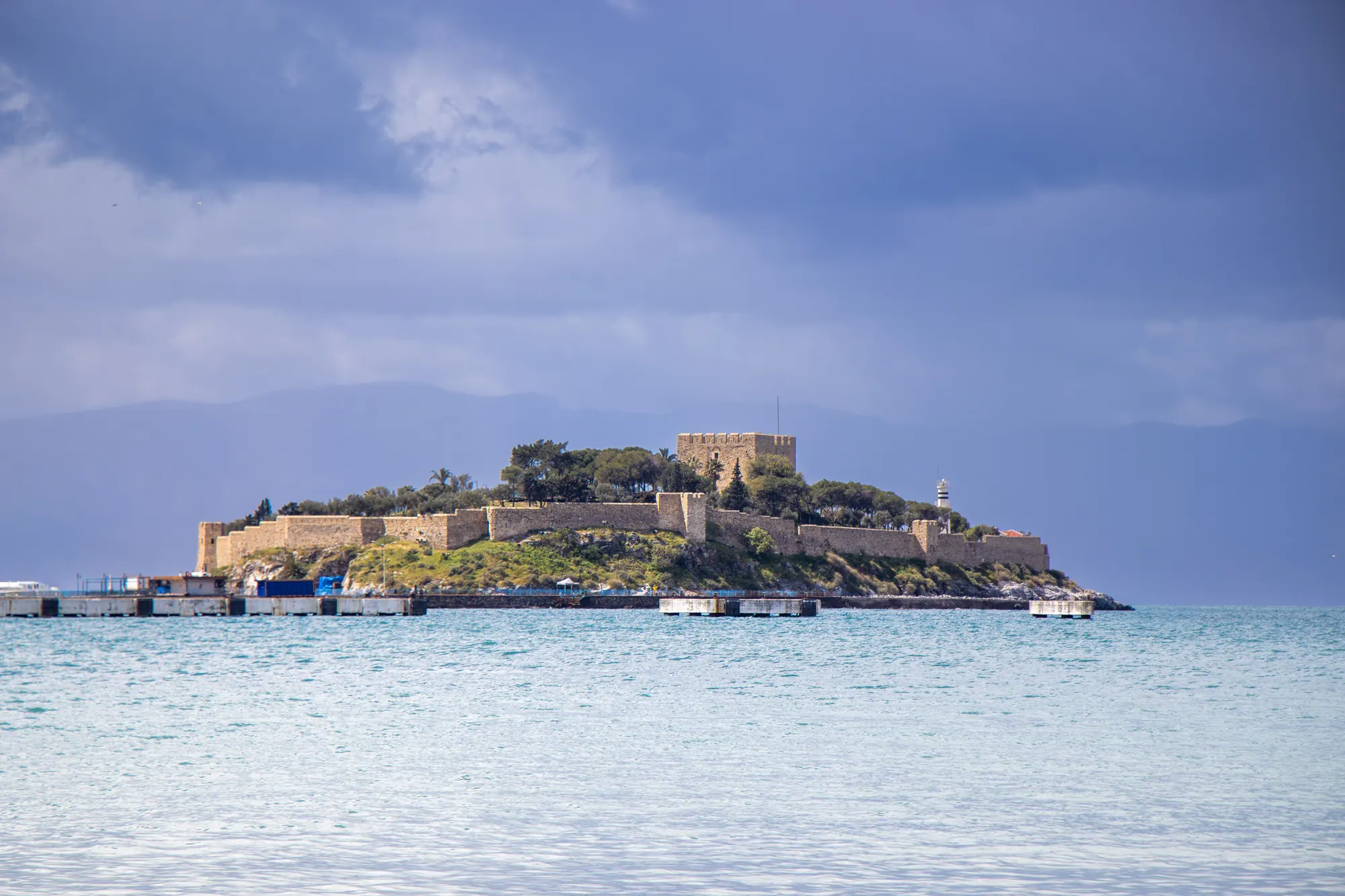
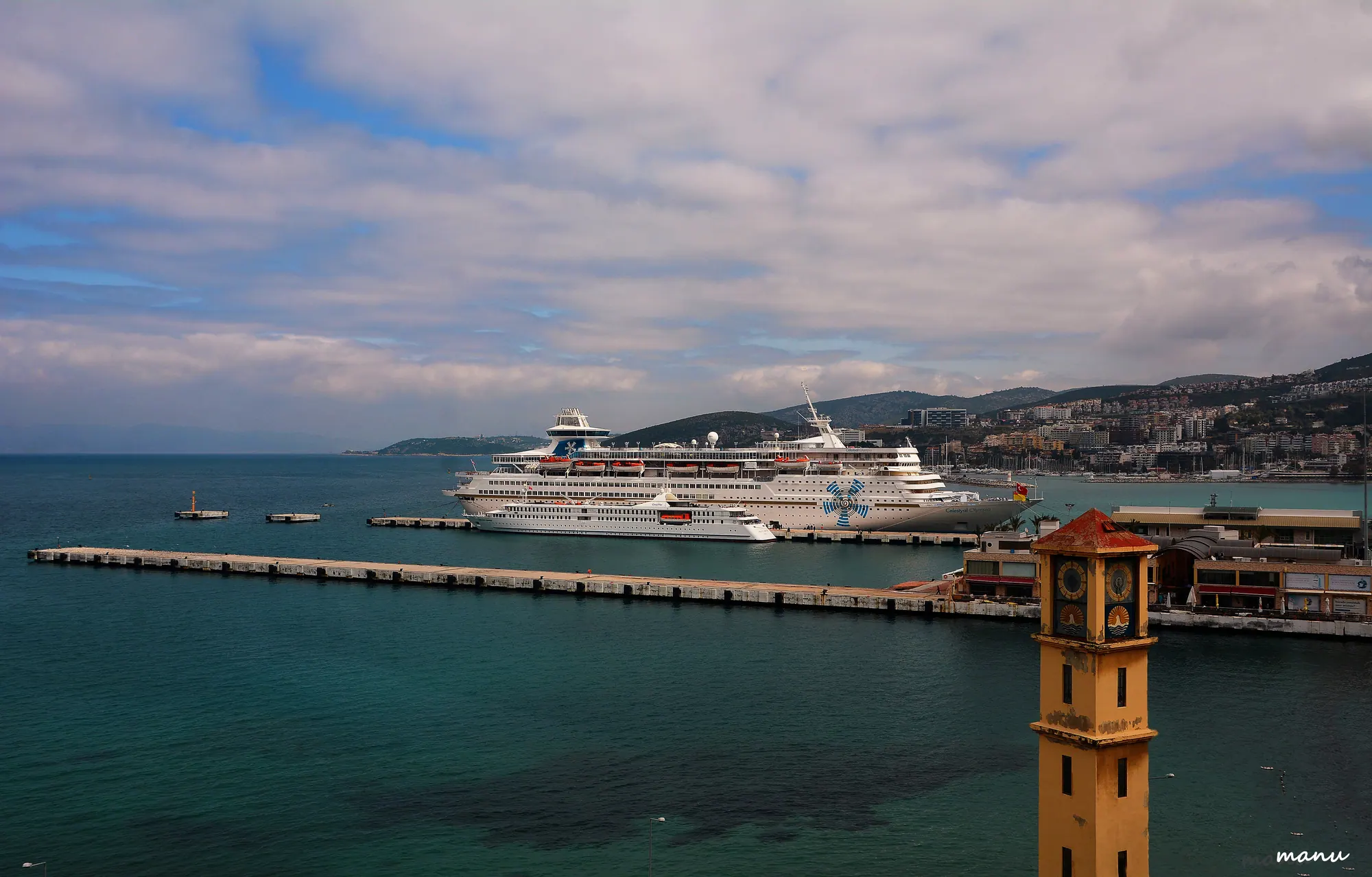
Kuşadası cruise port is about 19 km by road from the Lower Gate of Ephesus and about 23 km from the Upper Gate, a drive of roughly 20 to 25 minutes to the nearer gate on a clear road1. With a fixed all-aboard time, the gate, the heat and the ship crowds decide more about the day than the distance does.
How far is Ephesus from Kuşadası cruise port?
The ruins are about 19 km by road from the ship to the Lower Gate, on the Selçuk side to the north, and about 23 km to the Upper Gate in the south12. On an empty road the nearer gate is 20 to 25 minutes away1.
There is an old irony in the drive. Ephesus was itself a harbour city, but silt carried down by the Küçük Menderes, the river the Greeks called the Kaystros, has pushed the shoreline steadily west8, leaving the ruins marooned some 5 km from open water9. The ships now berth at Kuşadası instead.
Should you start at the Upper Gate or the Lower Gate?
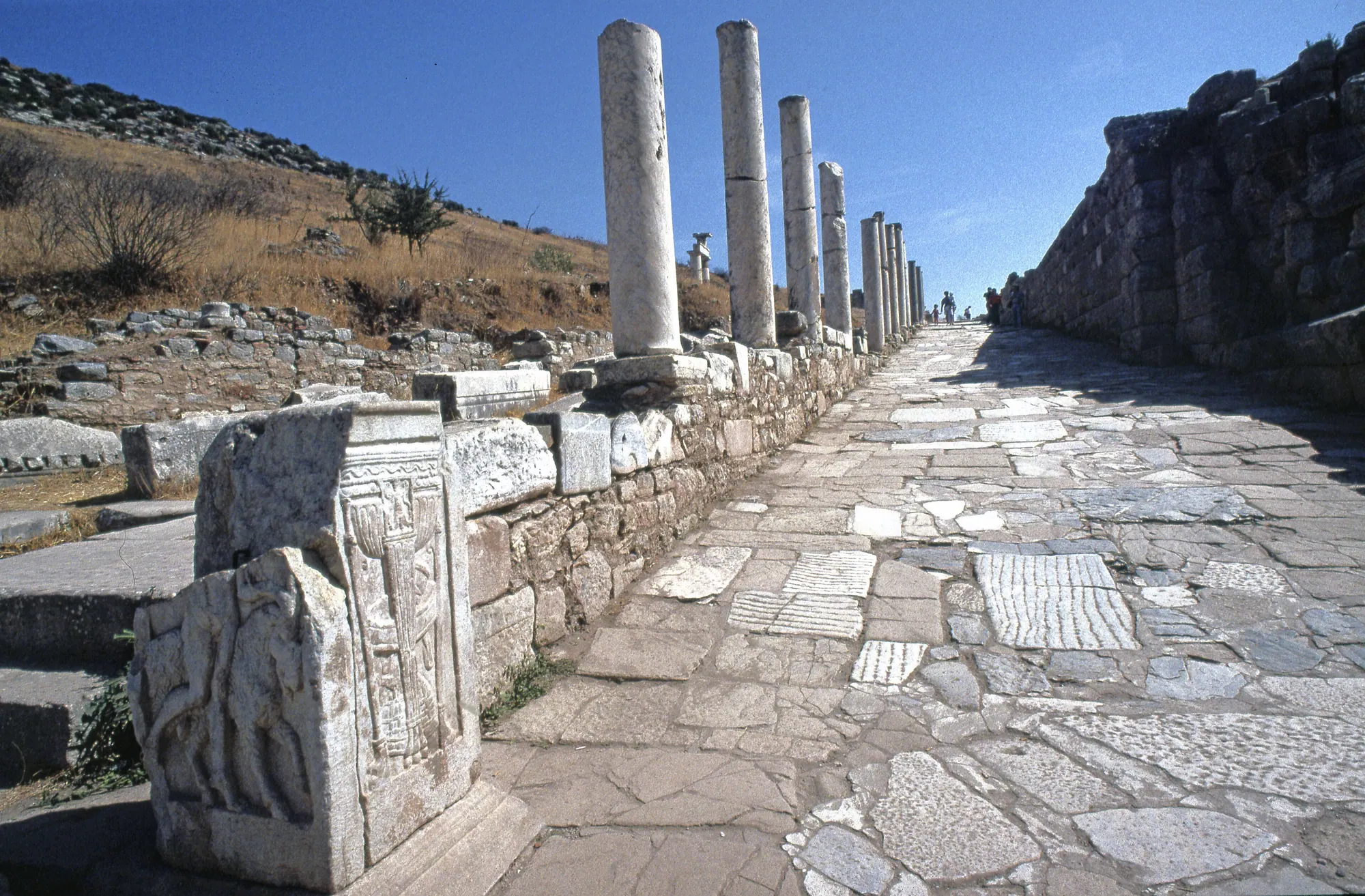
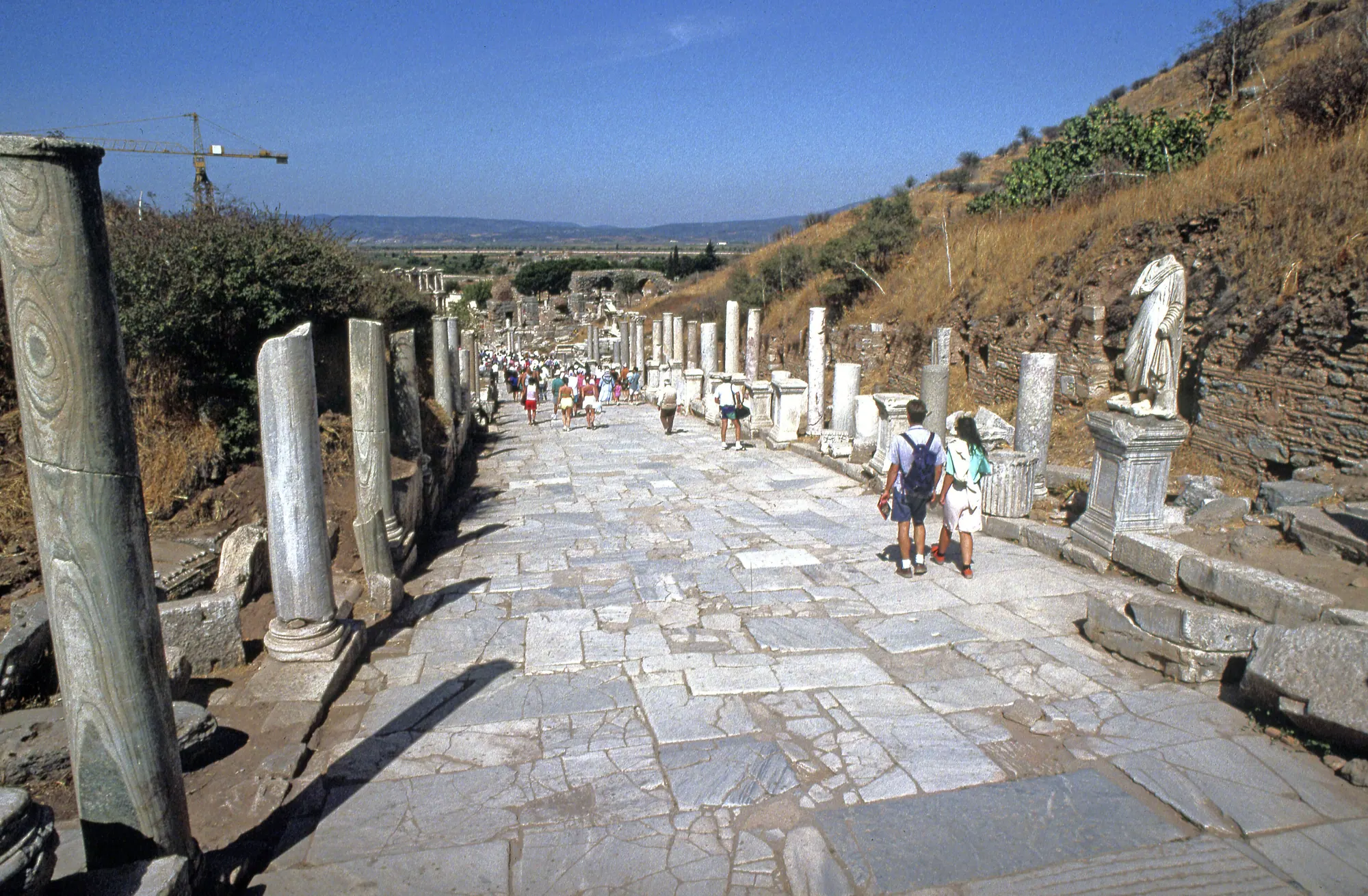
Start at the Upper Gate if you can, and finish at the Lower. Curetes Street, the main street through the centre of the city, runs for roughly 210 m from the Hercules Gate to the Library of Celsus and falls about 20 m on the way3. Taken from the top, it is a walk downhill in the heat, with the Library of Celsus coming into view at the bottom.
The Upper Gate is a modern entrance, not an ancient one. The Magnesian Gate, the largest gate of ancient Ephesus, stands about 300 m south of it on the old road to Magnesia10.
Starting at the top only works if your transport meets you at the bottom, so anyone making their own way should agree where the car or taxi will wait before setting off.
A cruise-day route through the ruins
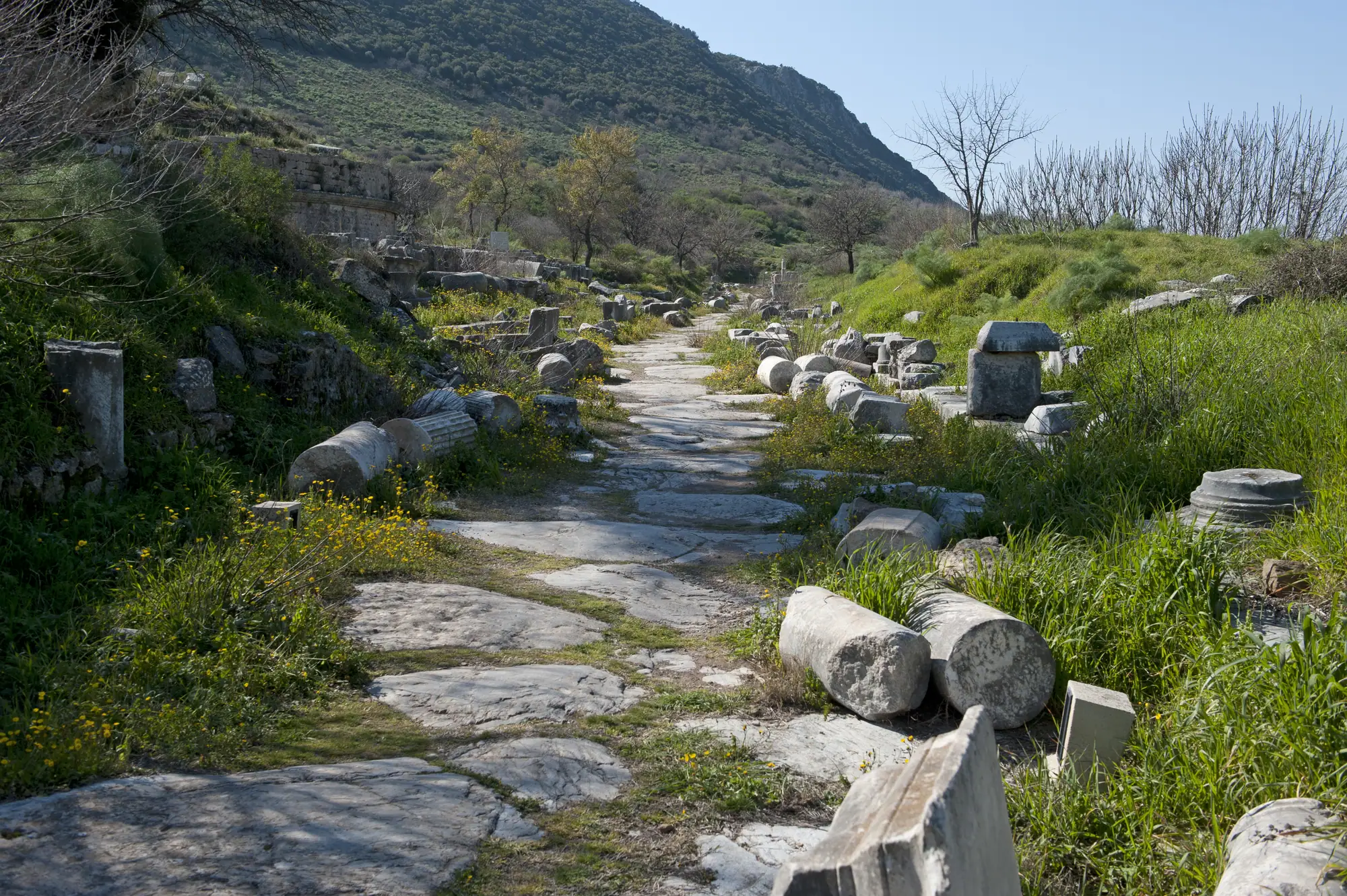
The downhill route follows the city’s spine. From the upper city, Curetes Street leads down to the Library of Celsus11, and the Terrace Houses, the roofed Roman houses on the slope above the street, open off it12. Beyond the library the way continues to the Great Theatre and the colonnaded Harbour Street, named after the emperor Arcadius, who rebuilt it13. Each monument, in the order you reach it, is part of the walking route through the ancient city, and the gates and paths are marked on the site plan.
Crowds on a ship day
The 2025 port totals in the factbox count cruise calls and passenger movements5. They are not counts of people visiting Ephesus. Several ships in port at once can mean a busy day at the ruins. In 2022 the museum director said cruise passengers from Kuşadası and İzmir made up the majority of visitors to Ephesus, and that a day with three ships in brought about 5,000 of them14. The site’s total for 2025: 2,550,45815 (checked on ), the highest of any museum or archaeological site in Turkey15.
Aim for the earliest gate arrival your ship’s schedule allows. Work backwards from your ship’s all-aboard time when arranging the return: the clear-road driving estimate leaves out queues, traffic and getting through the terminal. Agree a return time with your driver and keep a buffer for delays.

Summer heat
July and August are the hottest months: reanalysis data for the Ephesus area give an average daily high of 35.6 °C in July and 35.2 °C in August, with about 17 to 18 days a month reaching 35 °C or more4. In high summer, carry water and start early.
Rain is rarely the problem on a cruise day. It falls almost entirely between October and April, and June to September are nearly dry16. The comfortable seasons are spring and autumn, with average highs of about 26 °C in May and 30 °C in September17.
What does the ticket cover?
The foreign-adult ancient-city ticket costs €4018 (checked on ) and includes the Ephesus Experience Museum18; the Terrace Houses are extra19. Of the Ministry’s two 72-hour combined tickets, the smaller adds the Terrace Houses and the larger adds the Ephesus Museum and the Basilica of St John site as well6. The Ministry’s audio guide comes with a foreign visitor’s ticket wherever the service exists20. Prices change on 1 April 202719.

Can you see more than the ancient city in one day ashore?
An early start and a late all-aboard leave room for one addition, rarely three.
- The House of the Virgin Mary. The shrine is about 5 km by road from the Upper Gate, or 11 km from the Lower Gate, and buses do not run there21. It fits best before the ruins: drive up first, then enter at the Upper Gate.
- The Temple of Artemis. The temple that Antipater of Sidon set above the other wonders of the world22 is now a field with a single column, reassembled from fragments found on the site23.
- Selçuk. Above the town, on Ayasuluk Hill, stand the Byzantine fortress and the Basilica of St John, which Justinian began in the 6th century24.
- Şirince. The hill village is about 28 km from the port and about 10 km from the Lower Gate7.
Tour guides are licensed in Turkey, and TUREB, the guides’ union, keeps a public database in which a guide’s licence can be checked25; a licence lets its holder guide only in the languages on the working card26.
Kuşadası before the cruise ships
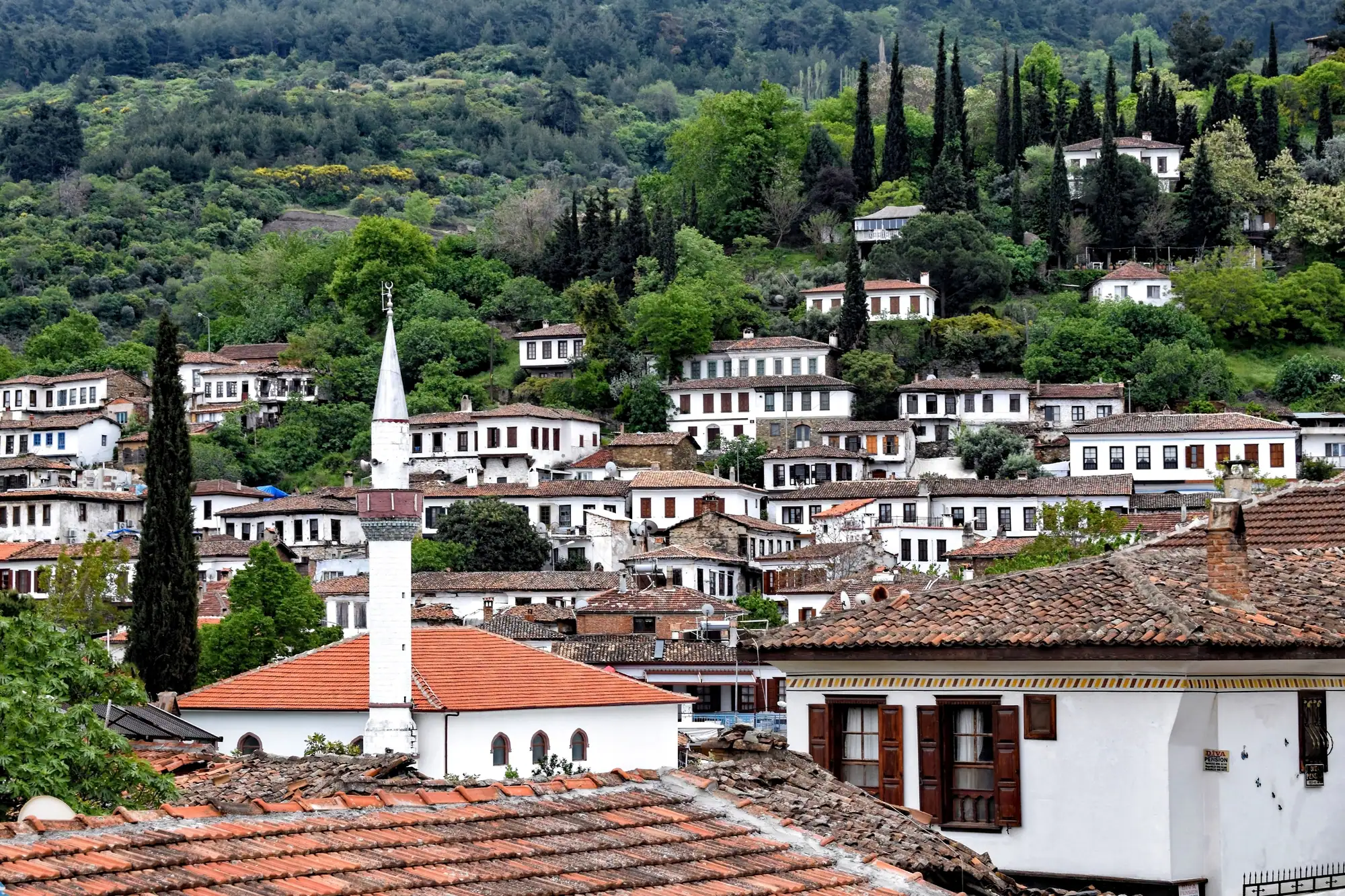
Kuşadası grew from a medieval trading post27. Türkiye’s UNESCO Tentative List entry describes Genoese merchants arriving in the late 13th or early 14th century, walling a new town and setting up a castle, the “New Pier” or Scalanova, on Güvercinada, the island now joined to the shore27. The castle is about 350 m long and about 200 m wide, with four towers and a small central citadel, and it went on the Tentative List in 2020 together with the town walls27.
The two towns have long been linked. Selçuk, the town beside Ephesus, belonged to Kuşadası until 1957, when it became a district of İzmir province28; the other ways in and out of Ephesus are set out in getting to Ephesus.
Sources
Each source is listed once. The numbers link back to the claims it supports; dates show when the source was checked.
- OSRM car/foot profiles over OpenStreetMap, our query 2026-09-14 1, 7, 21
- OpenStreetMap nodes: Lower Gate 37.9454,27.3421; Upper Gate 37.9355,27.3462; Selçuk station 37.9509,27.3729 2
- muze.gov.tr › muze-detay 2, 18, 20
- turkishmuseums.com › 4 2, 18
- www.austriaca.at › 9783700183419 3
- turkisharchaeonews.net › curetes-street-ephesus 3, 11
- ERA5 reanalysis, grid 37.945N 27.345E, daily 1996-2025, our aggregation 4, 16, 17
- www.mgm.gov.tr › il-ve-ilceler-istatistik.aspx 4, 16, 17
- www.mgm.gov.tr › il-ve-ilceler-istatistik.aspx 4, 16, 17
- denizcilikistatistikleri.uab.gov.tr › kruvaziyer-istatistikleri-2025 5
- denizcilikistatistikleri.uab.gov.tr › kruvaziyer-istatistikleri-2026 5
- www.ephesustoursbylocals.com › entrance-fees 6
- dosim.ktb.gov.tr › 132665,kambine-biletpdf.pdf 6
- en.wikipedia.org › Şirince 7
- tr.wikipedia.org › Şirince 7
- Kraft, Brückner, Kayan, Engelmann 2007, Geoarchaeology 22:121-149, doi:10.1002/gea.20151 8
- Stock, Pint, Horejs, Ladstätter, Brückner 2013, Quaternary International 312:57-69 8
- web.archive.org › 1018 8
- www.oeaw.ac.at › ephesos-bio-geo-archive 8
- turkisharchaeonews.net › harbour-ephesus 9
- whc.unesco.org › 6387 9
- en.wikipedia.org › Ephesus 9, 13
- web.archive.org › magnesian-gate.html 10
- turkisharchaeonews.net › magnesian-gate-area-ephesus 10
- de.wikipedia.org › Kuretenstraße 11
- www.oeaw.ac.at › research-history 12
- www.petersommer.com › ephesus-terrace-house-2 12
- de.wikipedia.org › Hanghäuser_von_Ephesos 12
- turkisharchaeonews.net › arcadiane-harbour-street-ephesus 13
- www.aa.com.tr › 2587714 14
- www.turizmgunlugu.com › turkiyenin-en-cok-ziyaret-edilen-muzeleri 14, 15
- www.egetelgraf.com › izmir-efes-oren-yeri-turkiyede-zirvede-174-milyon-ziyaretci 15
- dosim.ktb.gov.tr › muze-ve-oren-yeri-ucretleri.html 18, 19
- izmir.ktb.gov.tr › izmir-ili-muze-ve-oren-yerleri-giris-ucreti-tarifesi.html 18, 20
- www.tursab.org.tr › 3ce94ed3-2265-4180-8a87-594371bcf0b5.pdf 19, 20
- www.tursab.org.tr › fd72b227-0a27-46f5-b7e8-25fe4f9a17d5.pdf 19
- www.tursab.org.tr › 2027-yili-muze-ve-orenyeri-giris-ucretleri-hakkinda-duyuru 19
- muze.gov.tr › muze-detay 20
- muze.gov.tr › muze-detay 20
- www.hzmeryemanaevi.com › location 21
- en.wikipedia.org › House_of_the_Virgin_Mary 21
- anthologiagraeca.org › urn:cts:greekLit:tlg7000.tlg001.ag:9.58 22
- www.livius.org › seven-wonders-of-the-ancient-world 22
- en.wikipedia.org › Temple_of_Artemis 22, 23
- de.wikipedia.org › Tempel_der_Artemis_in_Ephesos 23
- Cartwright 2018 23
- muze.gov.tr › muze-detay 24
- en.wikipedia.org › Ayasuluk_Hill 24
- www.mevzuat.gov.tr › 1.5.6326.pdf 25, 26
- RehberVeritabani guide database link 25, 26
- www.tureb.org.tr › RehberVeritabani 25
- web.archive.org › 6468 27
- en.wikipedia.org › Güvercinada 27
- islamansiklopedisi.org.tr › ayasuluk 28
- www.selcuk.bel.tr › selcuk-belediyesi-tarihcesi 28
- turkisharchaeonews.net › selçuk 28
- www.visitizmir.org › 243 28