
İsa succeeded his brother Hizir as ruler of the Aydınid beylik around 1360 and held it for thirty years; under him, Ayasuluk reached its commercial peak, its trade revenue paying for the mosque and other monumental building, Foss records1. Clive Foss, writing in 1979, called the mosque the first major civic building put up at Ephesus since the age of Justinian, and, in his own moment, the last on that scale — a verdict of 1979, not a timeless one2.
Something of the town’s ordinary civic fabric survives from just before the mosque went up. In 1339 the visiting Archbishop Matthew received a hostile welcome at Ayasuluk: townsmen threw stones at the house where he was staying and broke its roof tiles, evidence Ladstätter uses to argue that ordinary roof tiles, not just the special coverings of monuments, were common on the town’s civic buildings3.
Ladstätter and Magdalino argue the mosque also answered a specific need. By 1304 the Basilica of St John, though thoroughly looted after the town’s surrender, was probably a patched but still-usable shell rather than a ruin — not yet the mosque it would briefly become. On this reading, the Aydınids needed an authentically Islamic building of their own, and that need, not just wealth or piety, shaped İsa Bey’s decision to build on a monumental scale4.
What the inscription says
The mosque’s Arabic foundation inscription, cut above the main portal, does something unusual for a building of its date: beside the founder’s name, in smaller lettering, it names the man who designed it. Two independent readings of the text agree on the name — Ali ibn al-Dimashqi, “Ali, son of the Damascene”: Karabacek’s 1906 decipherment of the inscription’s damaged section, worked from a plaster cast and published in the Institute’s original Forschungen in Ephesos volume, and Bayat’s 1991 edition of the published Arabic text, as reported by Ladstätter and Magdalino5. An architect named on the building he designed is not the norm for a 14th-century Anatolian mosque, and it is the detail the inscription is best remembered for.
The same damaged section has been read two ways for its date. Ladstätter and Magdalino, citing Bayat’s 1991 edition of the Arabic text, read the month as Shawwal: 9 Shawwal 776 AH, which converts to 13 March 13756 — refining, to the day, the “March 1375” long given for the mosque. Karabacek’s earlier 1906 decipherment of the same passage, working directly from the damaged stone by way of a cast, instead read the month as Sha’ban: 9 Sha’ban 776 AH, or 13 January 13757. That second reading belongs in a footnote, not as a rival headline — it is a paleographic variant on which month name the worn inscription actually carries, not a different calculation. A third date sometimes met in print, Clive Foss’s 30 January 1375, fits neither reading and should be treated as superseded: it falls some seventeen days short of the Sha’ban conversion and about seven weeks short of the Shawwal one, and is most likely Foss’s own transcription or conversion slip rather than a third reading of the stone8.
The building itself is a rectangle 56.53 by 48.68 m, laid out on the pattern of the Umayyad Mosque of Damascus (built AD 706–714/15): a prayer hall along one side, an arcaded, colonnaded courtyard filling the rest, Ladstätter and Magdalino write9. It originally carried twin minarets, one at each end of the prayer hall — a pairing found with no other prayer hall of its period, and not repeated until much later royal Ottoman foundations, they note10.
Built from older Ephesus
The mosque’s grandest columns are not its own. Elliger identifies red columns from the frigidarium of the Harbour Baths at Ephesus reused inside the building, and Ladstätter and Magdalino separately describe four colossal columns standing in the prayer hall — two of red Aswan granite framing two grey monoliths — arranged to frame the view toward the mihrab and probably drawn from the same harbour complex11: two independent identifications of a specific donor building, where the site has generally pointed only to “Artemision marble” in the vaguest terms.
The front of the mosque is evidently faced with the same brilliant white marble which made the temple of Diana shine like a meteor at the head of the port. The mosque has precisely the same striking effect at present, and no doubt the church of Justinian was constructed with the spoils of the temple; the rich columns within the mosque are undoubted evidence of it.
Arundell traced the marble to the temple; the identifications above point more precisely to the Harbour Baths, itself very likely built from older, re-used stone. Both agree the mosque’s fabric is older than the mosque.
Ladstätter argues the plan itself carries the architect’s origin: naves running parallel to the qibla wall, crossed by a transverse nave, a layout that recalls the Ulu Cami of Diyarbakır and, again, the Umayyad Mosque of Damascus12. Evliya Çelebi, writing in the mid-17th century, records that visitors removed their shoes on entering the courtyard itself, not only the prayer hall — a Syrian custom, as Ladstätter and Magdalino read it, extending the ritual purity of the whole enclosure rather than the prayer hall alone13.
Little of the original decoration survives complete. Ladstätter and Magdalino note that the mihrab’s calligraphy has been reconstructed from fragments recovered in İzmir, combining a kufic invocation of God with a thuluth-script Qur’anic verse calling on believers to bless and salute the Prophet14, and that the calligraphic inscriptions that once filled the mosque’s north and east portals were removed at some point and now survive built into two different mosques in İzmir, the Kestanepazarı Camii and the Çorakkapı Camii15. One detail often taken for a purely Ottoman signature turns out to be older: the dogtooth cornice common on Ayasuluk’s Turkish monuments, later called “characteristically Ottoman”, was itself inherited from Byzantine architecture, Ladstätter finds16.

A court, not just a court mosque
The richest material about İsa Bey has nothing to do with his mosque’s stonework. Foss and, separately, Ladstätter and Magdalino both place the poet Ahmedi — regarded as the leading Turkish poet of the 14th century — at İsa’s court at Ayasuluk: Foss records him composing study aids for İsa’s son, and Ladstätter and Magdalino add that he produced an Arabic–Persian dictionary there before later dedicating his own Turkish Alexander romance to a different patron17. İsa Bey also had a large, multi-part Qur’an produced for his new mosque: Foss records thirty manuscripts of the Qur’an copied for its use, and Ladstätter and Magdalino describe a single Qur’an in thirty parts, one volume of which survives in a private collection — most likely the same conventionally thirty-volume Qur’an described two ways rather than two different objects18.
Other scholars and writers were drawn to the same small court. Foss records that the physician Haji Pasha of Konya, serving as judge, dedicated his major medical manual to İsa Bey in 138119, and that in 1367 the writer Fahri dedicated to him his Turkish translation of the Persian romance Khosro and Shirin, part of an early flowering of written Turkish literature at Ayasuluk20. Michael Ducas — grandfather of the later Byzantine historian Doukas — fled Constantinople after a conspiracy and took refuge at İsa Bey’s court; a learned physician and a Christian at a Muslim ruler’s table, he was welcomed, salaried and allowed to settle at Ephesus, Foss adds21.
İsa’s wife, Azize Hatun, matched him in philanthropy of her own: she endowed a public soup kitchen and a mosque, and together the couple funded pious foundations with income from a bath, a mill, a candle factory, a linseed-oil press, vineyards and land — a far larger charitable footprint than survives from Hizir’s own reign, which funded only a single mosque, built by his wife, Foss records22.
Two myths, and a scholarly dispute
The mosque’s marble-faced exterior and richly decorated portal so impressed early travellers, visiting after Ayasuluk’s decline following Tamerlane’s invasion, that some mistook the building itself for a converted Church of St John — a misreading Foss and, independently, Ladstätter and Magdalino both record23. It is one of two myths worth clearing up here; the other concerns priority. Katharina Otto-Dorn called the İsa Bey Mosque the oldest known Turkish mosque built with a courtyard. Godfrey Goodwin, as reported by Ladstätter and Magdalino, points instead to the Ulu Cami at Manisa — built in 1374 by İshak Bey of the Saruhan clan, one year earlier — as also having an integral courtyard24. Neither claim is adjudicated here; both scholars are naming the same kind of building for the same reason, and disagreeing only on which one came first.
Evliya Çelebi, visiting in the mid-17th century, rated the mosque as large as Hagia Sophia and comparable only to the Umayyad Mosque of Damascus, describing gold-lettered inscriptions, four huge, unmatched pillars, a princes’ bench and a since-relocated shrine that once held a relic of the Prophet’s cloak25.
When Tamerlane was at Aiasaluk, he is said to have thrown a dart, or shot an arrow, in the great mosque, which was to be seen even at the present day, sticking nearly in the centre of the dome. I certainly, at my first visit to Ephesus, saw something sticking there, which I could readily believe was an arrow.
Arundell reports the arrow as legend, not as something he could verify. The mosque could still unsettle a guest: in 1631 the traveller Tavernier and his companions were arrested by janissaries for eating lunch and drinking wine inside it during Ramadan, and bribed their way out before the local judge26.
Seeing it today
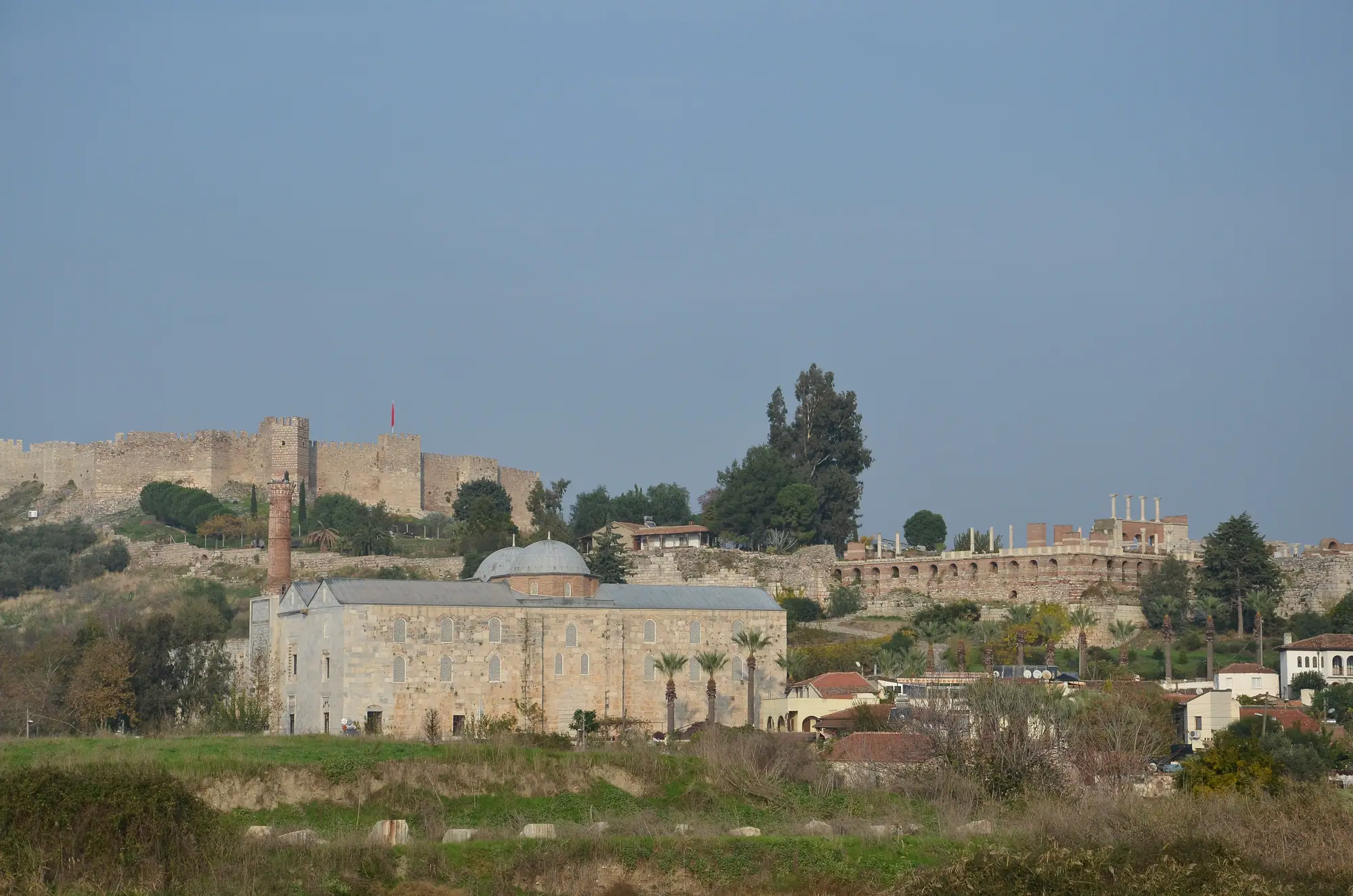
The mosque stands below the hill it shares with the Basilica of St John and the castle above it, one of several medieval monuments covered together on the guide to around Ephesus. Its later years, and İsa Bey’s own place in the Aydınid succession, belong to the fuller history of Ephesus; the village satellite trip many visitors add to a day at Ayasuluk, Şirince, lies a further drive into the hills.

Sources
Each source is listed once. The numbers link back to the claims it supports; dates show when the source was checked.
- Foss 1979, 155 1
- Foss 1979, 160 2, 22, 23
- Ladstätter 2015, 133 3
- Ladstätter and Magdalino 2019, 203 4, 9
- Institut 1905, 131 5, 7
- Ladstätter and Magdalino 2019, 207 5, 6, 14, 15
- Foss 1979, 158 8
- Ladstätter and Magdalino 2019, 205 10
- Elliger 1985, 79 11
- Ladstätter and Magdalino 2019, 206 11
- Ladstätter 2015, 130 12
- Ladstätter and Magdalino 2019, 204 13, 24
- Ladstätter 2015, 132 16
- Foss 1979, 161 17, 18, 19, 20
- Ladstätter and Magdalino 2019, 209 17, 21, 23
- Ladstätter and Magdalino 2019, 208 18
- Foss 1979, 174 25
- Foss 1979, 176 26