
Elliger identifies Curetes Street as the one deliberate exception to the Hippodamian grid the city planners laid out, in both the Lysimachan foundation and the later Roman rebuilding1. The reason, he adds, lies further back than either: an archaic-period necropolis already followed this same route before the Hellenistic grid was drawn, which is why the later street cuts across it rather than falling into line1. It runs downhill from the Hercules Gate to the Library of Celsus, the spine of the walk through the ancient city.
Origins: the street the grid couldn’t touch
Beneath the street’s own paving, excavators found an over-life-size marble portrait head of Lysimachos, stylistically dated to the 280s BC — a striking find in itself, buried under the road named, centuries later, for a different set of priests entirely2.
The street and its name
The street’s ancient name, Embolos, is attested from a dedication recording its paving under Domitian through to a late antique verse calling it “the beautiful ground of the city,” and its colonnades offered shelter from sun and rain along the whole route3. An inscription elsewhere on the street calls the Embolos outright "the most beautiful [section] of the city"3.
What the name actually meant is disputed, and the site’s own working description has repeated the wrong answer. It has been common to gloss Embolos as “the wedge,” on the assumption that the name describes the street’s shape. Foss rejects that etymology directly, attributing the claim to the scholar Vetters, and argues instead that embolos was simply the ordinary late-antique Greek word for any colonnaded street — used in other cities regardless of their layout, wedge-shaped or not4. On Foss’s reading, nothing about the name tells you anything about the street’s plan; it is descriptive of the colonnade, not the geometry.
The street’s width has its own, smaller correction. Foss gives the Embolos’s width as exactly eleven metres5, a figure that had stood largely unchecked. The Austrian excavation team’s later, dedicated study of the street settles the question with a fuller survey: 216 m long, 6–8 m wide, with porticoes of 3.5–5 m on each side and a gradient of 10.5%, dropping from 30.28 m above sea level at the Gate of Heracles to 9.77 m at the Library of Celsus5. Foss’s eleven metres should be read as an earlier estimate the fuller survey has superseded, not as the current figure.
The modern name, Curetes Street, has nothing to do with either. The Austrian excavators coined it because spolia columns from the Prytaneion, inscribed with yearly lists of the priestly Curetes, were reused to repair the street’s paving6.

The Hercules Gate: a street closed to wheels
At the street’s upper end, a late antique gate carved with reliefs of Heracles in his lion skin narrowed the passage and closed it to wheeled traffic, letting pedestrians through by steps alone. Exactly when that gate was built is unresolved. Within a single edited volume, Bammer dates it to AD 459 by identifying a named proconsul in the dedication, Jobst supports that date stylistically, and the volume’s own editor, Scherrer, will only commit to "probably mid-5th century"7. No single date commands agreement — the gate is named with confidence far more often than it is dated with any.
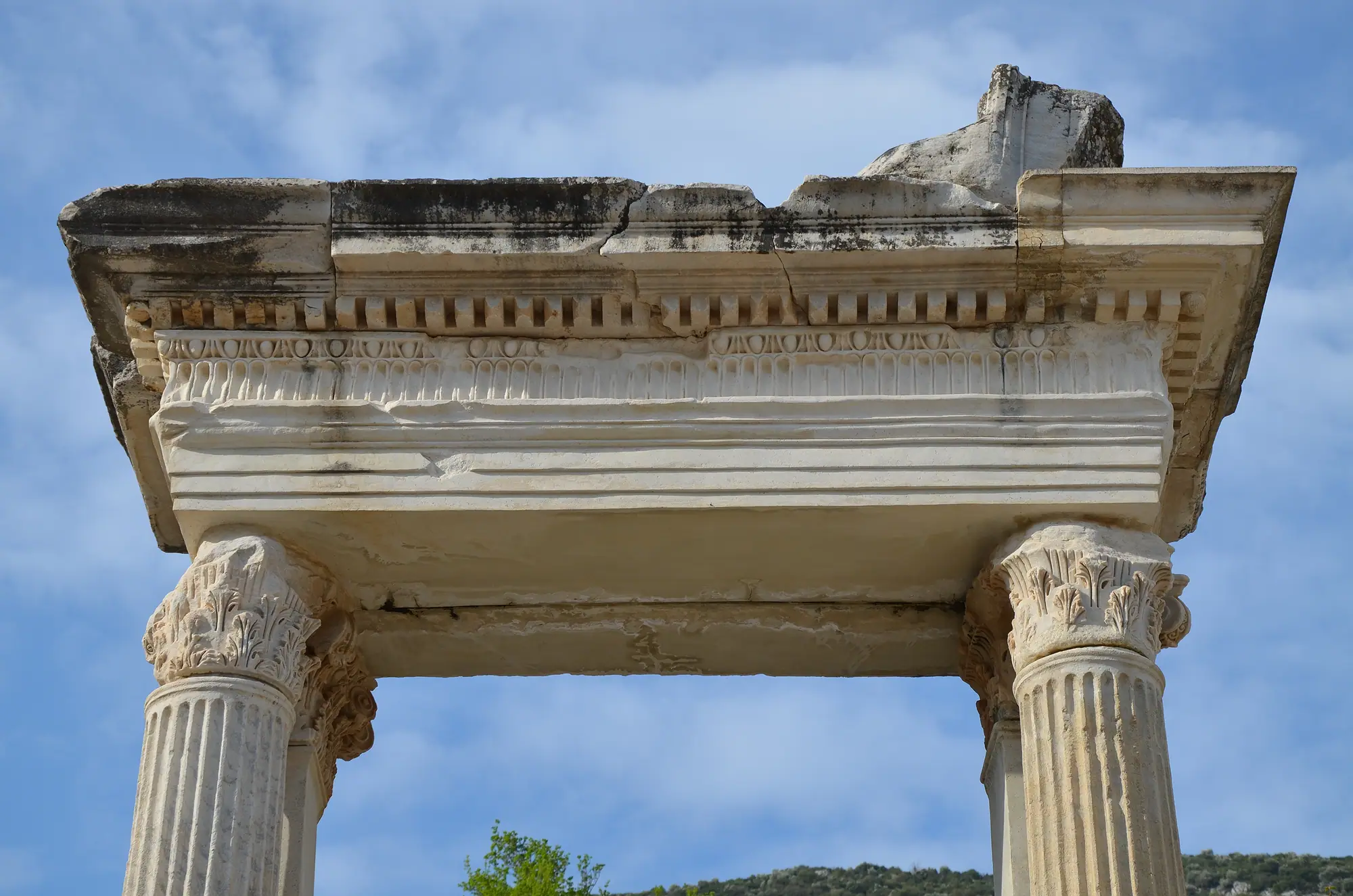
The Fountain of Trajan
Partway down the street, Aristio — three times asiarch and neokoros — dedicated the Fountain of Trajan between AD 102 and 1048. Elliger notes that its central niche held a giant statue of Trajan shown as conqueror of the Dacians, whose surviving base still shows his right foot resting on a globe, the standard symbol of imperial power9. Water reached the fountain by a pipe roughly twenty miles long, from Tire to the west of Ephesus8.
The facade’s other statues are where the agreement stops. Elliger’s account lists a fallen figure of Apollo among the facade statues and no Nerva at all. Rogers’s later work, and the fact register independently, list Nerva instead and no Apollo10. Two sources now agree against the one, which tips the balance toward Nerva, but the disagreement itself has not been resolved by checking the original stone against both readings — that check belongs to Quatember’s dedicated 2011 fountain monograph, not yet folded into this page.
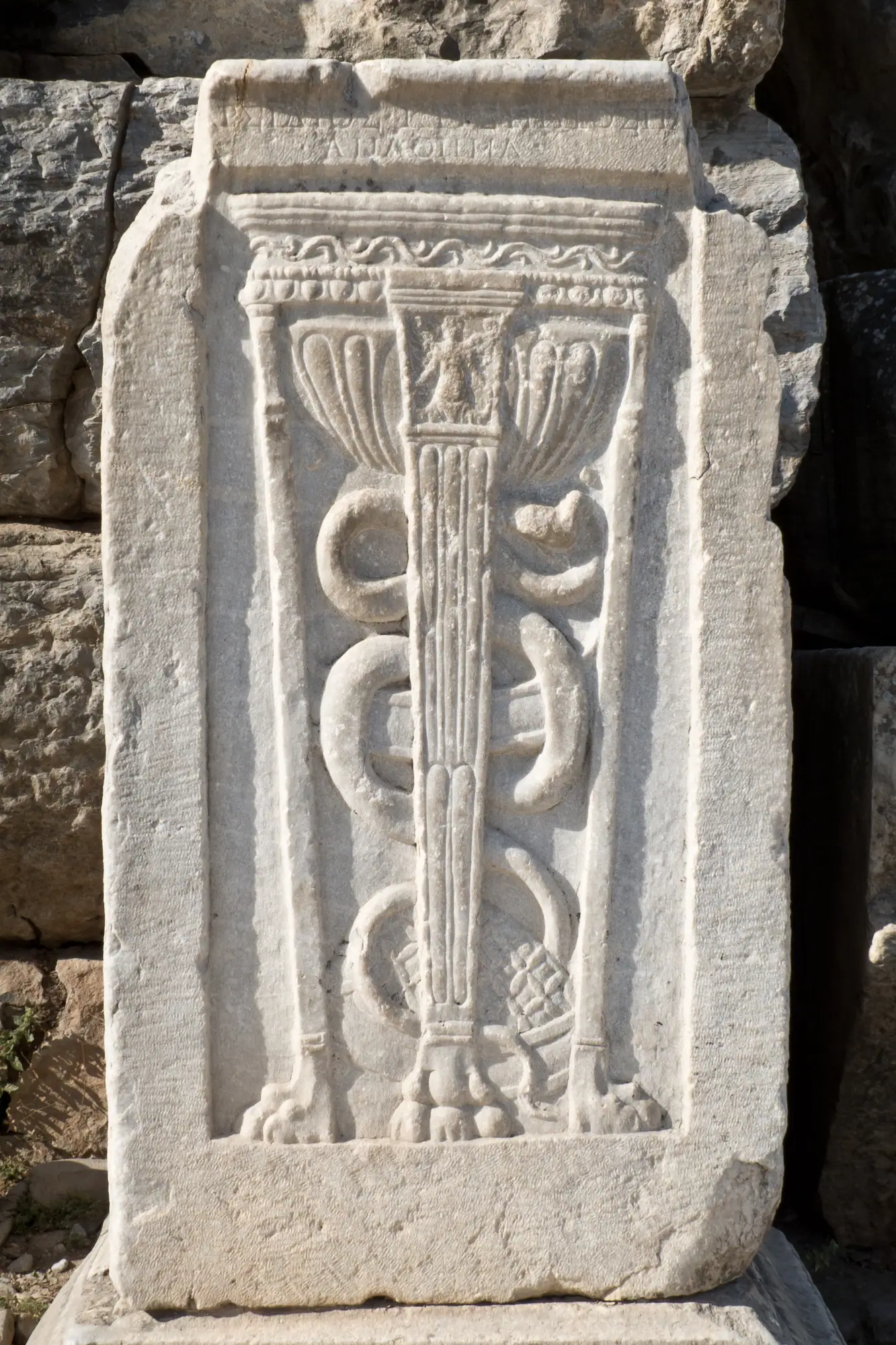
Three tombs at the foot of the street
Guides usually name two tombs at the lower end of Curetes Street — the Octagon and the Heroon — but a third stood between them, per Elliger: a heroon-style grave of an unidentified young woman, about twenty years old, from the Augustan era11. Late in antiquity, the western of the three tombs, the Heroon, was converted into a large fountain basin, its screens carved with Christian symbols — probably driven, Elliger suggests, in a still-densely-populated district, by a real crisis in the water supply rather than by indifference to the dead12.
Whether the Heroon really is the Tomb of Androklos, the city’s legendary founder, is unresolved, and the two candidate sites contradict each other directly. John Turtle Wood identified a monument near the Magnesian Gate as Androklos’s tomb in 1869. Knibbe and Thür consider that identification unlikely, since Pausanias’s own route — past the Olympieion, then Androklos’s tomb, then the Magnesian Gate — does not match where Wood actually found his monument; Thür proposes instead that the Heroon here, on Curetes Street itself, is the real tomb13. Thür’s argument for an early date rests on construction technique: the Heroon’s core uses plain ashlar masonry rather than the opus caementicium introduced to Asia Minor around 50 BC and used in the neighbouring Octagon, and a drainage channel here predates the Octagon (41 BC) but postdates the Heroon itself — placing the Heroon before the mid-1st century BC14. Neither candidate is settled; readers should treat the Androklos identification, on either site, as an argument rather than a fact.
A 1988 excavation of a nearby sarcophagus found three people inside: a marble portrait head of an imperial priest in his sixties, the bones of a three- or four-year-old boy, and a second man, also in his sixties, with arthritis. Thür has argued that the priest is Aristion, reburied here after originally lying near the so-called Octagon of "Arsinoe IV"15.
The Octagon’s imperial edicts
The Octagon’s own base carries a cluster of Late Roman imperial texts, independently reported across three separate works. A joint rescript of the emperors Valentinian, Valens and Gratian, dated AD 371, orders an inquiry into embezzled funds meant to rebuild the city after earthquakes in 358 and around 365, and promises to free Ephesus from what it calls the "ugly dust of old ruins"16. A separate letter calls Ephesus outright “Asiae caput” — capital of Asia — recording a grant of 100 iuga of land plus the Leuce estate as a pilot wall-repair scheme, alongside a rare hard figure for the whole province’s tax base: 6,736.5 prime iuga, plus 700 defective iuga16.
Late antique street life, and a brothel that may not have been one
By the 4th and 5th centuries the street had become a working district as much as a ceremonial one. Metalworkers operated from the tabernae behind the Fountain of Trajan and at shop doorways from the 5th to the 7th centuries, and shopfronts in the colonnade were given marble veneer in the 5th and 6th17. Ladstätter and Magdalino note that Curetes Street is probably Ephesus’s single richest case of spolia reuse: honorific statues set between the colonnade’s columns frequently do not belong with the inscribed bases they now stand on, so a base’s inscription often does not actually name the statue above it — a caution worth keeping in mind at any point along the street18.
One building near the street’s lower end carries a genuine, unresolved dispute over what it was. Foss reports that a house here was formerly wrongly identified as a brothel, and argues it was in fact an ordinary house, with an atrium, dining rooms, a peristyle court and two mosaics. Rogers reports the opposite: citing D. Knibbe’s rebuttal of the original excavators’ scepticism, he maintains the brothel reading of the building’s paidiskeion inscription19. Neither position has displaced the other.
Further down, chariot-racing loyalties left their own mark, Foss notes: inscriptions near the Theatre and on the main street name the Blues and the Greens, cut during the bitter early-7th-century rivalry between the two factions, tied respectively to the emperor Phocas and his successor Heraclius20. By the 7th and 8th centuries the street’s grander life was over. A large storehouse-like building, about 60 by 30 m, was built over the rubble of the street’s once-luxurious late-antique houses, with small terraced houses filling in the rest — and, Foss adds, the coin evidence for the district essentially stops with Heraclius’s reign, with only two coins, of Constantine V and Constantine X, representing the whole of the rest of the Byzantine period there21.
Older scholarship had also assumed the wrong god for one of the street’s festivals. A statue group dedicated to Dionysos, dated AD 92–93, stood at the crossroads of Curetes Street and Marble Street, marking the site of the katagogia festival. Ramsay and other older scholars had assumed the festival belonged to Artemis; a Priene inscription, cited by Strelan, confirms it belonged to Dionysos instead22. Church tradition places the bishop Timothy’s fatal confrontation with a crowd of Dionysos’s revellers, who had come down from Bülbüldağ, at the same crossroads, “in the middle of the Embolos” itself, with his burial afterward on Mount Pion23, part of the wider story told on Sacred Ephesus.
Walking Curetes Street today means walking through all of this at once: a route older than the city’s own street plan, a name that has been mistranslated for decades, a fountain whose statues nobody has fully agreed on, and a house whose function two respected scholars still read in opposite ways. Little of it is settled, and that is closer to how the street’s own history actually reads than a single confident description would be.
Sources
Each source is listed once. The numbers link back to the claims it supports; dates show when the source was checked.
- Elliger 1985, 39 1
- Elliger 1985, 53 1
- Elliger 1985, 48 2
- Foss 1979, 65 3
- Rogers 1991, 95 3, 8
- Foss 1979, 66 4, 5
- Waldner 2020, 164 5
- Koester 1995, 21 6, 7
- Koester 1995, 10 8
- Rogers 2012, 194 8, 10
- Elliger 1985, 70 9, 10
- Elliger 1985, 66 11
- Elliger 1985, 177 12
- Waldner 2020, 22 13
- Koester 1995, 164 14
- Rogers 2012, 403 15
- Elliger 1985, 176 16
- Foss 1979, 69 16
- Wankel 1979, 264 16
- Wankel 1979, 268 16
- Dey 2015, 91 17
- Pülz 2020, 299 17
- Ladstätter and Magdalino 2019, 37 18
- Foss 1979, 63 19
- Rogers 1991, 96 19
- Rogers 1991, 121 19
- Foss 1979, 17 20
- Foss 1979, 113 21
- Strelan 1996, 123 22
- Foss 1979, 33 23
- Koester 1995, 268 23