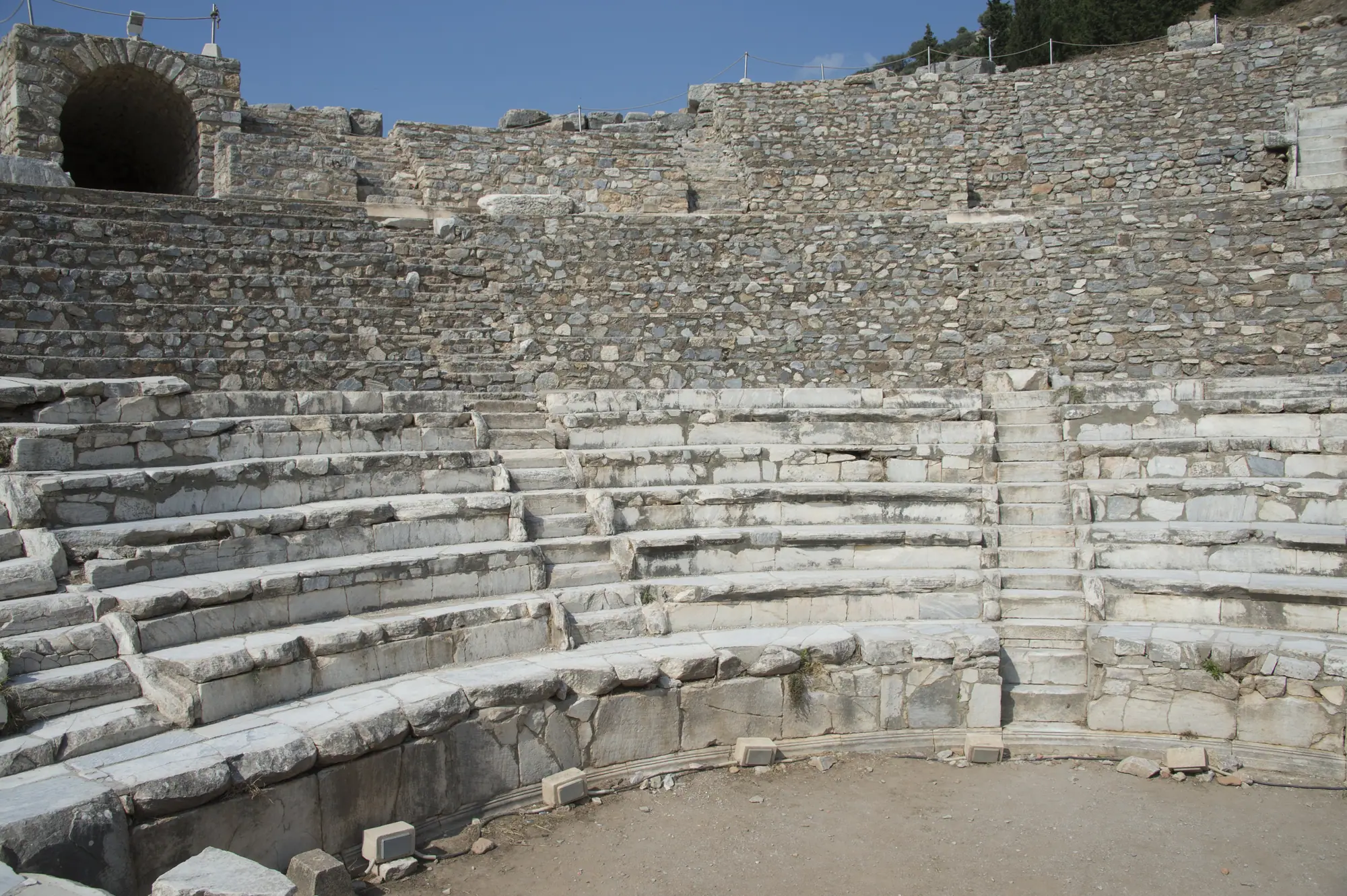
The building most visitors know as the Odeon stands beside the State Agora, and for over a century it was read as a theatre before Bier’s study confirmed it was in fact the Bouleuterion, the seat of the city council1. That identification had its own history of doubt and correction, and so, more recently, has the building’s date, its seating count and even what to call it — because there turns out to be a second, quite separate odeon at Ephesus, inside the Artemision, first identified only in 2011.
Signposted Odeon, actually the council house
The correct functional identification was only settled by Alzinger’s 1975 study of the government quarter, more than a century after Wood’s first excavation here in 18641. The debate had its own sequence of named scholars. Eichler first doubted the old “Odeum as theatre” reading in 1965/66, because the stage looked too shallow for drama. Fossel clinched the Bouleuterion identification in 1967: the supposed backstage corridor was really a rainwater channel, the stage too narrow for performance, the facade columns unbonded, and the whole plan paralleled the Hellenistic council houses at Miletus and Priene. Meinel then proposed in 1982 that the building began as a Bouleuterion and was only later remodelled into a musical Odeion under Vedius, for the Hadrianeia festival2. A separate theory of Alzinger’s, that an even earlier Hellenistic bouleuterion once stood on the same spot, is judged unproven by Bier: no theatre-type features survive beneath the Roman building, and it is not even established that this was the civic centre in Hellenistic times at all3.
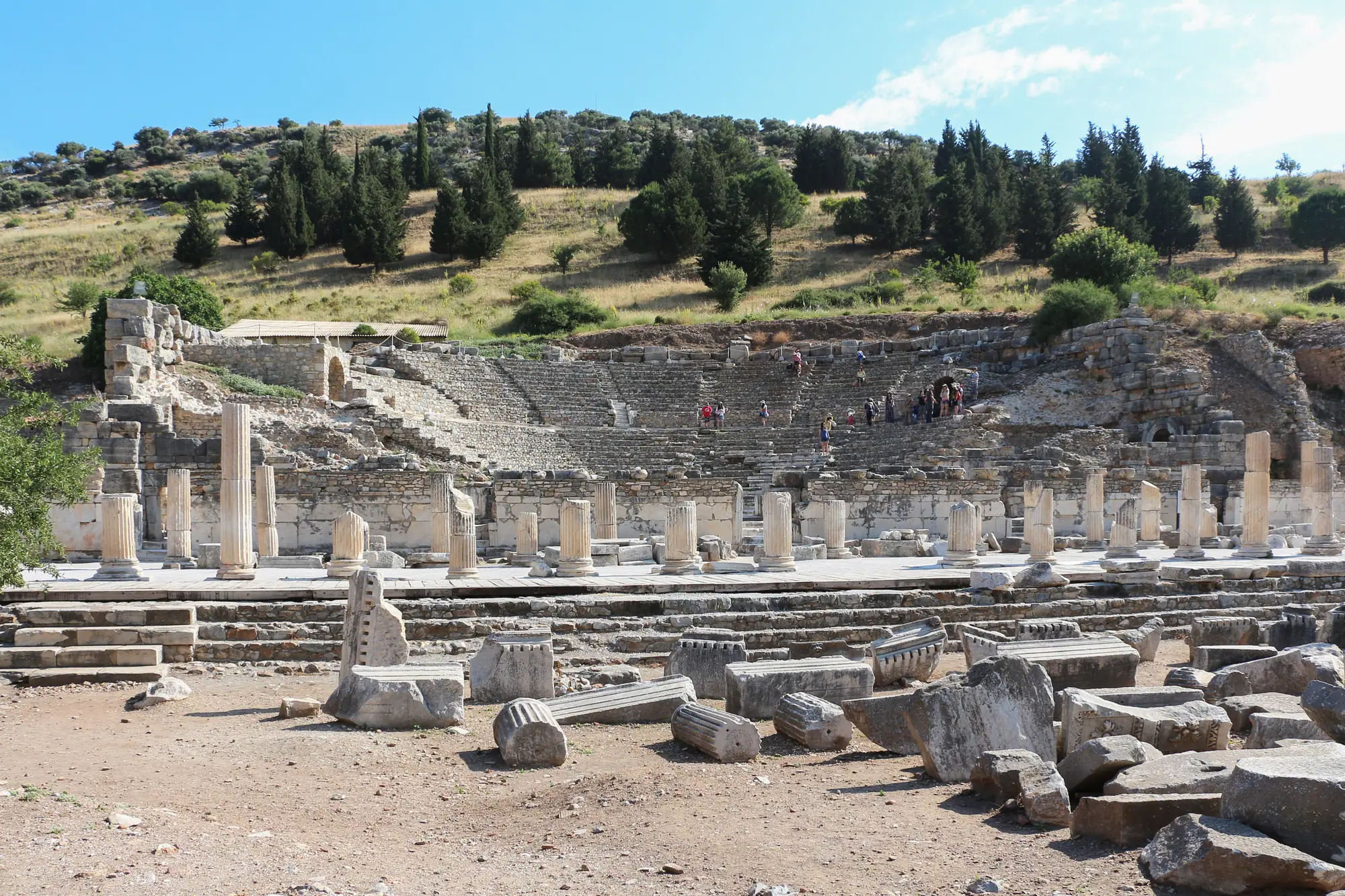
CORRECTION: when was it really built?
Guides and encyclopedias have long given a construction date of around AD 150, credited to Publius Vedius Antoninus. A dedicated architectural and epigraphic study by Lionel Bier — begun in 1997, published posthumously in 2011 after Bier’s death partway through the drawings — shows the true sequence was different4. Bier’s study finds that a Bouleuterion already stood on the site, post-Augustan in origin, and was definitely standing by AD 128/129: a Hadrianic letter of that date is carved directly onto the building’s original wall, later covered over by Vedius’s marble veneer. Vedius’s own work, precisely dated to AD 145–c. 161 by three letters of Antoninus Pius, was, he shows, a renovation of the stage facade rather than the building’s original construction5. A third source, Groh, gives a conflicting date of around 11 BC and a smaller 32 × 45 m footprint; set against Bier’s detailed, 47 m-diameter study, that figure looks the weaker of the two and is treated here as the outlier5.
Seats: settling a real dispute
Figures of 1,400 or 1,500 seats have circulated for years, and a lower figure of about 300 has also been floated. Bier’s dedicated study instead counts over 1,600 seats: 15 rows in five wedges in the lower cavea, 10 rows in ten sections in the upper, inside a retaining wall about 47 m across67. That also likely settles the 300-seat figure, which was probably a single-tier count rather than the building’s true total. The retaining wall itself was built without mortar or metal clamps, a choice that, Bier notes, eventually let it collapse7. Despite walls around 17 m tall plus a further 3–4 m of roof, the building was largely hidden from the Agora by its own, shorter Basilica Stoa: visible from the surrounding hills as an expanse of roof, but its true size unguessable from the square itself, Bier observes8. That roof, Bier calculates, spanned about 28 m at its centre and 21 m at the sides, a shallow pitch under roughly 20% grade, tile-clad and likely left with its timbers exposed — a span comparable to Pliny’s account of Tiberius’s 120-foot display log and Dio Cassius’s description of Agrippa’s roofless diribitorium9.
Ceremonial side doorways once linked the building symbolically to the neighbouring bath-gymnasium and the Prytaneion; they were later blocked once that relationship ended, and the east doorway may never have been finished at all, Bier records10.
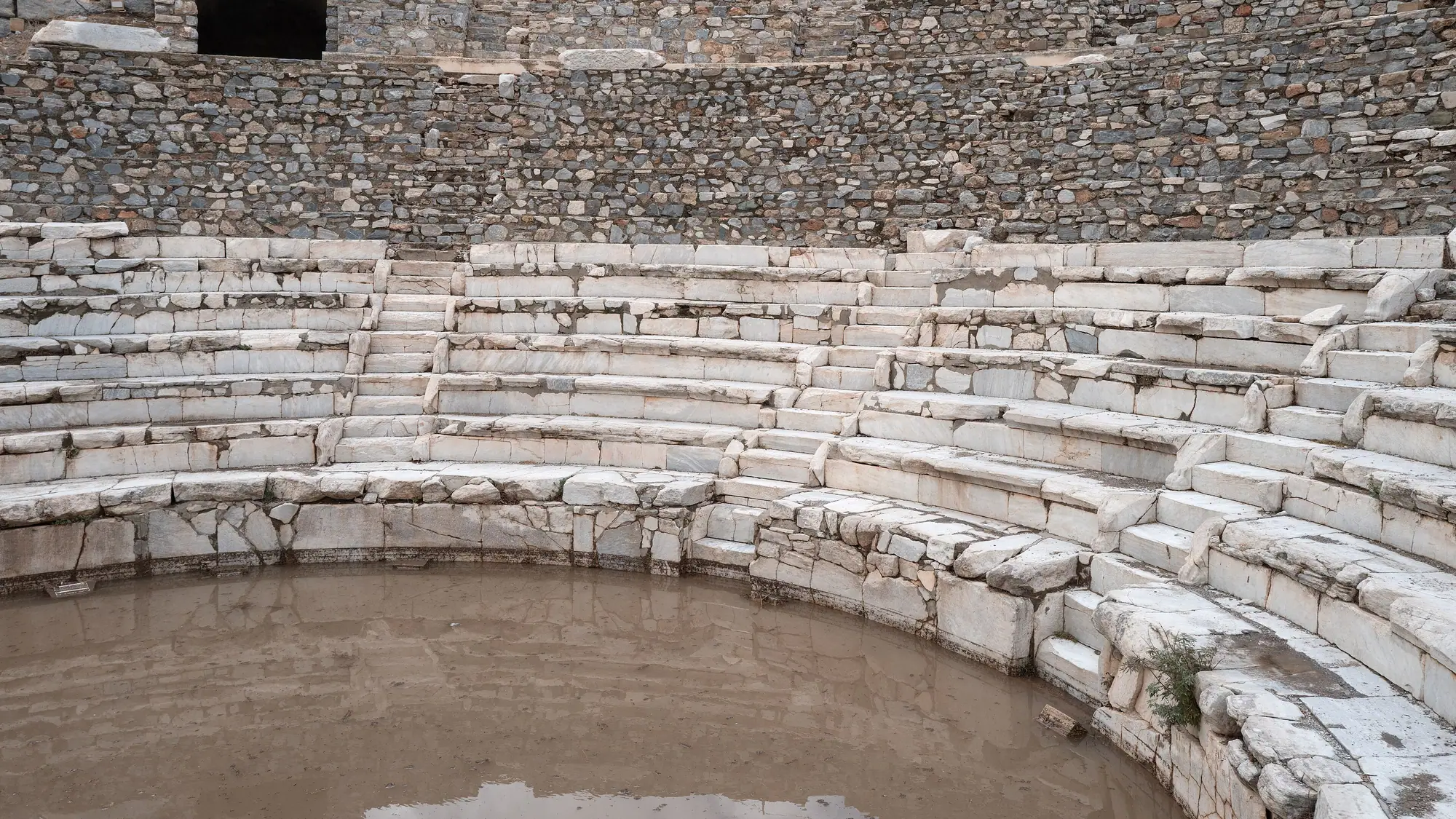
Why a council house needed musical statuary
The Ephesian boule, or city council, had 450 members, mostly from influential families, meeting under a boularchos to decide finances, construction, elections and legal scrutiny; like other high-imperial bouleuteria, the building doubled as a lecture hall and performance venue beyond council business, Bier notes11. Vedius Papianus, as agonothete of the Hadrianeia games his father had founded in AD 123/124, wanted a proper venue for them, and Muse statues found on site — Terpsichore, Erato, Melpomene among them — back up that explanation, Bier argues12.
The Vedius-era stage facade doubled as a dated, self-documenting portrait gallery: three letters from Antoninus Pius, precisely dated AD 145, 149/50 and 150, a Hadrian honorific inscription of around AD 135, and a Lucius Verus statue base from before AD 161, now in the British Museum, per Bier13. One of Antoninus Pius’s letters was itself a public reprimand of the Ephesians over their reception of Vedius’s benefactions — direct epigraphic evidence of aristocratic resentment at his wealth and influence14. The statue identifications on the facade remain genuinely disputed: a Faustina statue base is read as either Domitia or Annia Galeria by different scholars, with no consensus reached, and Bier himself first read the pair flanking Antoninus Pius as Vedius and Papiane before revising, within the same 2002 paper, to Hadrian and Sabina15. A carved cross on a lintel here is not evidence of Christian use of the building — it represents, Bier suggests, the routine “neutralising” of pagan monuments seen across Roman Asia Minor16.
A discovery history of its own
Pococke’s 1745 account is the earliest modern description of the building, including the first known sketch of the city. Wood began digging here on 15 March 1864, redirected from the Great Theatre; scientific excavation proper only began in 1908, prompted by a bull’s-head capital Wood had found decades earlier, and the 1909 diagrammatic plan drawn up by Heberdey and Wilberg remained the sole basis for every theory about the building for the rest of the century17. A 2009 excavation trench turned up a pocket watch from the 1860s–80s, lost in the backfill of Wood’s own old search trench, per Zabrana18.
Wood’s own finds came with tangled records. His Muse statue — called Euterpe in his letters but Erato in his published book, though she is probably Terpsichore, since Erato is never shown with a lyre — sank with the ship carrying her toward the British Museum, was recovered damaged, and sat unidentified in the Ermoupoli museum on Syros for about 150 years before modern research placed her19. The missing head of a Lucius-Verus-as-Mars statue has four conflicting fates across Wood’s own accounts: shipwreck aboard the Cornish Lass in his published 1877 book, theft from the dig site or an offer of 20 lire in Smyrna in his private letters to Newton, and a fourth claim, from a 1900 source, placing it in a Smyrna museum. Wood also misidentified the same statue as Commodus in most of his letters, only correcting to Lucius Verus in 18772021.
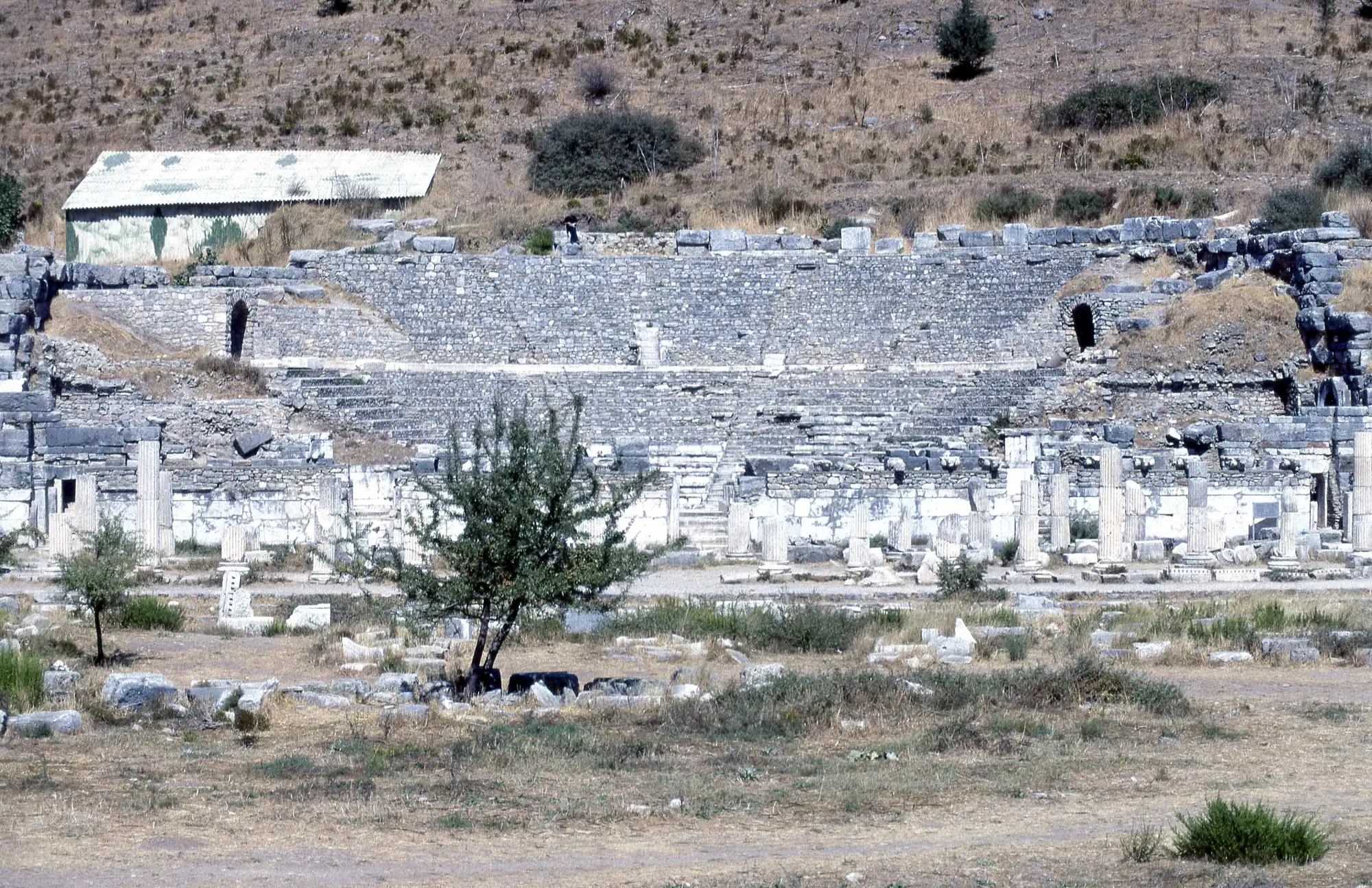
A second, separate odeon, inside the Artemision
There is another odeon-type building at Ephesus, entirely distinct from this one, inside the Artemision precinct itself — identified only by fieldwork from 2009 onward, having previously been read merely as a grandstand or “tribune.” It must be kept clearly apart from the State Agora Bouleuterion described above, and the two should never be merged under one description, per Zabrana22. Zabrana’s report finds that the Artemision’s odeon measures about 40 × 24 m, with nine barrel-vaulted substructure chambers and seating for roughly 1,000 people across 14 rows in four wedges, reached by five staircases; its floor was an opus sectile design using marble brought from as far as Thasos and Dokimeion23. It was built in the second half of the 1st century AD, rebuilt in the mid-2nd to early 3rd century with an added latrine, and burned in the 5th or 6th century, with some use continuing afterward, in Zabrana’s account24. Zabrana notes that it served musical practice and competitions tied to the Artemis cult, paralleling the theatre at Sparta; inscriptions record victories there by an actor, a rhetor and an encomium-poet in games honouring Artemis Ephesia25. A late find of weapons — arrowheads, spearheads and a firearm — comes from its Late Byzantine layers, probably tied to either Tamerlane’s early-15th-century attack or the 1424 Ottoman takeover, Zabrana notes26.
The State Agora building sits among the other civic monuments mapped on the ancient city, close by the Prytaneion it was ceremonially linked to and a short walk from the Commercial Agora on the other side of Marble Street.
Sources
Each source is listed once. The numbers link back to the claims it supports; dates show when the source was checked.
- Bier 2011, 11 1, 4, 17
- Bier 2011, 28 2, 3
- Bier 2011, 81 5
- Bier 2011, 48 6
- Bier 2011, 31 7
- Bier 2011, 56 8
- Bier 2011, 54 9
- Bier 2011, 53 10
- Bier 2011, 98 11, 13
- Bier 2011, 218 12
- Bier 2011, 100 14, 20
- Bier 2011, 103 15
- Bier 2011, 107 16
- Zabrana 2018, 237 18, 25
- Aurenhammer 1990, 75 19, 21
- Bier 2011, 99 19
- Bier 2011, 101 21
- Zabrana 2018, 216 22
- Zabrana 2018, 234 23
- Zabrana 2018, 236 24
- Zabrana 2018, 235 26