
Long before it was a Byzantine stronghold, Ayasuluk Hill was worth holding for its position. Herodotus records that during Croesus’s siege of Ephesus in the 6th century BC, the Ephesians tied a rope from the Temple of Artemis to the city wall, symbolically dedicating the city to the goddess in order to halt the attack — an episode the modern excavation report citing him links specifically to this hill, since only Ayasuluk fits the siege layout the story implies, though Herodotus’s own stated distance for the rope is itself questioned1. Centuries later, once the lower city’s harbours had silted beyond use, this hill became the place Ephesus itself withdrew to, and the walls still visible today are the record of that long withdrawal.

Two wall circuits, not one
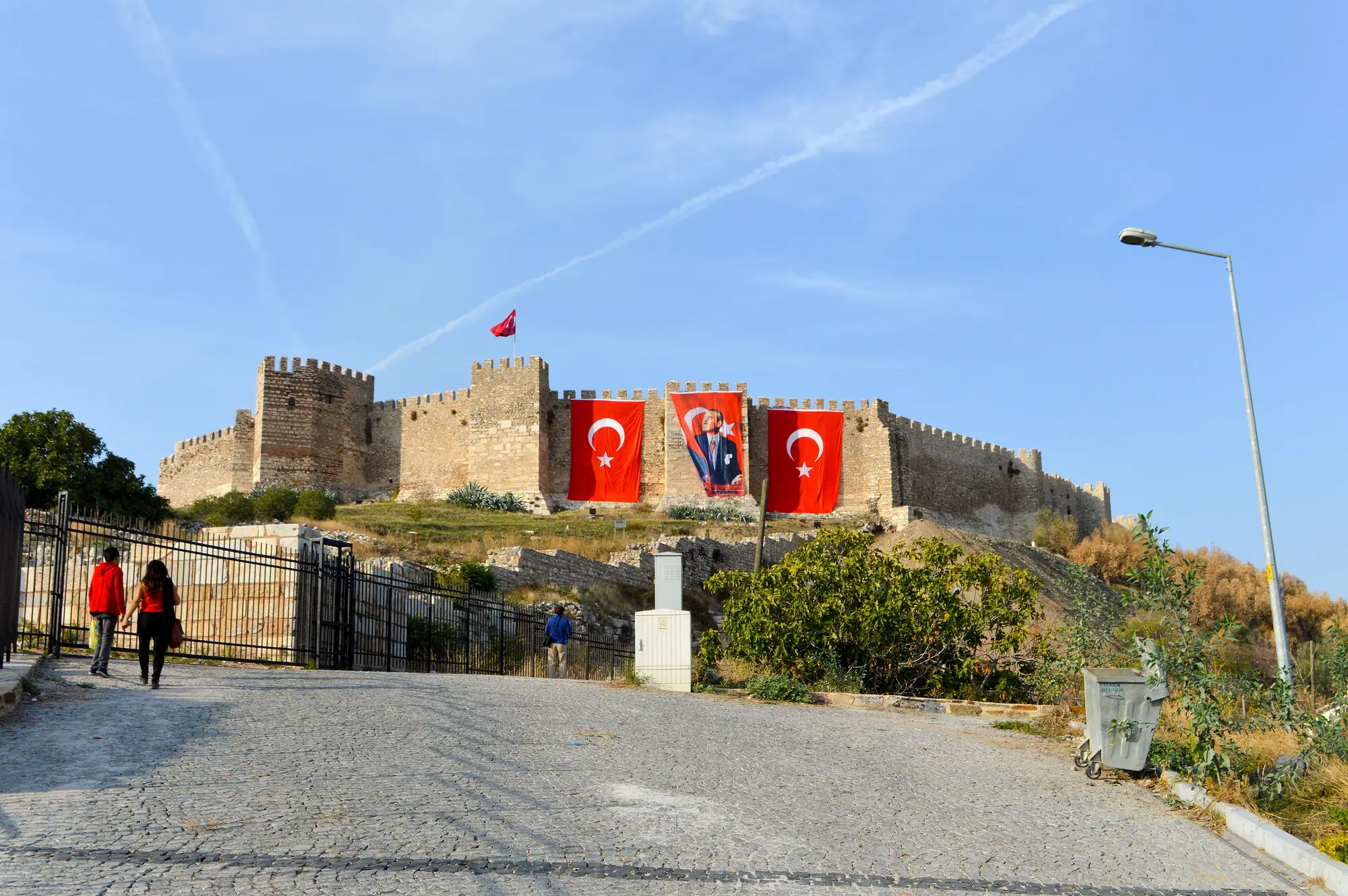
The castle above Selçuk is often described with a single tower and gate count, but the sources disagree, and the disagreement is not a simple error to correct — it looks instead like two different fortification systems being counted separately. One figure, used elsewhere on this site, gives the castle fifteen towers and two gates, east and west2. A dedicated excavation report instead gives the outer Byzantine fortress circuit twenty towers in total, six of them guarding entrance gates, and separately describes a distinct inner terrace wall, 1.60–1.90 m thick, running around the church’s atrium and apse, as a second fortification system on the same hill3. This page does not attempt to decide which published figure is right, because the honest answer is that they may both be right about different things: an inner terrace wall and an outer fortress circuit, not yet fully disentangled in the published record. Until they are, neither count should be read as settling the other.
What is firmer is the sequence the walls grew from. The Lysimachean city wall down in the lower city, for comparison, was, per the excavation report, 3–4 m thick, built of large rusticated ashlar with unmortared rubble fill and quarried on site — the old Koressos quarry pits were incorporated directly into its circuit4. As the city’s population later shrank well below what that huge Lysimachean circuit needed, a much smaller Byzantine wall, of rubble and hard mortar and incorporating reused material, replaced it on a reduced footprint, the report adds5 — the same pattern of shrinking, reusing and rebuilding that produced the hilltop fortress. Muss and Bammer report that much of the fortress’s own marble facing is reused Stadium seating, some pieces still carrying their original inscriptions and backrests, built into the wall at what look like essentially random points6.
Stone from older buildings
The hill’s walls are, in large part, a museum of spolia. Kintrup finds that sarcophagi, funerary reliefs, architectural fragments and inscriptions from the ancient city, its cemeteries and even the Artemision were all pulled in as fortress building material7. One striking example, Kintrup notes, only came to light through its own travels: an Attic sarcophagus carved with the story of Achilles, built into the wall of the fortress’s Gate of Persecution, was first reported by the travellers Spon and Wheler in 1678, and had reached Woburn Abbey, the seat of the Duke of Bedford in England, by before 18288. Kintrup also traces a companion base fragment to that same sarcophagus, rediscovered and photographed by Benndorf in 18959, and a related sea-thiasos relief fragment, from the same fortress spolia context but a separate object with its own provenance, that reached Vienna in 191110. Most scholars date the spolia-built wall itself, the rebuilt Gate of Persecution among it, to the 7th–8th century AD response to Arab raids, though Kintrup notes that some researchers argue for a different date without specifying it11.
The quarrying reached further than the fortress walls alone. Muss and Bammer find that stone-robbing of the Temple of Artemis began under Justinian, but that reuse of the Altar’s own carved blocks specifically continued into the 9th century, with some pieces travelling as far as the 14th-century İsa Bey Mosque below the hill12. As the same excavation report notes, clearance work on the fortress walls in 1990 turned up the first prehistoric settlement remains ever found anywhere at Ephesus, a reminder that the hill’s building history runs back far further than its medieval defences13.

When the city moved uphill
The shift from the lower city to this hill can be dated only loosely, but the evidence points to the early-to-mid 8th century. Administrative seals from the Bishop’s Palace stop appearing in the first third of the 8th century, which Ladstätter and Magdalino read as a sign that the episcopal and administrative centre moved to Ayasuluk around then — a geostrategic response to Arab attacks, since the hill faces the Anatolian hinterland14. The following century and a half, they note, is genuinely hard to date closely: coin circulation collapsed after the reign of Constans II, and the fine-dating pottery types of the period disappear from the record too, leaving the late 7th to late 9th century as a real dating gap rather than a documented sequence15.
A fortress, not quite a town
By the 11th century, the Life of St Lazarus records only the Ayasuluk administrative centre, beside the basilica, as still being called a “kastron” or “polis”; the surrounding valley below had emptied out16. That is not surprising given how little room the hilltop actually offered: Ladstätter and Magdalino calculate that once the basilica and the citadel are subtracted, only about 2.3 hectares of buildable land remained, which is a fort’s footprint, not a town’s17. Ladstätter and Magdalino, reading the archaeological evidence, argue against a simple story of Ephesus being abandoned wholesale in favour of this one hill; instead, two small Middle Byzantine towns most likely coexisted side by side, an argued model rather than a settled fact18. Devotion kept pace with defence, they add: in the 12th and 13th centuries, a chapel near the basilica’s treasury and the fortification’s entrance portal were both freshly frescoed with prophets, saints and St John himself19.
Continuity through conquest
The town’s political history was not as sharply punctuated as its name changes suggest. Ladstätter and Magdalino note that an earlier, brief Turkish occupation, from 1090 to 1096, had already come and gone before the better-known conquest of 1304, with Byzantine rule — and Ayasuluk as its centre — resuming in between20. When the 1304 conquest did come, they find, it was not itself a sharp break in the settlement’s fabric: Turkish Ayasoluk grew directly out of the existing Byzantine settlement inside the old Artemision temenos, with its castle on the hill above21. Building reuse continued under the beyliks that followed, and heavily, the same account holds: spolia use by the western Anatolian beyliks was so thorough that a tomb inside the Artemision is built almost entirely from reused ancient fragments, not merely accented with them22. Even the modern place name, per Kraft and colleagues, is a 20th-century decision rather than an ancient survival: “Selçuk” was created only under Atatürk, a deliberate reminder of the Seljuk-descended Aydınoğulları dynasty, while before that the settlement had been called Ayasuluk continuously since the Turkish conquest23.
The harbour that moved on
Ayasuluk’s fortunes were tied, like the lower city’s before it, to a harbour that kept failing and relocating. By the early 9th century the old harbour in this area was already inadequate for the Byzantine fleet, which sailed from Phygela instead — a finding that independently corroborates the separately sourced record, on Harbour Street, of the Byzantine fleet’s own Crete expeditions of 903 and 961 doing the same24. A new port, about 3 km downriver from the old harbour, had, per Kraft and colleagues, become the commercial centre for the settlement by the 14th and 15th centuries; the last recorded major fleet action to sail from an Ayasuluk-area harbour was in 1329, when Seljuk forces besieged İzmir25.
Ayasuluk Hill is now the hub for two of the medieval town’s other great monuments: the Basilica of St John, whose tomb of the apostle and Byzantine building phases this page’s fortress walls once protected, and the İsa Bey Mosque, built below the hill once the old basilica had served as a mosque for a time in its own right. Both sit inside the wider story of places around Ephesus, and the fortress that overlooks them is the clearest single monument to how long, and how deliberately, this one hill was defended.
Sources
Each source is listed once. The numbers link back to the claims it supports; dates show when the source was checked.
- Institut 1905, 31 1
- Institut 1905, 32 1
- Institut 1905, 33 1
- www.kulturportali.gov.tr › ayasuluk-tepesi-ve-st-jean-aniti-oren-yeri- 2
- turkisharchaeonews.net › basilica-saint-john-and-ayasuluk-fortress 2
- Muss and Bammer 2001, 28 3, 6, 13
- Institut 1905, 91 4, 5
- Kintrup 2017, 169 7
- Kintrup 2017, 49 8
- Kintrup 2017, 50 8
- Kintrup 2017, 60 8, 9
- Kintrup 2017, 75 10
- Kintrup 2017, 170 11
- Muss and Bammer 2001, 29 12
- Ladstätter and Magdalino 2019, 58 14
- Ladstätter and Magdalino 2019, 59 14, 15
- Ladstätter and Magdalino 2019, 61 16
- Ladstätter and Magdalino 2019, 63 17, 18
- Ladstätter and Magdalino 2019, 65 19, 21
- Ladstätter and Magdalino 2019, 103 20
- Ladstätter and Magdalino 2019, 113 22
- Kraft et al. 2007, 350 23
- Foss 1979, 123 24
- Foss 1979, 185 24
- Kraft et al. 2007, 145 24, 25